

Article submission has changed significantly over the years. What was once treated mainly as a way to build large numbers of backlinks is now better understood as a form of content distribution, audience development, and online publishing.
In 2026, publishing an article on an external platform can be useful when the platform is relevant to your subject, maintains reasonable editorial standards, and gives readers a genuine reason to engage with the content.
The objective should not be to publish the same article across hundreds of websites simply to acquire links. A better approach is to create useful, original content, choose appropriate publishing platforms, follow their guidelines, and use references naturally.
This guide explains what article submission sites are, how they work, whether they can still contribute to SEO, how to evaluate platforms, how to submit content effectively, and which mistakes to avoid.
What Are Article Submission Sites?
Article submission sites are websites and publishing platforms where authors can submit or publish articles, tutorials, guides, opinion pieces, and other forms of written content.
The term can refer to several different types of publishing platforms.
Self-Publishing Platforms
Self-publishing platforms allow registered users to create and publish their own content.
These can include blogging platforms, professional publishing networks, newsletter platforms, and community-driven websites.
Editorial Publishing Platforms
Editorial publishing platforms review submitted content before publication. The level of review varies from basic quality checks to detailed human editing.
For example, HackerNoon states that submitted stories go through human editorial review before publication.
Niche Publishing Communities
Some platforms focus on specific industries such as technology, programming, marketing, business, finance, or other specialist subjects.
These platforms can be particularly useful when the article closely matches the interests of their existing audience.
Content Curation and Community Platforms
Other websites allow users to share, organize, discuss, or curate content rather than functioning as traditional article directories.
The important distinction is that not every publishing platform should be viewed primarily as a backlink source. Audience relevance, content quality, editorial standards, and the purpose of the platform are more important.
How Does Article Submission Work?
The process varies from one platform to another, but most article submission workflows follow several basic steps.
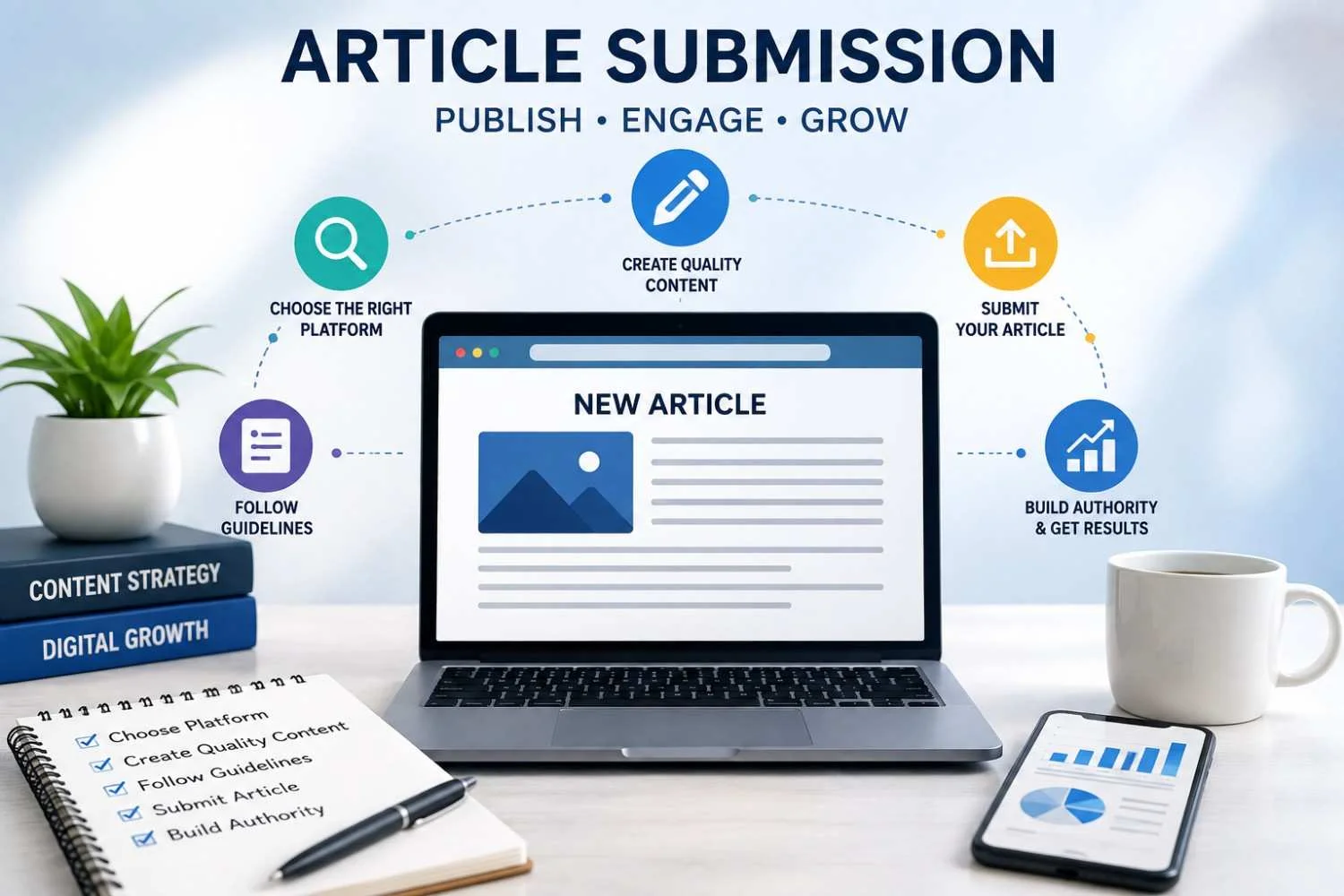
1. Choose a Relevant Platform
Start by finding websites that actually publish content related to your topic.
A technology tutorial, for example, is more likely to provide value on a technology-focused community than on a generic directory containing unrelated content.
The closer the relationship between your topic and the platform’s audience, the more useful the publication opportunity is likely to be.
2. Check the Publishing Guidelines
Before writing your article, review the platform’s current requirements.
Look for information about:
- acceptable topics
- article length
- originality
- images
- author profiles
- external links
- promotional content
- editorial review
- formatting
- republishing
Following these requirements can improve the likelihood that your submission is accepted.
3. Create Original Content
Write the article specifically for the intended audience.
Avoid copying an existing article from your website and publishing the same version everywhere. A strong submission should provide value on its own, even if a reader never visits your main website.
4. Add References Naturally
External references should support the information being discussed.
If your own website contains a useful resource that expands on the subject, it can be referenced where it genuinely helps the reader.
The link should make sense within the paragraph rather than being inserted simply to obtain a backlink.
5. Submit the Article
Depending on the platform, your article may be published immediately or sent through an editorial review process.
Some platforms may ask authors to make revisions before publication, while others have more automated publishing systems.
Are Article Submission Sites Still Effective for SEO in 2026?
They can be useful, but not in the old-fashioned “publish everywhere and collect backlinks” way.
Modern SEO places greater emphasis on useful content, relevance, trust, and satisfying the user’s search intent.
For additional context, read Google’s search guidance, which covers important principles for website owners and content creators.
Article submission can support a broader marketing strategy when it helps you:
- reach a new audience
- demonstrate expertise
- increase brand visibility
- generate referral traffic
- develop publishing relationships
- distribute original research
- participate in relevant industry communities
However, publishing large numbers of low-quality articles primarily for links is a very different strategy.
Google has warned about manipulative large-scale article campaigns, particularly where articles exist primarily to generate keyword-rich links.
The modern principle is straightforward:
Publish because the content belongs on the platform—not simply because the platform can provide a link.
Article Submission vs. Guest Posting
Article submission and guest posting are related but different approaches.
Article Submission
Article submission generally involves publishing content through an existing publishing platform, community, or submission system.
The process may look like:
Create account → write article → submit → review → publication
Guest Posting
Guest posting normally involves approaching a specific publication or editor with a content proposal.
The process is more relationship-oriented:
Research publication → identify editor → pitch topic → approval → write → editorial review → publication
These approaches can complement one another.
For example, quality guest publishing can be used alongside carefully selected article submission platforms as part of a wider content distribution strategy.
Benefits of Article Submission
Article submission should not be viewed exclusively as a backlink tactic. There are several other potential benefits.
1. Audience Exposure
Publishing on an established platform can introduce your content to readers who may not have discovered your website directly.
A relevant audience is generally more valuable than simply choosing a platform because it has a high third-party SEO metric.
2. Referral Traffic
Readers who find an article useful may follow relevant references to learn more.
This can generate referral traffic from people who already have an interest in the subject.
3. Brand Visibility
Publishing useful content on relevant external platforms gives your brand additional opportunities to be discovered.
Over time, consistent contributions can help establish recognition within a particular subject area.
4. Expertise and Reputation
High-quality articles can demonstrate knowledge and experience.
A complete author profile, relevant publications, and useful contributions can create a stronger professional presence.
5. Content Distribution
External publishing platforms can provide additional channels for distributing:
- tutorials
- original research
- case studies
- industry analysis
- educational guides
- practical how-to content
This makes article submission more useful as a content distribution strategy than as a simple link-building shortcut.
How to Choose the Best Article Submission Sites
Do not select platforms solely because a list describes them as “high DA” or “high authority.”
Third-party metrics can be useful for research, but they are not Google ranking scores.
Instead, examine several factors.
1. Topical Relevance
Ask:
Does this platform regularly publish content related to my subject?
A smaller but highly relevant platform can be more useful to your target audience than a large general directory with little topical connection.
2. Editorial Standards
Check whether the platform:
- reviews submissions
- removes spam
- has contributor requirements
- maintains content standards
- publishes genuine authors
- limits excessive promotional content
3. Real Audience
Look beyond SEO metrics.
Check whether the platform has:
- active readers
- comments or discussions
- social engagement
- recent publications
- genuine contributors
4. Existing Content Quality
Review several recent articles.
Be cautious if the website contains large quantities of:
- spun content
- scraped articles
- unrelated promotional posts
- gambling spam
- adult spam
- excessive commercial links
5. Link Policies
Always check the platform’s current external-link rules.
Never assume that publishing an article automatically gives you a followed backlink.
Step-by-Step Article Submission Strategy
Step 1: Research the Platform
Before writing, examine:
- subject coverage
- recent articles
- contributor guidelines
- editorial standards
- audience
- link policies
- author requirements
Use an SEO research process to determine whether the platform and topic are genuinely relevant to your publishing objective.
Step 2: Identify a Content Gap
Don’t submit an article simply because the platform accepts submissions.
Look for questions its audience still needs answered.
Search existing content and identify:
- missing topics
- outdated information
- unanswered questions
- opportunities for original research
- areas where you can provide a clearer explanation
Step 3: Create a Platform-Specific Article
Avoid publishing the exact same article everywhere.
Adapt the:
- headline
- introduction
- examples
- terminology
- structure
- references
- depth
to the intended audience.
The result should feel like content created for that publication rather than a mass-distributed article.
Step 4: Use Links Sparingly
A useful reference should have a clear purpose.
If your website contains a detailed resource that explains a concept in greater depth, linking to it can make sense when the reference genuinely helps the reader.
This is where relevant link insertion is more useful than adding predetermined links without considering the surrounding context.
Step 5: Complete Your Author Profile
Where available, provide:
- real author name
- professional biography
- profile image
- relevant expertise
- social profiles
- website information
A complete profile can make the contribution more useful and credible to readers.
Step 6: Submit and Respond to Editorial Feedback
If an editor requests changes, treat the feedback as part of the publishing process.
You may be asked to:
- change the headline
- remove promotional language
- improve the introduction
- add references
- rewrite sections
- remove unnecessary links
Following editorial requirements generally results in a stronger final article.
How to Use Anchor Text in Article Submissions
Anchor text should describe the destination naturally.
Avoid repeatedly using the same commercial keyword across every external publication.
For example, instead of forcing an exact-match phrase into every article, descriptive wording can be used when it accurately represents the destination.
Possible contextual phrases include:
- content publishing platforms
- publishing resources
- article distribution guide
- relevant publishing opportunities
The best anchor depends on the sentence and the page being referenced.
The same principle applies to internal links on your own website: relevance comes before forced anchor variation.
Google also provides guidance about how website owners should qualify certain outbound links. See Google’s recommendations for qualifying links for the official documentation.
Common Article Submission Mistakes
Publishing the Same Article Everywhere
One of the biggest mistakes is treating article submission as mass syndication.
Creating original or substantially adapted content for different audiences is a better approach.
Choosing Sites Only by DA or DR
Third-party metrics can help with research, but they do not tell you whether a website is relevant, active, trustworthy, or useful to your audience.
Using Exact-Match Anchors Excessively
If every article uses the same commercial keyword as its link anchor, the overall pattern can become unnecessarily repetitive.
Use natural descriptive wording where appropriate.
Publishing Thin Content
A short article filled with generic statements may provide little value.
Focus on answering the user’s question comprehensively rather than writing to an arbitrary word count.
Using Automated Submission Tools
Automating submissions across hundreds of unrelated websites can result in repetitive, low-quality publishing patterns.
A selective, editorial approach is more sustainable.
Ignoring Platform Guidelines
Every platform has its own rules.
Ignoring them can result in rejection, editing requests, or removal of published content.
Article Submission Platforms Worth Exploring in 2026
Instead of presenting an unverified “100+ high-DA” list, it is more useful to evaluate active platforms according to their current rules and your particular topic.
| Platform | Best suited for | Publishing model |
| HackerNoon | Technology, AI, programming, startups | Editorial review |
| HubPages | General informational topics | Community publishing |
| Medium | General knowledge, business, technology | Self-publishing |
| DEV Community | Software development and technology | Community publishing |
| Professional and business content | Professional publishing | |
| Substack | Newsletters, analysis and specialist content | Newsletter publishing |
| Hashnode | Developers and technical publishing | Developer publishing |
HackerNoon
HackerNoon is particularly relevant for technology-focused authors. Its publishing information describes a submission process for technology stories with editorial review.
Its submission checklist also encourages contributors to research whether a topic has already been covered before submitting.
That illustrates an important principle: topic relevance and editorial quality matter more than simply finding a website that accepts any article.
Other Platforms
Medium, DEV Community, LinkedIn, Substack, Hashnode, and similar publishing platforms should be evaluated according to their current rules and the audience you want to reach.
A platform’s reputation alone does not mean that every type of article belongs there.
Building Content Publishing Relationships
Article submission can also become part of a broader publisher relationship strategy.
Rather than viewing every external website as a one-time backlink opportunity, identify platforms and publishers that consistently cover your subject.
Building content publishing relationships can help create more sustainable opportunities for future contributions, collaborations, and audience development.
When direct communication with an editor is required, a targeted approach is generally more useful than sending the same message to hundreds of websites.
Developing effective publisher outreach methods can therefore complement an article-submission strategy.
Should You Submit Every Article to Multiple Platforms?
Usually, no.
A better workflow is:
One strong idea → identify the right audience → choose the appropriate platform → adapt the article → publish → measure results
For example, a detailed programming tutorial may be appropriate for a developer-focused platform, while a business strategy article may be more suitable for a professional publishing environment.
The platform should follow the content—not the other way around.
How Many Article Submission Sites Should You Use?
There is no universal number.
Publishing on five relevant platforms is not automatically better than publishing on two.
Likewise, submitting 100 articles does not automatically produce better SEO than publishing 10 genuinely useful contributions.
Focus on:
- relevance
- originality
- editorial quality
- audience
- consistency
- useful references
- measurable referral traffic
rather than a fixed submission target.
Do Article Submission Links Help SEO?
They can provide value, but do not treat every link as a ranking shortcut.
Depending on the platform, links may be:
- followed
- nofollowed
- marked as user-generated
- restricted
- removed during editorial review
Even when a link does not directly pass ranking value, the publication itself may provide:
- referral traffic
- brand exposure
- content discovery
- professional visibility
- audience engagement
The safest strategy is to create content that would still be worth publishing even if the backlink did not exist.
Frequently Asked Questions
What is an article submission site?
An article submission site is a platform where authors can publish or submit articles, guides, tutorials, or other written content for an external audience.
Are article submission sites still useful in 2026?
Yes, selected platforms can still be useful for content distribution, audience development, brand visibility, and referral traffic. Their value depends heavily on relevance and content quality rather than the number of links they provide.
Are article submission sites the same as guest posting sites?
No. Article submission generally involves publishing through a platform or submission system, while guest posting usually involves pitching and contributing content to a specific publication.
Do article submission links pass link equity?
Not necessarily. Link attributes and platform policies vary. You should never assume that a submission automatically provides a followed ranking link.
Should I use exact-match anchor text?
Avoid excessive exact-match anchor text. Use descriptive anchors that make sense in the surrounding sentence and accurately describe the destination.
Can I submit the same article to multiple websites?
It is generally better to create platform-specific content or substantially adapt the article for each audience rather than mass-publish identical copies.
How do I find good article submission sites?
Evaluate topical relevance, editorial standards, audience quality, recent activity, content quality, and current submission rules. Use third-party SEO metrics only as supplementary research rather than your primary selection criterion.
How many articles should I submit?
There is no fixed number. A small number of genuinely useful contributions on appropriate platforms can be more valuable than large-scale submissions to unrelated directories.
Final Thoughts
Article submission still has a place in modern content marketing, but the strategy needs to evolve.
The old model was:
Write one short article → submit it to hundreds of directories → build as many links as possible.
The modern model is:
Research the audience → choose a relevant platform → create original content → follow editorial guidelines → use links naturally → distribute and measure the content.
That difference matters.
If your primary goal is search visibility, article submission should be treated as one part of a broader SEO and content strategy, not as a standalone backlink-building system.
Choose platforms because they are relevant to your readers, create content that genuinely deserves publication, and use external links where they improve the reader’s experience.
For GetGuestPosts, this article now fits naturally into a wider topical cluster around article publishing, guest posting, publisher relationships, outreach, link insertion, and SEO research.