
Guest posting is often associated with link building, but a useful guest article can do much more than provide a link.
Publishing valuable content on a relevant website can help introduce your expertise to a new audience, generate referral traffic, build relationships with publishers, and support a broader content marketing strategy.
If you are researching UploadArticle guest posting, it is useful to understand the process beyond simply uploading an article. The quality of the publication, relevance of the topic, usefulness of the content, and way links are handled can all affect the value of the opportunity.
This guide explains how UploadArticle guest posting works, how to evaluate publishing opportunities, how to create useful guest content, how to use links naturally, and how to avoid common mistakes.
What Is UploadArticle Guest Posting?
UploadArticle guest posting refers to creating an article for publication on another website, blog, or article publishing platform.
Depending on the platform, contributors may submit an article for editorial review or upload content through a publishing system. The exact process varies between websites.
A typical guest posting process may involve:
- Finding a relevant publication
- Reviewing its submission requirements
- Researching its audience and existing content
- Choosing a useful topic
- Creating original content
- Adding relevant references and links
- Submitting or uploading the article
- Reviewing the published version
- Measuring the results
The important point is that publishing an article is only one part of guest posting. The article should also be relevant to the publication and useful to its readers.
Why Do Businesses Use Guest Posting?
Guest posting can support several legitimate marketing and publishing goals.
Reach a New Audience
Publishing an article on a relevant website can introduce your business, ideas, or expertise to people who may not already know your brand.
Audience relevance matters. A smaller publication with readers who care about your subject can be more useful than a larger website with little connection to your topic.
Demonstrate Expertise
Guest content gives you an opportunity to explain a subject, share practical experience, and demonstrate knowledge.
Useful contributions can include:
- Practical examples
- Original observations
- Step-by-step advice
- Industry experience
- Research
- Comparisons
- Expert explanations
The goal should be to teach or help the reader rather than simply promote a website.
Generate Referral Traffic
A relevant article can introduce readers to another useful resource.
For example, if a guest post discusses article publishing opportunities, a contextual link to a detailed guide about article directories for backlinks can give interested readers a logical next step.
Referral traffic is generally more meaningful when visitors arrive because they are genuinely interested in the subject.
Build Publisher Relationships
Guest posting can also help create relationships with website owners, editors, and other industry professionals.
A good contribution may lead to future publishing opportunities, collaborations, interviews, or other forms of exposure.
If your strategy involves developing long-term publisher connections, understanding the role of an UploadArticle relationship can provide additional context.
How Does UploadArticle Guest Posting Work?
Guest posting workflows differ between platforms, but the process usually follows a similar sequence.
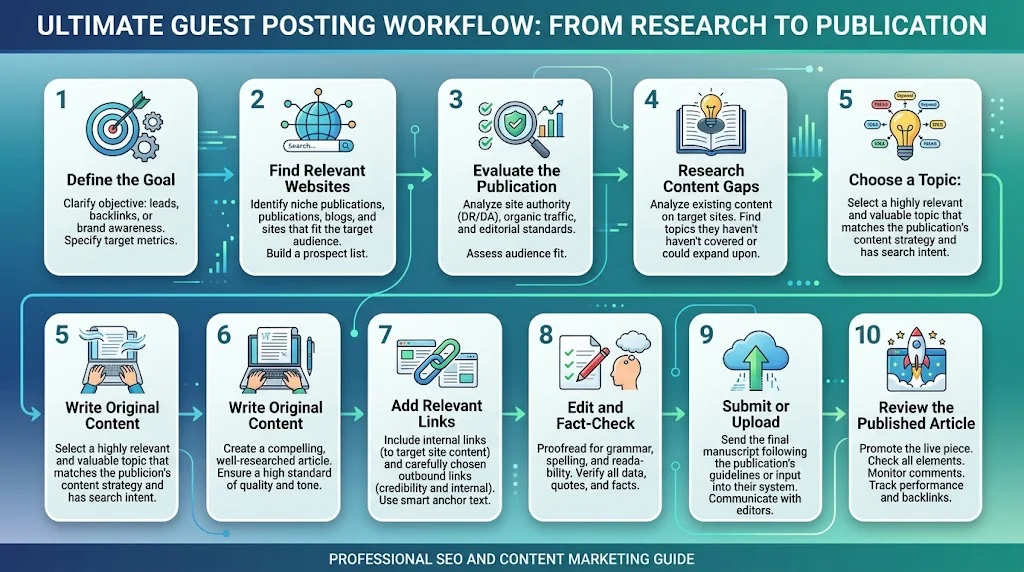
1. Find a Relevant Publication
Start with websites that have a genuine connection to your subject or target audience.
Consider:
- Topical relevance
- Audience fit
- Content quality
- Editorial standards
- Website experience
- Existing article quality
- Publishing practices
Do not choose a publication simply because it accepts guest articles.
2. Review the Submission Requirements
Before preparing content, check the publisher’s requirements.
These may cover:
- Word count
- Topics
- Formatting
- Images
- Author information
- External links
- Promotional content
- References
- Review procedures
Following the requirements can improve the quality and efficiency of the submission process.
If the platform requires an account before content can be submitted, contributors may also need to review the UploadArticle login process before beginning.
3. Research the Website
Read several recent articles before choosing your topic.
Look at:
- Subjects the site covers
- Writing style
- Heading structure
- Typical article depth
- Audience level
- Linking practices
- Types of sources referenced
This research helps you produce content that feels appropriate for the publication.
4. Find a Genuine Content Opportunity
Look for questions, problems, or subjects that the site’s audience would actually benefit from.
A useful guest post topic should be:
- Specific
- Relevant
- Practical
- Informative
- Original
- Appropriate for the audience
Avoid choosing a topic simply because it allows you to insert a particular keyword.
5. Write the Article for That Audience
A guest article should feel like a genuine contribution rather than a generic article copied from another publishing campaign.
Adapt the:
- Examples
- Tone
- Depth
- Structure
- Terminology
- Introduction
to the audience you are writing for.
6. Add Useful References and Links
Links should support the information rather than dominate the article.
A link can be appropriate when it:
- Provides additional information
- Supports a factual statement
- Explains a complex concept
- Gives readers a relevant resource
- Provides a useful next step
Google’s documentation on creating crawlable links explains how links help users and search engines discover related pages and resources.
7. Submit or Upload the Article
Follow the publisher’s preferred process.
Some websites use editorial review, while others allow contributors to upload content directly.
8. Review the Published Page
Once the article is live, check:
- Headings
- Formatting
- Images
- Links
- Anchor text
- Author information
- Spelling
- Page accessibility
A final review can identify problems that were not obvious during submission.
How to Choose a Quality Guest Posting Website
Finding websites that accept guest posts is relatively easy. Finding websites that are genuinely worth contributing to requires more evaluation.
Check Topical Relevance
The publication should have a meaningful connection to your subject.
For example, an SEO article will generally make more sense on a digital marketing publication than on an unrelated website simply because the unrelated site has strong SEO metrics.
Evaluate the Audience
Ask:
- Who reads the website?
- What topics interest them?
- What problems do they have?
- Would your article help them?
Audience fit is one of the most important factors to consider.
Review Content Quality
Read several recent articles.
Look for:
- Original information
- Clear explanations
- Useful examples
- Proper editing
- Consistent quality
- Relevant topics
A site filled with low-value or heavily promotional articles may not provide the editorial environment you are looking for.
Examine Editorial Standards
A quality publication should have reasonable expectations for contributed content.
Be cautious if a website appears willing to publish almost anything without meaningful review.
Consider Website Experience
Look at the website as a reader.
Consider its:
- Navigation
- Organization
- Mobile usability
- Author information
- Contact information
- Overall presentation
Use SEO Metrics as Supporting Data
SEO tools can provide useful research data, but third-party metrics should not be the only reason you select a website.
A domain rating, authority score, or estimated traffic figure cannot tell you whether the site’s audience is relevant to your business.
How to Create a High-Quality Guest Post
The quality of the article is more important than simply meeting a word count.
Start With a Clear Reader Benefit
Before writing, identify what the reader should learn or accomplish after reading the article.
A focused purpose makes it easier to remove unnecessary information.
Add Original Value
Original value can come from:
- Practical experience
- Examples
- Comparisons
- Research
- Checklists
- Step-by-step processes
- Expert explanations
- Updated information
You do not need to invent a completely new subject. You need to provide useful information in a way that helps the audience.
Avoid Generic Filler
Statements such as “SEO is important for businesses” do not provide much value without explanation.
Instead, explain:
- Why something matters
- How it works
- When it should be used
- What mistakes to avoid
- What readers should do next
Keep the Structure Easy to Follow
Use descriptive headings, short paragraphs, lists, tables, and examples where they improve comprehension.
The structure should help readers scan the article while still providing enough detail.
Match the Publication’s Audience
An advanced SEO audience may expect different explanations than beginners or small-business owners.
Adjust terminology and examples accordingly.
How Should Links Be Used in Guest Posts?
Links are useful when they help readers access additional information.
They should not be added simply to increase the number of backlinks.
Use Contextual Links
A contextual link fits naturally within the discussion.
For example, an article discussing content preparation could naturally reference relevant UploadArticle.com tools if readers would benefit from learning more about those resources.
Use Descriptive Anchor Text
Anchor text should give readers a reasonable idea of where the link leads.
Useful anchor text may include:
- Descriptive phrases
- Brand names
- Resource names
- Natural language
- Relevant concepts
Avoid forcing the same commercial keyword into multiple links.
Avoid Excessive Linking
There is no universal number of links that every guest article should contain.
The appropriate number depends on the article and whether the links provide genuine value.
A useful guest post should remain useful even if a reader never clicks one of its links.
Paid Guest Posts and Sponsored Links
Guest posting can sometimes involve payment for publishing or promotion. When money changes hands, the purpose and treatment of links should be considered carefully.
Google’s Search spam policies identify links created primarily to manipulate rankings as a form of link spam. Google also provides guidance for qualifying paid links appropriately.
For paid placements, publishers may use attributes such as rel="sponsored" or rel="nofollow" where appropriate.
The important distinction is between legitimate advertising or sponsored exposure and purchasing links specifically to manipulate search rankings.
Does Guest Posting Still Work for SEO?
Guest posting can still have value, but it should not be treated as a guaranteed ranking technique.
Google has explained that it does not discourage guest or contributor articles when the purpose is to inform users, educate another site’s audience, or create awareness. The concern is large-scale article campaigns where the primary purpose is building links. (Google’s guidance on large-scale article campaigns)
This creates an important distinction.
Guest posting as content marketing:
Useful content published for a relevant audience.
Guest posting primarily for link manipulation:
Large-scale content created mainly to obtain ranking-related links.
The first approach can provide genuine marketing value. The second can create search-policy risks.
Before publishing, ask:
Would this article still be worth publishing if it contained no backlink?
If the answer is yes, the contribution is more likely to have a genuine purpose.
Guest Posting and Site Reputation Abuse
Another consideration is where third-party content is published and why.
Google’s guidance on site reputation abuse focuses on third-party content that is published primarily to take advantage of a host website’s existing ranking signals.
Third-party content itself is not automatically problematic. The context, purpose, and relationship between the content and the host website matter.
Before publishing contributed content, ask:
- Does the subject fit the website?
- Would the site’s readers expect this content?
- Does it provide genuine value?
- Is it editorially appropriate?
- Does the publisher maintain reasonable content standards?
These questions are more useful than judging an opportunity from a single SEO metric.
Common Guest Posting Mistakes
Choosing Websites Only for SEO Metrics
A high authority metric does not automatically make a website a good publishing opportunity.
Relevance, audience, content quality, and editorial standards should also be considered.
Repeating Exact-Match Anchor Text
Using the same commercial anchor repeatedly can make links look unnatural.
Use descriptive language that accurately represents the destination.
Publishing Thin Content
Articles containing generic statements and little practical information provide limited value.
Each major section should teach, explain, demonstrate, or solve something.
Publishing the Same Article Everywhere
Avoid submitting identical articles to many unrelated websites.
Create original contributions tailored to each publication.
Adding Too Many Links
A guest post should not look like a list of backlinks surrounded by text.
Each link should have a clear reason to exist.
Ignoring Editorial Guidelines
Ignoring submission requirements can lead to rejection, poor formatting, or an article that does not fit the publication.
Writing for Search Engines Instead of Readers
Keyword repetition and forced anchor text can make an otherwise useful article difficult to read.
Ignoring the Audience
An article can be accurate and well written but still fail if it does not address the publication’s readers.
Measuring Only Rankings
Guest posting can create value through referral traffic, brand exposure, audience development, and relationships.
Rankings are not the only outcome worth evaluating.
A Practical UploadArticle Guest Posting Workflow
A consistent workflow can make guest posting easier to manage.
Step 1: Define the Goal
Decide whether your primary goal is:
- Audience exposure
- Referral traffic
- Brand awareness
- Thought leadership
- Publisher relationships
- Content marketing
Step 2: Build a Relevant Shortlist
Identify publications that fit your subject and audience.
Step 3: Evaluate Each Website
Review topical relevance, audience, content quality, editorial standards, and overall website experience.
Step 4: Research Content Gaps
Find subjects that could provide something useful to the publication’s readers.
Step 5: Develop a Specific Topic
Create an article idea with a clear reader benefit.
Step 6: Pitch or Submit
Follow the publisher’s preferred submission process and personalize your communication when appropriate.
Step 7: Write Original Content
Create the article specifically for the publication.
Step 8: Add Relevant References
Use links and sources where they improve the reader’s understanding.
Step 9: Edit and Fact-Check
Review grammar, spelling, claims, formatting, links, and overall usefulness.
Step 10: Review the Published Article
Confirm that the final page appears correctly and that important links and formatting work.
Step 11: Measure the Outcome
Depending on the goal, monitor:
- Referral traffic
- Engagement
- Leads
- Brand exposure
- Publisher relationships
- Content performance
How to Measure Guest Posting Results
The right metrics depend on what you wanted to achieve.
Referral Traffic
Look at whether visitors are reaching your website from the guest article.
Engagement
Review whether those visitors explore relevant pages or leave immediately.
Leads and Conversions
If the guest post supports a business objective, monitor enquiries, sign-ups, or other meaningful actions.
Brand Exposure
Some articles may increase awareness without producing immediate clicks.
Publisher Relationships
A useful contribution can create future editorial opportunities.
Content Performance
Evaluate whether the article attracted the intended audience and provided useful information.
Avoid treating a single metric as proof of success or failure.
Guest Posting Quality Checklist
Before submitting a guest article, check the following:
- ✓ The publication is relevant
- ✓ The audience matches the topic
- ✓ The article has a clear purpose
- ✓ The content is original
- ✓ The article provides useful information
- ✓ The structure is easy to follow
- ✓ Important claims have been checked
- ✓ Links are relevant
- ✓ Anchor text is natural
- ✓ Promotional content is limited
- ✓ Editorial requirements have been followed
- ✓ Images meet the publisher’s requirements
- ✓ The article has been proofread
- ✓ The final version has been reviewed
Frequently Asked Questions
What is UploadArticle guest posting?
UploadArticle guest posting refers to creating and publishing an article on another website or article publishing platform. Depending on the platform, the content may be reviewed by an editor or uploaded directly.
Is guest posting still useful?
Yes. Guest posting can help with audience exposure, referral traffic, expertise, brand awareness, and publisher relationships when the content and publication are genuinely relevant.
Is guest posting good for SEO?
Guest posting can support broader marketing goals, but it should not be used primarily as a large-scale method for manipulating search rankings through links. Google specifically warns against large-scale article campaigns created mainly for link building.
How do I find quality guest posting websites?
Look for websites that match your subject and audience. Review their content quality, editorial standards, topical relevance, audience fit, and overall website experience instead of relying only on SEO metrics.
How many links should a guest post contain?
There is no universal number. Add links when they provide useful context or additional information. The article should remain useful even without the links.
Should guest posts use exact-match anchor text?
Not necessarily. Descriptive and natural anchor text is generally more appropriate than repeatedly forcing commercial exact-match keywords into articles.
Can I publish the same guest post on multiple websites?
It is better to create original contributions for individual publications. Tailoring content to each audience generally produces a more useful publishing experience.
What should I check before accepting a guest posting opportunity?
Review topical relevance, audience fit, content quality, editorial standards, promotional balance, link practices, and whether the opportunity provides genuine value to the intended audience.
Are paid guest posts allowed?
Paid placements can be legitimate advertising or sponsorship, but links created primarily to manipulate search rankings can violate Google’s spam policies. Paid links should be appropriately qualified according to their purpose.
Final Thoughts
UploadArticle guest posting can be a useful part of a broader content marketing strategy when relevance, originality, and reader value come before link quantity.
The strongest approach is to choose appropriate publications, understand their audiences, identify useful topics, create original content, use links only when they help readers, and follow editorial requirements.
Avoid mass-produced articles, unrelated websites, excessive linking, and manipulative anchor-text practices.
Instead, treat every guest article as a genuine contribution that should be valuable on its own.
Before submitting a guest post, ask one simple question:
Would this article be worth publishing if it contained no backlink?
If the answer is yes, you are much closer to creating guest content that provides genuine value to readers and meaningful marketing potential for your business.