
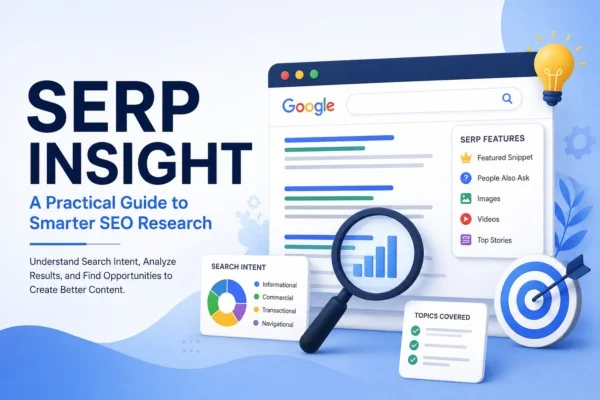
SERP insight is the process of studying search engine results pages (SERPs) to understand what people are looking for, what type of content Google is displaying, how competing pages satisfy a query, and where there are genuine opportunities to create something more useful.
Instead of choosing a keyword and immediately writing an article, SERP insight starts with the search results.
You examine search intent, ranking pages, content formats, recurring topics, unanswered questions, SERP features, competitors, and content gaps. Those observations can then guide your content strategy, on-page SEO, competitor research, guest posting, internal linking, and contextual link-building decisions.
SERP Insight is not an official Google tool or ranking metric. It is a practical SEO research approach.
The objective is not to copy pages that already rank. The objective is to understand the search landscape and create content that genuinely helps the person behind the query.
What Is SERP Insight?
SERP Insight means extracting useful SEO information from the search results for a particular query.

SERP stands for Search Engine Results Page. When someone searches Google, the results may contain organic listings, videos, images, local results, discussions, news, featured results, and other search features.
A useful SERP insight analysis asks:
- What does the searcher actually want?
- What type of pages are ranking?
- What topics appear repeatedly?
- Which questions are being answered?
- Which questions are poorly answered?
- What content format appears appropriate?
- What makes the strongest results useful?
- Where could a new page provide genuine additional value?
- Which existing pages are closely related to the topic?
The most important part is interpretation.
Simply collecting rankings, keywords, or SEO metrics is not enough. The value comes from turning that information into better decisions.
Why Is SERP Insight Important for SEO?
Keyword research can tell you that people search for a phrase, while SEO tools can provide data such as search volume, competition, backlinks, and estimated traffic.
But those numbers do not fully explain what a searcher expects to see.
The actual SERP provides that context.
For example, imagine you are researching a keyword related to guest posting. If most results are detailed educational guides, the searcher is probably looking for information. If the results are mainly service pages, the query may have stronger commercial intent.
That difference can influence:
- Content format
- Search intent
- Page structure
- Topics to cover
- Calls to action
- Internal links
- Content depth
- Conversion strategy
Google’s guidance emphasizes creating helpful, reliable, people-first content and using SEO to help search engines understand useful content. Core requirements for appearing in Google Search
This is where SERP insight becomes valuable: it connects keyword research with actual user expectations.
SERP Insight vs. SERP Analysis
The terms are closely related, but there is a useful distinction.
SERP analysis generally means examining search results and ranking pages.
SERP insight focuses on what you learn from that analysis and how you use those observations to make better SEO decisions.
For example:
SERP analysis:
“Most ranking pages are detailed guides.”
SERP insight:
“This query appears informational, so a detailed guide is likely more appropriate than a short sales page. However, existing guides do not explain how to apply the process, so a practical workflow could provide additional value.”
The second observation is actionable.
That is the real purpose of SERP insight.
What Should You Analyze in a SERP?
You do not need to analyze every available data point. Focus on information that can change your content or SEO strategy.
1. Search Intent
Search intent is one of the most important parts of SERP research.
Ask:
What is the person trying to accomplish with this search?
Common types include:
Informational Intent
The user wants to learn something.
Examples:
- what is SERP insight
- how does SERP analysis work
- what is search intent
Commercial Investigation
The user is comparing options before taking action.
Examples:
- best SEO tools
- guest post services
- SEO link-building strategies
Transactional Intent
The user is ready to perform an action.
Examples:
- buy SEO software
- hire an SEO agency
- order a guest post
Navigational Intent
The user is looking for a particular website, company, or page.
The SERP can help validate your interpretation. If most results are educational guides, an informational page may be appropriate. If service pages dominate, the searcher may have a different expectation.
2. Ranking Content Types
Look at the types of pages appearing in the results.
You might find:
- Guides
- Tutorials
- Lists
- Comparison pages
- Service pages
- Product pages
- Case studies
- News articles
- Videos
- Forums
- Documentation
Do not automatically copy the dominant format.
Instead, ask why that format appears useful for the query.
For example, “how to analyze SERPs” naturally lends itself to a practical tutorial. A short definition may answer the basic question but leave the reader needing another search.
3. SERP Features
Search results can contain more than traditional organic listings.
Depending on the query, you may see:
- Featured snippets
- People Also Ask
- Image results
- Video results
- Local results
- Discussions
- Shopping results
- News results
These features provide additional clues about what people are looking for.
For example, if People Also Ask repeatedly contains questions about “how,” “why,” and “what,” those questions can help you understand the information needs surrounding the main topic.
However, do not add FAQ sections or other elements simply because they might appear in search. Every section should have a genuine purpose.
4. Common Topics and Subtopics
Review several relevant ranking pages and identify topics that repeatedly appear.
For SERP research, these may include:
- Search intent
- SERP analysis
- Competitor research
- Content gaps
- Keyword research
- SERP features
- Content optimization
- Internal linking
- Content updates
- SEO measurement
- Backlink relevance
- Contextual links
Repeated topics can reveal what users commonly expect.
But repetition alone is not a reason to include something.
A topic belongs in your article when it helps the reader understand or accomplish something.
5. Content Gaps
One of the most useful applications of SERP insight is finding meaningful content gaps.
A content gap does not simply mean:
“My competitor mentioned a keyword that I didn’t mention.”
A more useful gap could be:
- An unanswered question
- A confusing explanation
- An outdated recommendation
- A missing example
- A missing step
- A weak comparison
- A topic explained only at a beginner level
- A lack of practical instructions
- Poor organization
- A lack of trustworthy supporting sources
For example, several articles might explain what SERP analysis means but fail to explain how to turn the analysis into a content brief.
That is a much more valuable opportunity than simply adding another definition.
How to Perform a SERP Insight Analysis
A practical SERP insight workflow can be completed in a series of clear steps.
Step 1: Choose the Primary Query
Start with one main query.
For example:
Primary topic: SERP insight
Then identify closely related concepts such as:
- SERP analysis
- search intent
- SERP research
- content gap analysis
- competitor analysis
- search results analysis
- contextual link research
These related concepts should support the main topic rather than become a collection of unrelated keywords.
Step 2: Search the Current SERP
Search for the query and examine the current results.
Do not rely entirely on old SEO articles or assumptions because search results can change.
Look at pages that are genuinely relevant to the query and ask why they appear useful.
Step 3: Examine Several Relevant Results
For each strong result, consider:
- What question does the page answer?
- Who is the intended reader?
- What content format is used?
- What major topics are covered?
- What does the page explain particularly well?
- What is unclear?
- What appears to be missing?
- Are examples provided?
- Are important claims supported?
- Would the reader still need to search elsewhere?
Google recommends evaluating whether your content provides original information, substantial value, and a satisfying experience for readers. Creating useful content for searchers
That is a useful standard for SERP research.
Step 4: Identify the Main Search Intent
After reviewing the results, determine the dominant intent.
For SERP insight, the primary intent is informational: the reader wants to understand the concept and learn how it can be used.
There can also be secondary intent around applying SERP research to SEO campaigns, guest posts, content planning, and contextual link research.
Step 5: Find the Information Gap
Ask:
What can I explain more clearly, practically, or completely without simply rewriting existing pages?
That question helps prevent your article from becoming another generic SEO summary.
Step 6: Create the Content Outline
Build the outline around the reader’s needs.
A useful outline might include:
- What is SERP insight?
- Why it matters
- SERP analysis vs. SERP insight
- What to analyze
- Practical workflow
- Content-gap research
- Application to guest posts
- Application to link insertion
- Common mistakes
- Measurement
- FAQs
Every section should answer a useful question.
How SERP Insight Helps With Link Insertion Research
One of the more practical uses of SERP research is evaluating potential contextual link opportunities.
A traditional link insertion involves adding a relevant backlink to an existing article. However, simply finding a website with a high Domain Rating or Domain Authority does not tell you whether the individual page is actually relevant.
SERP research adds another layer.
You can examine:
- The topic of the existing page
- Search queries for which it receives visibility
- Its content depth
- The surrounding section where a link could fit
- The relationship between the host page and destination page
- The likely audience overlap
- Whether the reference would genuinely help readers
This is the foundation of SERP research for contextual placements.
For a detailed guide specifically focused on this process, see our resource on SERP Insight Link Insertion.
The important point is that link insertion should begin with relevance, not with the question:
“Can I get a backlink from this website?”
A better question is:
“Would this resource naturally improve this article for its readers?”
Page-Level Relevance Matters
A website can have strong overall SEO metrics while containing pages that have little connection to your topic.
For contextual links, the actual page matters.
Consider:
Website relevance → Page relevance → Paragraph relevance → Destination relevance
The closer these relationships are, the more naturally the link fits.
For example, an article explaining competitor SEO research may reasonably reference a detailed resource about SERP research.
But the same destination may be difficult to justify inside an unrelated article about cooking, travel, or home decoration.
How to Evaluate a Link Insertion Opportunity
Before requesting a placement, review the actual page.
1. Is the page topically relevant?
The subject should have a logical connection with your destination.
2. Does the page have search visibility?
Organic visibility can provide useful evidence that the page has established relevance.
3. Is the content useful?
Avoid pages that appear to exist primarily to sell links.
4. Can the link fit naturally?
The surrounding paragraph should make sense before and after the link is added.
5. Does the destination add something?
The destination should provide information that genuinely expands on the subject.
6. Is the anchor descriptive?
Readers should have a reasonable idea of what they will find after clicking.
This approach is more useful than judging opportunities from domain metrics alone.
Choosing Natural Anchor Text
Anchor text is the clickable wording used for a link.
A common mistake is using the same exact-match keyword repeatedly.
Instead, use descriptive variations that accurately represent the destination.
For example, depending on context, relevant anchors can include:
- SERP research for contextual placements
- contextual link research
- relevant link placement
- backlink relevance
- a practical guide to guest posting
- guest posting opportunities
- guest posting platforms
- backlink evaluation methods
The anchor should fit the sentence naturally.
For example:
Before requesting a contextual placement, use SERP research for contextual placements to evaluate whether the host page actually matches the destination.
This is much more natural than forcing the exact target keyword into every paragraph.
Guest Posting vs. Link Insertion
Guest posting and link insertion can both be part of an SEO and content outreach strategy, but they work differently.
Guest Posting
With guest posting, you create a new article for another publication.
This gives you greater control over:
- Topic
- Structure
- Examples
- Context
- References
- Link placement
If you are new to the process, our practical guide to guest posting explains how to find relevant websites, research publishers, create useful content, and use links naturally.
Link Insertion
With link insertion, an existing article is updated with a relevant resource.
The advantage is that the article already exists and may already have:
- Search visibility
- Existing backlinks
- Established topical context
- An existing audience
However, the placement needs to be natural because the original article was not necessarily created around your destination page.
Neither method is automatically better. The quality and relevance of the individual opportunity matter more.
Building Topical Authority With Internal Links
SERP insight becomes even more useful when it is connected to your site’s content architecture.
Instead of publishing isolated articles, create relationships between related resources.
For example, a website covering guest posting and SEO could build a cluster around:
SEO Research
→ SERP analysis
→ Search intent
→ Competitor research
→ Content gaps
→ Guest posting
→ Link insertion
→ Backlink evaluation
→ Internal linking
Each page should have a clear purpose.
Internal links should help readers move between closely related resources.
For example, someone reading about SERP research for guest posts may naturally want to learn about guest posting opportunities.
Similarly, someone researching publishing platforms may benefit from a detailed resource about guest posting platforms.
This creates a logical path through the site rather than a collection of unrelated links.
A Practical SERP Insight Example
Suppose you want to create content around:
guest post services
Instead of immediately writing a generic article, start by studying the search results.
You might discover that users want information about:
- What guest post services actually provide
- How publishers are selected
- Website relevance
- Content quality
- Outreach
- Editorial placement
- Link relevance
- Pricing considerations
- Potential risks
- How results should be evaluated
That information can influence the article structure.
The final page could then explain not just what guest posting is, but how someone should evaluate a service before choosing one.
This is a practical example of turning SERP observations into content decisions.
How SERP Insight Improves Content Strategy
A weak content process often looks like:
Keyword → Write article → Add keywords → Publish
A stronger process is:
Query → SERP → Intent → Competitor research → Content gap → Outline → Useful content → Optimization → Measurement
The second approach gives you a reason for each major decision.
It also reduces the temptation to write content simply because a keyword has search volume.
Google does not recommend creating content around an arbitrary word count. The focus should instead be on providing useful information that satisfies the reader’s needs. Creating helpful, reliable, people-first content
Using SERP Insight for Guest Posts
SERP research can improve guest-post planning by showing what readers expect from a topic before an article is written.
Review:
- Search intent
- Ranking content
- Common questions
- Content gaps
- Existing articles
- The target publication’s audience
Then create an original article that fits the host website.
For more detailed guidance, see our SERP Insight guest posting guide.
The key principle is simple:
Research the topic first, create useful content second, and add links only where they make sense.
Using SERP Insight for Link Building
SERP insight should not mean “build more links.”
The goal is to make better decisions about relevance.
A strong link research process considers:
- Topical alignment
- Page-level relevance
- Organic visibility
- Content quality
- Audience overlap
- Editorial context
- Destination usefulness
- Natural anchor text
Third-party metrics such as DR and DA can be useful supporting signals, but they should not replace manual evaluation.
A page with modest metrics but strong topical relevance can be more logically useful than a high-metric page that has nothing to do with your subject.
For readers researching broader link-building strategies, a relevant internal resource can help them explore how different approaches fit into an SEO campaign.
Measuring SERP Insight Results
SERP insight is valuable when it leads to measurable improvements.
You can monitor:
- Organic impressions
- Organic clicks
- CTR
- Average position
- Search queries
- Organic traffic
- Relevant keyword visibility
- Referral traffic
- Conversions
- Indexed pages
Google Search Console’s performance reports provide data about impressions, clicks, CTR, and position. Organic search performance data
For your own analysis, avoid judging the entire strategy by one keyword.
A page can gain visibility for many related queries even if its primary keyword does not immediately reach the top position.
This is particularly important when analyzing a page that is already receiving substantial impressions.
If a query has strong impressions but a relatively low CTR and an average position near the first-page boundary, it may represent an optimization opportunity—but it is not a guarantee that one update will produce a specific ranking increase.
Common SERP Insight Mistakes
1. Copying Ranking Pages
Ranking pages should be research material, not templates to reproduce.
Your article needs its own explanation, examples, experience, organization, or useful perspective.
2. Choosing Backlinks Only by DR or DA
Domain-level metrics are useful for comparison, but they do not establish page-level relevance.
3. Ignoring Search Intent
A page can be technically optimized and still fail if it does not satisfy the user’s actual goal.
4. Repeating Exact-Match Keywords
Natural language is preferable to repeatedly inserting the same keyword.
5. Adding Links Where They Do Not Belong
A link should have a clear purpose.
If removing the link would make no difference to the reader, reconsider whether it belongs.
6. Writing Only to Reach a Word Count
More words do not automatically create a better article.
Add information because it helps the reader—not because an SEO tool says the page should be longer.
7. Treating Search Results as Permanent
SERPs change.
Competitors publish new pages, existing pages are updated, search intent evolves, and Google changes how results are displayed.
SERP insight should therefore be revisited when an important page stops improving.
A Simple SERP Insight Framework
For regular SEO work, use this framework:
1. Query
What exactly are people searching for?
2. Intent
What are they trying to accomplish?
3. SERP
What types of results does Google currently display?
4. Competition
What are relevant ranking pages doing well?
5. Gap
What useful information is missing or poorly explained?
6. Content
What can you create that genuinely improves the result?
7. Optimization
How can the page be made clear, accessible, useful, and easy to navigate?
8. Links
Which internal and external references genuinely help the reader?
9. Measurement
What happens after publication?
10. Improvement
What evidence tells you the page needs another update?
This framework keeps SEO connected to the actual user rather than reducing the process to keywords and rankings.
Frequently Asked Questions
What does SERP insight mean?
SERP insight means using information from search engine results pages to understand search intent, ranking content, SERP features, content gaps, and potential SEO opportunities.
Is SERP Insight an official Google tool?
No. SERP Insight is not an official Google product or ranking metric. It is a practical term for analyzing search results and turning those observations into SEO decisions.
What is the difference between SERP insight and SERP analysis?
SERP analysis is the process of examining search results. SERP insight is the actionable understanding you gain from that analysis and how you apply it to SEO decisions.
Why is SERP insight important?
It helps you understand what users are likely expecting from a query before you create or optimize a page.
Can SERP insight help with content writing?
Yes. It can help identify search intent, content formats, important subtopics, unanswered questions, and opportunities to provide additional value.
Can SERP insight be used for guest posts?
Yes. SERP research can help you choose relevant topics and create guest articles based on genuine audience needs rather than writing generic content solely to obtain a link.
Can SERP insight be used for link insertion?
Yes. It can help identify existing pages where a contextual resource may be genuinely relevant to the reader. Page-level relevance should be considered alongside broader website metrics.
What makes a link insertion relevant?
A strong contextual opportunity usually has a logical connection between the host page, surrounding paragraph, destination page, and reader’s intent.
Should every backlink use exact-match anchor text?
No. Descriptive and natural anchor variations are generally more appropriate than repeatedly forcing the same keyword.
Does SERP insight guarantee Google rankings?
No. No legitimate SEO research method can guarantee a particular Google ranking. SERP insight is a decision-making framework, not a ranking guarantee.
Should you copy pages that already rank?
No. Use ranking pages to understand the topic, intent, format, strengths, and gaps. Then create original content that provides its own value.
Are DA and DR part of SERP insight?
They can be used as third-party reference metrics, but they are not Google ranking scores. They should not replace search-intent analysis or page-level relevance.
Final Thoughts
SERP insight is the practice of turning search results into better SEO decisions.
Instead of starting with a keyword and immediately producing an article, you first study the search landscape.
You look at:
- Search intent
- Ranking content
- Content formats
- SERP features
- Common topics
- Content gaps
- Competitor strengths
- User questions
- Editorial relevance
- Link opportunities
Then you use those observations to create something genuinely useful.
For content strategy, this can lead to clearer and more relevant articles.
For guest posts, it can help create articles that fit the publication and its audience.
For link insertion, it can help identify pages where a contextual reference actually makes sense.
For internal linking, it can help connect related pages into a stronger topical structure.
The key principle is simple:
Research the SERP to understand the user—not to copy the SERP.
When used this way, SERP insight becomes more than a keyword-research technique. It becomes a practical framework for building content around real search needs while keeping SEO aligned with people-first principles.