
Cold outreach can often feel like shouting into the void. You craft a message, hit send, and wait—only to receive complete silence.
Editors and content managers receive dozens, sometimes hundreds, of pitch emails every week. The vast majority of these pitches may be ignored because many are generic, self-serving, copy-pasted templates that fail to show genuine value to the publisher.
If you want your outreach emails opened, read, and considered, you need to know how to write a guest post pitch that stands out for the right reasons.
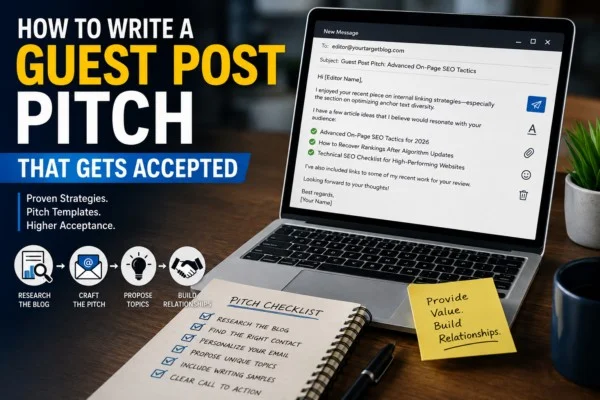
In this comprehensive guide, you will learn a practical step-by-step framework to research target blogs, craft compelling email subject lines, pitch relevant article topics, and build long-term relationships with site owners.
What Makes a Guest Post Pitch Successful?
Before typing a single word of your outreach email, it helps to put yourself in the shoes of the editor receiving it.
Editors do not primarily care about your goal of building backlinks or driving referral traffic to your own site. Their priority is to publish high-quality, engaging, and useful content that resonates with their existing audience while keeping the editorial process efficient.
A successful pitch answers three immediate questions for an editor:
- Who are you? (Are you a trustworthy, knowledgeable contributor?)
- What value are you offering? (Is your proposed topic fresh, relevant, and well-researched?)
- Why our site? (Have you actually read our publication, or is this mass outreach?)
When your emil answers these questions clearly and concisely, you give the editor a straighatforward reason to consider your proposal.
Step-by-Step Framework: How to Write a Guest Post Pitch
Writing a winning guest blog pitch requires careful preparation before hitting send. Follow this practical 5-step process to improve the quality and relevance of your outreach.
Step 1: Lay the Groundwork with Prospect Research
Sending a pitch to an unvetted blog is an easy way to get ignored. Before reaching out, audit your target blog using the following criteria:
Review Their Content Guidelines: Many blogs have a dedicated write-for-us page detailing word counts, formatting, and link policies. Adhering strictly to these guidelines shows professional respect and reduces unnecessary back-and-forth.
Analyze Their Top Content: Browse their recent articles, popular posts, and social channels to understand their audience, tone, and content style.
Identify Content Gaps: Search their site using Google operators (e.g., site:targetsite.com “topic”) to ensure they haven’t already covered your proposed idea.
For a more structured approach to identifying suitable publishers and preparing your outreach, review this guide to publisher outreach strategy.
Step 2: Find the Right Point of Contact
Sending a generic message to info@domain.com or editor@domain.com often produces weaker results than contacting a relevant person directly. Instead, search LinkedIn or the target site’s “About” page for specific roles, such as:
- Head of Content
- Content Marketing Manager
- Managing Editor
- Blog Editor
Once you have identified the right contact name, use verified outreach techniques or reliable bulk email finder strategies to locate their direct work email address.
Crafting the Pitch Email (Section by Section)
To write a pitch that gets results, break your email down into five essential building blocks.
1. The Subject Line
Your subject line influences whether your email gets opened or overlooked. Keep it clear, concise, and professional. Avoid clickbait or overly pushy phrases.
Effective Subject Line Examples:
- Guest Post Pitch: [Proposed Topic] for [Blog Name]
- Content Idea for [Blog Name]: [Proposed Topic]
- Quick guest article submission: [Topic]
If you’re still learning the fundamentals of guest posting and outreach, this beginner’s guide to guest posting provides useful background before you start pitching publishers.
2. Personalized Opening
Demonstrate immediately that you are a real human writing a specific pitch, not an automated bot. Mention a recent article they published or a specific takeaway you enjoyed.
Example: “Hi [Name], I recently read your guide on [Article Title] and really appreciated your point on [Specific Insight]. That inspired me to reach out.”
3. Proof of Expertise
Briefly state who you are and establish your authoritativeness (E-E-A-T). Link to 2–3 of your best published writing samples on reputable sites in the same niche.
Strong writing samples can help demonstrate your experience and give an editor more context before deciding whether your proposed contribution is a good fit. For more guidance on presenting yourself effectively, see this resource on building credibility as a guest author.
4. Topic Proposals
Present 2–3 unique, highly relevant article concepts. For each topic, provide:
- A working headline
- A 2–3 sentence outline or main takeaways
- The benefit to their audience (e.g., target keywords, content gap filled, unique data)
The more closely your ideas align with the publication’s existing audience and editorial direction, the easier it is for an editor to evaluate your proposal.
5. Call-to-Action (CTA)
End with a polite, frictionless CTA that makes it easy for the editor to reply.
Example: “If any of these topics sound like a fit for your editorial calendar, let me know and I will draft a full outline for your review.”
The goal is to make the next step simple. Instead of pushing for an immediate publication, frame your message as a content collaboration opportunity that gives the editor room to evaluate your ideas.
Pitch Templates: Good vs. Poor Outreach
To illustrate how to write a guest post pitch effectively, let us compare a low-quality pitch against a more personalized one.
❌ What NOT to Do (Generic / Spammy Pitch)
Subject: Guest post query
Dear Admin,
I am a professional content writer and I love your blog. I want to contribute a high-quality article to your website for free.
Here are my topics:
Tips for Digital Marketing
How to do SEO
Please let me know if I can send the article along with my links.
Thanks,
Mark
Why this fails: It is generic, addresses a formal “Admin,” offers overly broad topics that many established sites have already covered, and clearly emphasizes link placement without demonstrating unique value.
✅ The High-Converting Pitch Template
Subject: Guest Post Pitch: Advanced On-Page SEO Tactics for [Blog Name]
Hi [Editor Name],
I enjoyed your recent piece on internal linking strategies—especially the section on optimizing anchor text diversity.
I’m a digital strategist at [Company/Brand], and I’ve been producing content in the SEO space for over five years. Given your readers’ interest in technical search strategies, I’ve put together three article ideas tailored specifically for [Blog Name]:
Idea 1: [Working Title]
Brief Description: A step-by-step breakdown showing how mid-sized blogs can audit and fix intent mismatches. Covers real case studies and practical fixes.
Idea 2: [Working Title]
Brief Description: An analysis of key algorithmic updates from recent months, outlining actionable steps for content recovery.
Here are two of my recently published pieces for reference:
[Link to Writing Sample 1]
[Link to Writing Sample 2]
If one of these ideas aligns with your current content plan, I’d be happy to send over a complete outline for your team to review.
Best regards,
[Your Name]
[Your LinkedIn Profile / Portfolio Link]
Comparison: Pitch Strategies Breakdown
Selecting the right strategy depends on your existing relationships, target publication, available resources, and outreach goals.
| Strategy Component | Low-Volume / High-Personalization | High-Volume / Automated |
| Primary Goal | Build relationships with relevant publications | Scale outreach across multiple prospects |
| Personalization Level | Deep (Mentions specific articles/authors) | Shallow (First name / Site name only) |
| Expected Outcome | Generally stronger relevance and relationship potential | Greater outreach volume but potentially lower engagement |
| Best For | Building industry authority & brand trust | Large-scale outreach campaigns |
| Recommended Approach | Strong choice when quality and relationships matter most | Use carefully and avoid overly repetitive messaging |
Common Pitch Mistakes to Avoid
Even experienced marketers make simple errors that can reduce their chances of getting published. Keep these common pitfalls in mind:
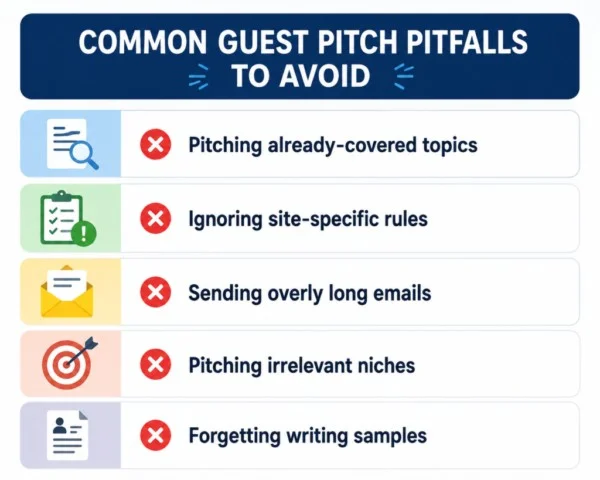
Ignoring Guidelines: If a site explicitly asks you to include a specific phrase in your subject line to prove you read the instructions, failing to do so can result in rejection. Following Google Search Essentials can also help you understand Google’s broader search guidance when creating content and thinking about search visibility.
Pitching Topics Already Covered: Always run a quick search on the site first. Pitching “What is Content Marketing?” to an established marketing blog shows a lack of preparation.
Overly Long Emails: Keep your outreach pitch concise. Editors do not have time to read a 500-word introduction. Aim for roughly 100 to 175 words when the publication does not specify a different format.
Failing to Follow Up: Editors are busy. If you haven’t received a reply after 5–7 business days, send a polite 2-sentence follow-up message on the same email thread.

Strategic Follow-Up Template
If an editor doesn’t respond to your initial message, a concise follow-up can give your original pitch another opportunity to be noticed.
Subject: Re: Guest Post Pitch: Advanced On-Page SEO Tactics for [Blog Name]
Hi [Editor Name],
Just following up on my previous message regarding potential guest post topics for [Blog Name].
I know editorial calendars fill up quickly! If those specific ideas don’t fit your current focus, I’m happy to pitch alternative topics that better align with your content goals for the quarter.
Best,
[Your Name]
Frequently Asked Questions (FAQs)
How long should a guest post pitch email be?
An ideal pitch email should be concise—typically between 100 and 175 words when the publication does not provide its own requirements. It should get straight to the point, clearly present your article ideas, provide relevant writing samples, and include a simple call to action without wasting the editor’s time.
How many topic ideas should I include in a guest post pitch?
It is best to include 2 to 3 distinct topic ideas. Pitching a single topic limits the editor’s options, while pitching too many can overwhelm them. Providing two or three tailored ideas gives them flexibility without cluttering the email.
Should I write the full article before pitching?
No. Unless a blog’s guidelines specifically request a full manuscript submission, you should generally pitch the concept first. Writing an entire draft beforehand risks wasting time if the publication rejects the topic or requests a different direction.
How long should I wait before following up on a pitch?
Wait 5 to 7 business days before sending your first follow-up email. If you still don’t receive a response after one or two polite follow-ups, it is best to move on and pitch those ideas to a different publication.
Final Thoughts
Mastering how to write a guest post pitch boils down to empathy, preparation, and personalization. When you shift your mindset from “How can I get a backlink?” to “How can I provide real value to this publication’s readers?”, your outreach becomes more useful and relevant.
Take the time to research your targets thoroughly, craft clear subject lines, propose unique topic ideas, and maintain a professional tone throughout your communications. For broader guidance on creating useful, people-first content, review Google’s guidance on creating helpful content.
By following the framework detailed above, you can improve the quality of your outreach, build stronger relationships with editors, and create more opportunities for high-quality guest publishing.