
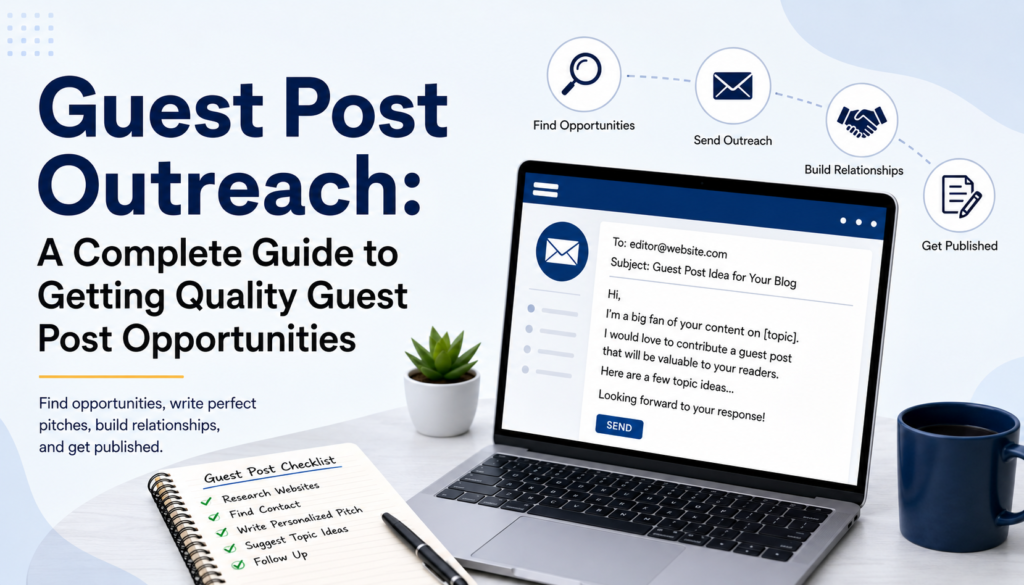
Guest post outreach is the process of contacting website owners, editors, publishers, and content managers to ask about publishing useful content on their websites. When done properly, outreach can help you build relationships, earn relevant editorial exposure, reach new audiences, and support a broader content marketing strategy.
However, successful guest post outreach is not about sending thousands of identical emails. Website owners receive many generic pitches, so a better approach is to identify relevant websites, understand their content, personalize your message, and offer an article that provides genuine value to their readers.
This guide explains how guest post outreach works, how to find suitable websites, how to evaluate publishing opportunities, what to include in an outreach email, how to follow up, and which mistakes can reduce your response rate.
What Is Guest Post Outreach?
Guest post outreach is the process of contacting relevant websites and asking whether they accept guest contributions.
A typical outreach campaign looks like this:
Find relevant websites → Research the site → Identify the right contact → Personalize the pitch → Suggest useful topics → Follow up → Agree on terms → Create the article → Submit and publish
The objective should be a mutually useful editorial collaboration rather than simply obtaining a backlink.
For example, if you operate a website about digital marketing, you might contact a marketing publication with a pitch for an original article about improving content promotion strategies.
The strongest pitches explain why the proposed article is useful for that particular website’s audience.
Why Is Guest Post Outreach Important?
Guest post outreach can provide several benefits when it is executed carefully.
Reach a Relevant Audience
Publishing on another relevant website can introduce your brand to readers who may not have discovered it otherwise.
A placement on a website that attracts your target audience is generally more useful than a random link from an unrelated website.
Build Industry Relationships
Outreach is not only about links.
A successful collaboration can lead to relationships with:
- Editors
- Publishers
- Bloggers
- Marketing professionals
- Business owners
- Content managers
- Other agencies
These relationships can create future publishing, networking, and collaboration opportunities.
Earn Relevant Editorial Exposure
A genuinely useful guest article can earn attention from an existing audience.
The value of the placement depends on factors such as topical relevance, editorial quality, audience fit, and the reputation of the publishing website.
Support Content Distribution
Guest contributions can also function as a content distribution channel.
Instead of publishing an article and waiting for people to discover it, you can introduce your expertise to an established audience.
How to Find Websites for Guest Post Outreach
Finding the right websites is one of the most important parts of the process.
Do not start by collecting thousands of domains. Start by defining the type of website that would genuinely be relevant to your content.
1. Search Google With Relevant Queries
You can use search operators and topic-based searches to identify potential publishers.
Examples include:
- “write for us” + marketing
- “guest post” + technology
- “contribute” + business
- “become a contributor” + SEO
- “guest article” + finance
- “submit an article” + SaaS
These searches can reveal websites that publicly advertise contribution opportunities.
However, do not limit your research to websites that have a dedicated “Write for Us” page.
2. Study Competitor Backlinks
Competitor backlink research can reveal websites that have previously published industry-related content.
Look at the types of websites linking to competing businesses and identify publishers that appear genuinely relevant.
Do not copy every backlink blindly. Evaluate each website before contacting it.
3. Search by Topic Rather Than Only “Write for Us”
Many good publishers do not have a “Write for Us” page.
Instead, search for websites that already publish the type of content you want to contribute.
For example, if your topic is SEO, look for:
- SEO publications
- Marketing blogs
- SaaS publications
- Business websites
- Entrepreneurship publications
This approach can uncover opportunities that standard guest-post search footprints miss.

How to Evaluate a Guest Post Website
A website should not be selected only because it has a high Domain Rating, Domain Authority, or another SEO metric.
Consider several factors together.
Topical Relevance
Ask:
Does this website publish content related to my subject?
A relevant website is usually a better target than an unrelated website with a higher third-party metric.
Content Quality
Read several recent articles.
Check whether they are:
- Well written
- Original
- Useful
- Properly edited
- Relevant to the site’s audience
Organic Visibility
Third-party SEO tools can provide estimates of organic traffic and authority, but these numbers are estimates rather than guarantees.
Use metrics as screening tools rather than as the only reason to select a publisher.
Audience Fit
Consider whether the site’s readers are actually potential customers or relevant members of your target audience.
A website with a smaller but highly relevant audience can be more valuable than a large unrelated publication.
Editorial Standards
Look at how the website handles contributed content.
If almost every page appears to exist only to sell backlinks, that is a warning sign.
A strong publishing opportunity should have a clear audience, useful content, and reasonable editorial standards.
What Makes a Good Guest Post Outreach Email?
A good outreach email should be:
- Short
- Specific
- Personalized
- Clear
- Professional
- Focused on the recipient
The recipient should understand within a few seconds:
- Who you are
- Why you contacted them
- Why your proposed content fits their website
- What you are offering
- What you want from them
Avoid sending a long introduction about yourself before explaining the reason for your email.
Guest Post Outreach Email Template
A simple outreach email can look like this:
Subject: Guest Article Idea for [Website Name]
Hi [Name],
I’ve been reading your content on [specific topic] and noticed that you cover [specific subject].
I’d like to contribute an original article that would be useful to your readers. One possible topic is:
“[Article Topic]”
The article would be original, well researched, and written specifically for your audience.
If you’re open to guest contributions, I’d be happy to send a few additional topic ideas.
Best regards,
[Your Name]
The important part is not copying this exact wording. Personalize the message based on the website and the person receiving it.
How to Personalize Guest Post Outreach
Personalization does not mean adding the recipient’s first name to an otherwise identical email.
A stronger approach is to reference something specific about the website.
For example:
I noticed your recent article about content distribution and thought a practical guide to measuring content promotion could complement it.
This demonstrates that you actually looked at the website.
Useful personalization points include:
- A recent article
- A specific category
- An editorial guideline
- A content gap
- A recurring topic
- A previous contribution
- A relevant audience problem
The more specific the observation, the more credible the outreach feels.
How to Create Guest Post Topic Ideas
Your topic should satisfy three requirements:
Relevant to the website + useful to its audience + connected to your expertise
For example, instead of pitching:
“10 SEO Tips”
you could pitch:
“How SaaS Companies Can Build a Sustainable Content Promotion Process”
The second topic gives the editor a clearer idea of the article’s value.
Before pitching, review the website’s existing articles and avoid suggesting topics that have already been covered extensively.
After selecting a relevant topic, you still need to present the idea in a way that makes sense to the publisher. Learning how to create strong content pitches can help you explain the proposed article, its audience value, and why it fits the publication.
Should You Mention the Backlink in the First Email?
There is no universal rule.
If the publisher has clear contributor guidelines, follow them.
If the website openly publishes commercial terms, transparent communication may be appropriate. For editorial outreach, however, leading with the value of the article is usually more effective than making the entire conversation about a backlink.
It is also important to understand Google’s guidance on links. The Google link best practices explain how descriptive link text can help users and search engines understand linked pages.
Google’s spam policies also address links created primarily to manipulate search rankings. Paid or sponsored placements should be handled according to Google’s applicable link-qualification guidance rather than being presented as natural editorial endorsements.
The goal should be to create useful content for readers first.
How to Follow Up After Guest Post Outreach
Editors are busy, so one unanswered email does not necessarily mean they are not interested.
A simple follow-up can be sent after a reasonable period.
Subject: Re: Guest Article Idea for [Website Name]
Hi [Name],
Just following up on my previous email regarding the guest article idea for [Website Name].
I’d be happy to send additional topic ideas if you’re currently accepting contributions.
Best regards,
[Your Name]
Keep follow-ups polite and limited. Repeatedly sending the same message can become annoying and may damage your reputation.
How Many Follow-Ups Should You Send?
There is no universal number that works for every publisher.
A practical approach is to send one or two polite follow-ups and then move on if there is no response.
The quality of your prospect list matters more than repeatedly contacting the same person.
Guest Post Outreach Mistakes to Avoid
1. Sending the Same Email to Everyone
Generic outreach is easy to ignore.
Personalize the message based on the website and its content.
2. Getting the Website Name Wrong
Nothing damages credibility faster than addressing an editor from another website.
Double-check every prospect before sending.
3. Writing Extremely Long Emails
Editors usually do not need your entire company history.
Get to the point quickly.
4. Pitching Irrelevant Topics
A website about technology is unlikely to want a completely unrelated article about gardening unless there is a genuine editorial reason.
5. Focusing Only on SEO Metrics
DR, DA, traffic estimates, and similar metrics can be useful for filtering prospects, but they do not tell the whole story.
Relevance and editorial quality matter too.
6. Using Fake Personalization
Writing “I loved your amazing website” without mentioning anything specific does not create genuine personalization.
7. Promising Guaranteed Rankings
Avoid claims such as:
“This guest post will guarantee higher Google rankings.”
SEO results are never guaranteed.
8. Mass Sending Without Quality Control
Large-scale outreach can be useful when properly managed, but sending irrelevant or deceptive messages at scale can turn outreach into spam.
Quality control should remain a priority at every stage.
Guest Post Outreach vs. Forum Link Building
Guest post outreach and forum link building serve different purposes.
| Approach | Main Activity | Primary Opportunity |
| Guest post outreach | Pitch and publish useful articles | Editorial exposure and relevant audience |
| Forum participation | Contribute to community discussions | Community engagement and referral traffic |
| Digital PR | Pitch newsworthy stories | Media coverage and brand visibility |
| Resource outreach | Suggest useful resources | Relevant mentions and links |
If you are also considering community-based promotion, your forum link building service can be evaluated separately from guest post outreach because the two approaches involve different publishing environments and outreach processes.
The important distinction is that forum participation should contribute genuinely useful information to the community rather than being used simply to place links.
How to Build a Guest Post Outreach Campaign
A simple campaign can be organized into six stages.
Stage 1: Define Your Target
Choose:
- Niche
- Country or market
- Website type
- Audience
- Content topics
Stage 2: Build a Prospect List
Record information such as:
- Website
- Contact name
- Contact email
- Niche
- Relevant page
- Traffic estimate
- Authority metric
- Guest post policy
- Outreach status
Stage 3: Qualify Prospects
Remove websites that are:
- Completely irrelevant
- Obviously spammy
- Filled with low-quality content
- Primarily created for selling links
- Inactive
- Poorly maintained
Stage 4: Find the Right Contact
Look for:
- Editor
- Content manager
- Managing editor
- Founder
- Marketing manager
- Website owner
A relevant contact is usually better than sending the message to a generic address when a suitable editorial contact is publicly available.
Stage 5: Send Personalized Outreach
Create a short pitch that explains:
- Why you’re contacting them
- Why your topic fits
- What you can contribute
- What the next step is
Stage 6: Track Results
Monitor:
- Emails sent
- Replies
- Positive replies
- Rejections
- Follow-ups
- Accepted topics
- Published articles
This allows you to identify which prospect types and pitches produce the best results.
A Simple Guest Post Outreach Spreadsheet
You can manage your campaign with a spreadsheet containing:
| Column | Purpose |
| Website | Target publication |
| Niche | Website topic |
| Contact | Relevant person |
| Outreach address | |
| Topic Idea | Proposed article |
| Status | Prospect / Sent / Replied |
| Follow-Up | Follow-up date |
| Price | If commercial terms apply |
| Article Status | Pending / Written / Published |
| Live URL | Published article |
This simple system can prevent duplicate outreach and make larger campaigns easier to manage.
How to Improve Guest Post Outreach Response Rates
Instead of trying to send more emails, improve the quality of each stage.
Improve Your Prospect List
Better prospects usually produce better conversations.
Focus on relevance, audience fit, content quality, and editorial standards.
Improve Your Subject Line
Keep it specific and natural.
Examples:
- Guest Article Idea for [Website]
- Content Contribution for [Website]
- Article Idea: [Topic]
Improve Your Pitch
Explain the value of the proposed article rather than talking only about yourself.
Improve Your Topic Research
Pitch topics that complement the website’s existing content without duplicating it.
Improve Your Follow-Up
Keep follow-ups short and polite.
Improve Your Offer
If appropriate, provide several topic options so the editor can choose what best fits their editorial calendar.
For businesses that are evaluating different publishing options, reviewing the available guest post pricing and packages can also help when commercial publishing is part of the broader content strategy.
Is Guest Post Outreach Still Useful?
Guest post outreach can still be useful when it is based on relevance, editorial quality, and genuine value.
However, guest posting becomes problematic when it is used primarily as a system for producing large quantities of manipulative links.
Google’s spam policies specifically address tactics intended to manipulate search rankings, including certain forms of link spam and paid links.
The safest long-term approach is therefore to focus on publishing genuinely useful content on websites where the content makes sense for the audience.
Google’s SEO Starter Guide also emphasizes helping search engines understand your content while making it useful and accessible to people.
Frequently Asked Questions
What is guest post outreach?
Guest post outreach is the process of contacting website owners or editors to propose publishing an original article that is relevant to their audience.
How do I find guest post opportunities?
You can find opportunities through Google searches, competitor backlink research, industry publications, contributor pages, networking, and direct research of websites that publish content in your niche.
What should I include in a guest post outreach email?
Include a short introduction, a specific reason for contacting the website, one or more relevant topic ideas, and a clear next step.
How many emails should I send for guest post outreach?
There is no universal number. Prioritize a qualified list of relevant prospects and send personalized emails rather than maximizing volume.
Should I ask for a backlink in my outreach email?
It depends on the publisher and the nature of the collaboration. Follow the website’s contributor or commercial guidelines and keep the focus on useful content rather than treating the article solely as a link placement.
How long should a guest post outreach email be?
Usually, a short email is easier for a busy editor to understand. Include enough information to explain your proposal without adding unnecessary background.
Is guest post outreach safe for SEO?
Legitimate editorial outreach focused on useful content is different from manipulative link schemes. Avoid deceptive practices, mass low-quality placements, and campaigns designed primarily to manipulate rankings.
How often should I follow up?
One or two polite follow-ups are generally enough. If there is no response, it is usually better to focus on other relevant prospects.
Conclusion
Effective guest post outreach is less about sending the largest number of emails and more about finding the right publishers, understanding their audience, and proposing content that genuinely fits their website.
Start with relevant prospects, research each publication, personalize your pitch, suggest useful topics, and maintain a simple outreach tracking system.
Avoid mass spam, irrelevant placements, exaggerated SEO promises, and low-quality websites.
When guest posting is treated as a genuine content collaboration, it can support brand visibility, audience growth, relationships, and broader content marketing efforts.
SEO results are never guaranteed, so guest post outreach should be one component of a wider strategy that includes useful content, technical SEO, internal linking, audience development, and legitimate promotion.