
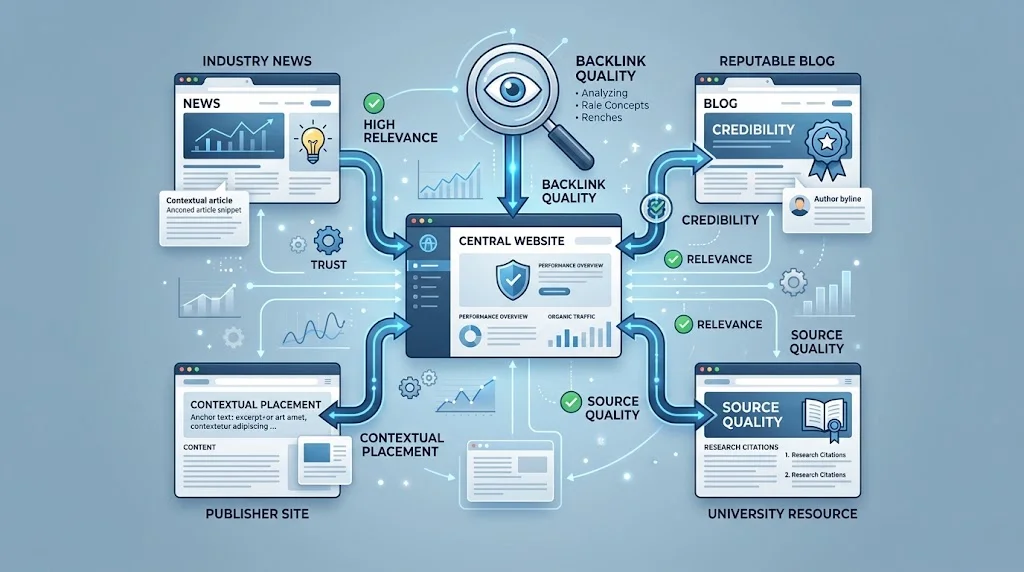
SEO link authority is an important concept in modern search engine optimization because not every backlink provides the same level of value. A link from a trusted, relevant website can be far more useful than dozens of links from weak, unrelated, or low-quality sources.
However, evaluating a backlink is not as simple as checking a Domain Authority or Domain Rating score. Effective SEO link authority evaluation requires looking at the quality of the referring website, the specific page containing the link, topical relevance, editorial context, audience alignment, and the overall credibility of the publisher.
Understanding these factors can help website owners build stronger link profiles and make better decisions when pursuing guest posts, digital PR opportunities, partnerships, or other legitimate link-building activities.
What Is SEO Link Authority?
SEO link authority refers to the perceived strength, credibility, and value that a website or webpage can provide through a backlink.
When one website links to another, that link can serve as a signal of relevance, usefulness, or editorial confidence. The value of the link depends heavily on the quality and context of the referring source.
This is why SEO link authority should not be treated as a single numerical score.
Third-party SEO platforms may use proprietary metrics to estimate website or page strength. These metrics can be useful for comparing opportunities, but they do not represent a universal search engine measurement.
A more useful approach is to evaluate the complete backlink opportunity.
For example, a website with moderate third-party authority but strong topical relevance and a genuine audience may be a better link opportunity than a high-metric website with little connection to your industry.
For a broader explanation of authority, trust, and backlink value, review these core link authority concepts.
How to Evaluate SEO Link Authority
A reliable SEO link authority evaluation process should consider several factors rather than relying on one metric.

1. Referring Website Quality
Start by examining the overall quality of the website that could link to you.
Look for:
- Original and useful content
- Clear editorial standards
- Consistent publishing activity
- A recognizable topic or industry focus
- A professional website structure
- Genuine information for readers
- Natural outbound linking practices
A quality website should look like a real publication, business, organization, or resource rather than a site created primarily to publish links.
Check several pages instead of judging the site from its homepage alone. Review recent articles, author information, category pages, and the general quality of the content.
2. Page-Level SEO Link Authority
Website-level metrics are only part of the picture.
The specific page where your backlink will appear also matters.
A strong domain can contain weak pages, outdated articles, thin content, or pages that attract little engagement. Conversely, a well-developed article on a smaller but highly relevant website can provide a meaningful contextual connection.
Consider:
- Is the page useful to visitors?
- Does the article fully address its topic?
- Is the content original?
- Does the page receive organic visibility?
- Are links placed naturally within the content?
- Does the surrounding text support your topic?
The actual linking page deserves almost as much attention as the domain itself.
3. Topical Relevance and SEO Link Authority
Relevance is one of the most important considerations when evaluating SEO link authority.
A link from a website that covers subjects closely related to your business can make more contextual sense than a link from a completely unrelated site.
For example, a backlink to an SEO agency from a respected digital marketing publication is naturally relevant. A link from a website focused entirely on an unrelated subject may have much less contextual value.
Relevance can exist at multiple levels:
- Domain-to-domain relevance
- Category-to-category relevance
- Article-to-page relevance
- Paragraph-to-link relevance
- Audience-to-destination relevance
The closer the connection, the more natural the backlink generally becomes.
4. Editorial Context
Where and how a link appears matters.
A backlink naturally referenced within a useful paragraph can make more sense than a link placed in a generic author bio, unrelated list, or page full of commercial links.
Consider the surrounding content.
Does the link help the reader understand the topic? Does it provide additional information? Does the destination genuinely support the statement being made?
Context should always be evaluated before authority metrics.
5. Audience Relevance
A website may have strong authority metrics but still be a poor opportunity if its audience has no interest in your subject.
Think beyond search engines.
Ask:
Would the people reading this page reasonably want to learn more about what my website offers?
If the answer is yes, the link may have additional value from referral traffic, brand exposure, and audience discovery.
This is particularly important for publishers, guest posting campaigns, and digital PR.
SEO Link Authority Metrics vs. Actual Link Quality
SEO platforms provide metrics that can make backlink analysis faster.
Common examples include:
- Domain Authority
- Domain Rating
- URL Rating
- Authority Score
- Trust-related metrics
- Estimated organic traffic
- Referring domain counts
These measurements can be helpful for filtering opportunities, but they should not become the entire evaluation process.
A website with a high metric can still have:
- Irrelevant content
- Poor editorial quality
- Artificial link patterns
- Little meaningful traffic
- Excessive commercial links
- Weak topical alignment
Likewise, a smaller website may have a lower score while maintaining strong relevance, useful content, and a genuine audience.
The best approach is to use metrics as screening tools, not final decision-makers.
Does a High Authority Score Mean Better SEO Link Authority?
Not necessarily.
A high authority score can indicate that a third-party platform considers a domain relatively strong, but it does not automatically mean every backlink from that website is valuable.
Imagine two potential publishers.
Website A has a very high authority metric but publishes content across dozens of unrelated subjects and frequently links to commercial websites.
Website B has a lower authority metric but specializes in your industry, publishes detailed content, and attracts an audience interested in your services.
Website B could be the more appropriate opportunity.
This is why backlink evaluation should combine quantitative and qualitative analysis.
Metrics answer questions such as:
How strong does this domain appear according to the tool?
Manual evaluation answers more important questions such as:
Why does this link make sense, and would it actually help the intended audience?
SEO Link Authority vs. Link Relevance
Authority and relevance are related but different concepts.
Authority generally concerns the strength, credibility, and established reputation of a website or page.
Relevance concerns how closely the website, page, content, audience, and linked destination relate to one another.
A backlink can have strong authority but weak relevance.
Another backlink can have strong relevance but come from a smaller publication.
Neither factor should automatically be ignored.
The goal is to find opportunities where quality, relevance, context, credibility, and audience alignment work together.
If you want to understand this distinction in greater depth, see comparing relevance and authority.
What Makes a Backlink Valuable for SEO Link Authority?
A valuable backlink usually combines several positive characteristics.
Relevance
The linking website and page should have a logical relationship with your topic.
Quality
The content should be useful, original, and created for people rather than primarily for manipulating rankings.
Editorial Placement
The link should fit naturally into the surrounding content.
Credibility
The publisher should demonstrate signs of being a legitimate and trustworthy source.
Audience Alignment
The site’s readers should have a reasonable interest in the linked destination.
Context
The surrounding paragraph should explain why the linked resource is useful.
Sustainability
The website should appear to be building a genuine publication or resource rather than participating in short-term link schemes.
A backlink becomes more meaningful when several of these characteristics exist together.
How to Check a Website Before Pursuing an SEO Link Authority Opportunity
Before investing time or money into a link opportunity, use a consistent evaluation process.
Step 1: Review the Website
Visit the homepage and several important sections.
Look for a clear purpose, useful content, recognizable topics, and signs of genuine editorial activity.
Step 2: Check Recent Content
Open several recently published articles.
Look for originality, depth, grammar, structure, and usefulness.
If recent content appears rushed or heavily optimized around commercial keywords, investigate further.
Step 3: Examine Topical Focus
Determine whether the website consistently covers subjects related to your industry.
A focused publication can provide stronger contextual relevance than a site that publishes almost anything.
Step 4: Review Existing Outbound Links
Look at links within several articles.
A website that naturally references authoritative resources is different from one that appears to publish large numbers of promotional links.
Step 5: Check Organic Visibility
Third-party tools can provide estimates of organic traffic and keyword visibility.
Use these figures as supporting evidence rather than treating them as exact measurements.
A sudden or unexplained traffic pattern may deserve additional investigation.
Step 6: Analyze the Linking Page
Do not evaluate only the domain.
Review the exact article or page where your link would appear and determine whether the context is genuinely relevant.
Step 7: Consider the Audience
Think about whether the site’s visitors could realistically benefit from your content, products, services, or resources.
A relevant audience can make a backlink more useful beyond SEO.
Step 8: Evaluate the Overall Risk
Finally, consider whether the website shows signs of manipulative or low-quality practices.
If a site appears to exist mainly to sell links, publishes excessive sponsored content without meaningful editorial value, or accepts content regardless of relevance, it may not be a worthwhile opportunity.
How Guest Posting Fits Into SEO Link Authority Evaluation
Guest posting can be useful when it involves genuinely helpful content created for a relevant publication and its audience.
The quality of the publisher should remain the priority.
Instead of asking:
“Can I get a backlink from this website?”
ask:
“Would this publication be a useful place for this content even if the backlink were not the main objective?”
That mindset naturally improves the quality of link-building decisions.
When evaluating guest posting opportunities, consider the publication’s topic, audience, editorial standards, content quality, and existing linking practices.
For additional context about how links should be handled and qualified, see Google’s documentation about links.
The objective should be to earn or place links within legitimate, useful content—not to create large volumes of artificial signals.
Common SEO Link Authority Mistakes
Several mistakes can weaken backlink evaluation.
1. Looking Only at Domain Authority
One metric cannot explain the complete quality of a link.
2. Ignoring Relevance
A powerful but unrelated website may not be the best opportunity.
3. Evaluating Only the Homepage
The quality of the exact linking page matters.
4. Chasing High Numbers
More backlinks do not automatically mean a stronger link profile.
5. Ignoring Editorial Context
A naturally placed contextual link can make more sense than a poorly positioned commercial link.
6. Buying Links Solely for Ranking Manipulation
Link acquisition should focus on legitimate marketing, relationships, useful content, and genuine editorial value.
7. Accepting Links From Every Available Website
Not every backlink opportunity deserves your time or budget.
8. Ignoring the Audience
A relevant audience can contribute value through referral traffic and brand exposure.
9. Treating Third-Party Metrics as Search Engine Scores
SEO tools estimate authority using their own methodologies. These numbers should be interpreted accordingly.
10. Failing to Review the Publisher Manually
Automated metrics cannot replace human judgment.
Practical SEO Link Authority Checklist
Before pursuing a backlink, ask:
- Is the website legitimate and active?
- Is its content high quality?
- Is the website topically relevant?
- Is the specific linking page useful?
- Is the backlink contextually appropriate?
- Does the publisher have a relevant audience?
- Are outbound links handled naturally?
- Does the website avoid obvious manipulative practices?
- Does the backlink opportunity make sense beyond the metric?
- Would the link still make sense to a reader?
If most answers are positive, the opportunity deserves further consideration.
Frequently Asked Questions About SEO Link Authority
What is SEO link authority?
SEO link authority describes the potential strength and credibility associated with a website or webpage as a linking source. It is best evaluated using multiple factors rather than a single third-party metric.
Is Domain Authority the same as SEO link authority?
No. Domain Authority is a proprietary metric created by an SEO software provider. SEO link authority is a broader concept that considers website strength, page quality, relevance, context, credibility, and other factors.
Is a high Domain Rating always better?
No. A high Domain Rating can be useful as one evaluation signal, but relevance, content quality, editorial context, and audience alignment can be equally or more important.
Does link relevance matter more than authority?
Neither should automatically be considered more important. A strong backlink opportunity often combines authority with meaningful topical relevance and natural editorial context.
How can I evaluate a backlink opportunity?
Review the referring domain, specific page, content quality, topical relevance, editorial placement, audience, outbound links, organic visibility, and overall legitimacy of the publisher.
Are all backlinks valuable for SEO?
No. Backlinks vary significantly in quality and usefulness. A smaller number of relevant, legitimate, contextually appropriate links can be more meaningful than a large collection of weak or unrelated links.
Can guest posting help build link authority?
Guest posting can support legitimate link acquisition when the content provides genuine value to a relevant publication and its audience. The focus should be on quality and relevance rather than producing links at scale.
Should I rely on SEO tools when evaluating links?
SEO tools are useful for gathering data and comparing potential opportunities, but they should support—not replace—manual evaluation.
Final Takeaway
SEO link authority is best understood as a multi-factor evaluation, not a single score.
The strongest backlink opportunities typically combine website quality, page-level strength, topical relevance, editorial context, audience alignment, and publisher credibility.
Third-party metrics can help you identify potential opportunities, but they should never be the only reason you pursue a link.
A smarter approach is to evaluate every backlink in context and ask whether the linking website, page, content, and audience genuinely make sense for your destination.
When quality and relevance come first, link-building decisions become more strategic, sustainable, and useful for both search visibility and real users.