
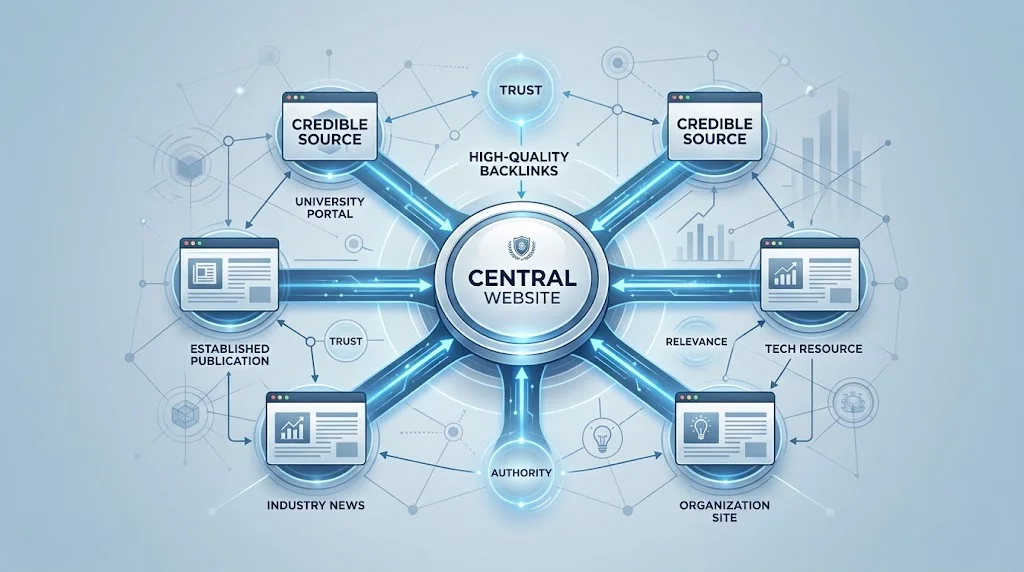
Link authority is an important concept in SEO that helps explain why some backlinks can be more valuable than others. However, link authority is not determined by a single score, such as Domain Authority or Domain Rating.
A backlink can come from a well-known website and still provide limited value if the linking page is irrelevant, the placement is unnatural, or the surrounding content offers little usefulness to readers. Likewise, a link from a smaller but highly relevant publication can be valuable because it connects related topics and reaches an appropriate audience.
Understanding link authority therefore requires looking beyond third-party metrics. Website quality, topical relevance, page-level context, editorial placement, audience fit, and the usefulness of the link all deserve consideration.
This guide explains what link authority means, how it differs from common SEO metrics, what makes a backlink authoritative, and how to evaluate link opportunities more effectively.
What Is Link Authority?
Link authority refers to the potential strength and value a backlink may have based on the credibility, relevance, quality, and context of the website and page providing the link.
In simple terms, it answers a practical question:
How valuable and trustworthy is this particular link likely to be?
A link from an established website with strong editorial standards, relevant content, and a genuine audience may be more meaningful than a link placed on a low-quality page created primarily to publish backlinks.
This is why evaluating backlinks requires more than checking whether a website has a high numerical SEO score.
Several factors can influence the quality of a link, including:
- The credibility of the referring website
- The quality of the linking page
- Topical relevance between the two pages
- The context surrounding the link
- The placement of the link within the content
- The quality and originality of the content
- The relevance of the site’s audience
- The naturalness of the anchor text
- The potential usefulness of the link to readers
- The overall editorial standards of the publisher
Link authority should therefore be treated as a multi-factor evaluation, rather than a fixed measurement.
How Does Link Authority Work?
Search engines use links as part of their systems for discovering and understanding relationships between pages. But not every backlink should be treated as equally valuable.
Consider two hypothetical backlinks.
The first comes from a respected industry publication. The linking article discusses the same subject as your page, and your resource is referenced because it provides additional information readers may find useful.
The second comes from an unrelated website containing hundreds of loosely connected articles and links.
Both are technically backlinks, but the surrounding circumstances are very different.
The first link has stronger signals of relevance, context, and editorial usefulness. The second may provide little meaningful value.
Referring-Domain Quality
The overall quality of the referring domain is an important starting point.
Look at whether the website:
- Publishes useful original content
- Has a clear editorial purpose
- Maintains reasonable content standards
- Covers identifiable topics
- Appears to serve real readers
- Keeps its pages updated when appropriate
- Avoids obvious patterns of manipulative linking
A website should not be judged solely by its age or traffic estimate. The quality and purpose of its content matter as well.
Linking-Page Quality
Domain-level evaluation is only part of the process.
The specific page containing your backlink deserves separate attention. A strong website can have individual pages that are outdated, thin, irrelevant, or poorly maintained.
Ask:
Would this page still be useful if the backlink were removed?
If the answer is yes, that can be a positive sign. If the entire page appears to exist mainly to accommodate links, its value deserves greater scrutiny.
Topical Relevance
Relevance helps establish a meaningful relationship between the linking page and the destination page.
For example, a digital marketing article linking to a detailed SEO resource makes intuitive sense. A gardening website linking to an unrelated cryptocurrency page may have little contextual connection.
Relevance does not mean every backlink must come from a website in exactly the same niche. Closely related industries and broader subject areas can also provide legitimate connections.
The key question is whether the relationship makes sense to a real reader.
Editorial Context
Where and why a link appears can matter as much as where it comes from.
A contextual link that naturally supports a statement, explains a concept, or directs readers toward a useful resource generally makes more sense than a link inserted into an unrelated paragraph.
The surrounding text should help readers understand why the destination page is relevant.
Audience Relevance
A website can have strong overall metrics but still be a poor link opportunity if its audience has no meaningful interest in your subject.
For example, a backlink from a publication read by your target customers may have practical value even if the website’s third-party authority score is not exceptional.
The potential audience should therefore be part of your evaluation.
Referring-Domain Diversity
A healthy backlink profile generally should not depend on one type of website or a small group of publishers.
Natural link acquisition can result in mentions from different publications, organizations, blogs, resources, communities, and industry websites.
Diversity alone does not make links authoritative, but an overly concentrated profile can provide less useful information about the broader recognition of a website.
Why Does Link Authority Matter?
Link authority matters because backlinks can contribute to how search engines discover pages and understand relationships between websites and topics.
However, a backlink should not be viewed as an automatic ranking boost.
A high-quality link can provide several practical benefits.
Referral Traffic
A relevant backlink can introduce your website to people who are already interested in the subject.
If the linking page attracts the right audience, referral traffic may be more valuable than a large volume of visitors with little connection to your business.
Content Discovery
Links can help users and search engines discover related resources.
When one useful page references another useful page, the connection creates a pathway between the two resources.
Credibility and Exposure
Being referenced by relevant publications can increase visibility and help establish familiarity within an industry.
This can be particularly valuable for businesses, publishers, and professionals trying to become recognized sources within a specific topic.
Topical Relationships
Relevant links can also help reinforce connections between websites and subject areas.
For example, an article about technical SEO that references a detailed resource about website crawling creates a logical topical relationship.
A More Balanced Link Profile
Evaluating links based on quality instead of quantity encourages a more sustainable approach to link building.
Rather than asking, “How many backlinks can we get?” a better question is:
“Which links genuinely make sense for our audience and content?”
That shift can lead to better long-term decisions.
Link Authority vs. Domain Authority
One of the most common sources of confusion is treating link authority and Domain Authority as the same thing.
They are not.
Domain Authority, commonly abbreviated as DA, is a third-party SEO metric developed by Moz. Other SEO platforms use their own metrics, such as Domain Rating (DR), Authority Score, or URL Rating (UR).
These metrics can be useful for comparing websites within a particular tool, but they are not Google ranking scores.
Link authority is broader. It considers the actual characteristics of a backlink and its context.
| Evaluation | What It Looks At |
| Domain Authority | Third-party estimate of overall domain strength |
| Domain Rating | Third-party estimate focused heavily on backlink strength |
| URL Rating | Third-party estimate of page-level link strength |
| Link authority | Broader assessment of backlink quality, relevance, context, and credibility |
This distinction is important because a website with a high DA or DR does not automatically provide a high-value backlink.
A more complete evaluation considers the website, page, content, context, audience, and purpose of the link.
For a deeper understanding of how backlink strength should be assessed from an SEO perspective, see our guide to SEO link authority.
Link Authority vs. Link Relevance
Link authority and link relevance are related, but they describe different characteristics.
Authority asks whether the source is credible and valuable.
Relevance asks whether the source and destination are meaningfully connected.
Ideally, a strong backlink opportunity has both.
Imagine a cybersecurity company publishes a detailed guide about phishing prevention.
A backlink from a respected cybersecurity publication discussing online security would likely have strong topical relevance and potentially strong authority.
A backlink from a highly authoritative general-interest website might have greater overall domain strength but less topical relevance.
Neither factor should automatically be ignored.
For a detailed comparison of these two concepts, explore our guide to link relevancy vs link authority.
What Makes a Link Authoritative?
There is no single characteristic that makes a backlink authoritative. Strong opportunities usually combine several positive qualities.
1. A Credible Publisher
The website should have a legitimate purpose and publish content for an identifiable audience.
2. Relevant Content
The article or page containing the link should relate naturally to the destination.
3. Strong Editorial Standards
Content should appear to be created for readers rather than primarily for manipulating search rankings.
4. Natural Placement
The backlink should fit naturally into the surrounding content.
A contextual reference that helps explain a topic is generally more useful than a link placed without a clear purpose.
5. Appropriate Anchor Text
Anchor text should describe or reasonably identify the destination without appearing artificially optimized.
Overusing exact-match commercial keywords across large numbers of links can create an unnatural pattern.
6. Genuine User Value
The strongest test is simple:
Does the link help the reader?
If clicking the link provides additional information, evidence, instructions, examples, or a useful resource, the link has a legitimate purpose.
7. A Relevant Audience
A link can be particularly useful when it places your content in front of people who are likely to care about your subject.
8. A Quality Linking Page
The individual page should provide useful information rather than functioning as a collection of unrelated outbound links.
How to Evaluate Link Authority Before Pursuing a Backlink
A consistent evaluation process can help SEO professionals avoid judging opportunities based on a single metric.

Step 1: Review the Website
Look at the site’s overall purpose, topic coverage, editorial quality, and reputation.
Do not immediately focus on DA or DR.
Step 2: Examine the Specific Page
Read the page where the link would appear.
Check its quality, relevance, freshness, and relationship to your target page.
Step 3: Check Topical Relevance
Ask whether the linking page and destination page address related subjects.
The relationship should make sense without forcing it.
Step 4: Evaluate the Audience
Consider whether the publication reaches people who could realistically benefit from your content, products, or services.
Step 5: Examine the Content
Look for original, useful, well-structured content.
Be cautious when a site contains large amounts of shallow or repetitive material.
Step 6: Inspect Outbound Linking Patterns
Look at other links on the site.
A publisher that regularly links to unrelated commercial pages or appears to sell links indiscriminately deserves additional scrutiny.
Step 7: Check Link Placement
A link surrounded by relevant information is generally more useful to readers than one hidden in an unrelated section, author box, or generic resource list.
Step 8: Review Anchor Context
The anchor should fit naturally into the sentence.
It should help users understand what they will find after clicking.
Step 9: Consider the Purpose
Ask why the link belongs there.
If you cannot explain the user benefit, the opportunity may not be strong enough.
Step 10: Use SEO Metrics as Supporting Evidence
Finally, use tools such as DA, DR, or other authority metrics as supporting indicators, not as the entire decision-making process.
This approach provides a more complete picture of backlink quality.
How to Build a Stronger Link Profile
Building link authority is less about collecting the largest possible number of backlinks and more about earning meaningful references.
Create Resources Worth Referencing
Original research, detailed guides, useful statistics, calculators, templates, studies, and practical resources can naturally attract citations.
Publish Expert-Level Content
Content should solve real problems and provide information that readers cannot easily find elsewhere.
Depth is useful when it improves the answer rather than simply increasing word count.
Build Genuine Publisher Relationships
Relationships with relevant publishers can create opportunities for legitimate editorial exposure.
The focus should remain on producing useful content and earning appropriate mentions rather than establishing links solely for ranking purposes.
Promote Useful Content
When you create something genuinely valuable, make the relevant audience aware of it.
Promotion can increase the chance that journalists, publishers, bloggers, organizations, and industry professionals discover and reference the resource.
Contribute Meaningfully
Guest contributions can be useful when they provide genuine expertise and value to the publication’s audience.
Google also provides guidance on qualifying links, which is useful when deciding how different types of links should be handled.
The goal should be to contribute something worthwhile rather than create pages primarily to obtain backlinks.
Common Link Authority Mistakes
Chasing DA or DR Alone
A high metric does not automatically mean a backlink is valuable.
Always evaluate the specific page and context.
Ignoring Relevance
An authoritative website can still be an inappropriate source if the subject relationship is weak.
Prioritizing Quantity Over Quality
Hundreds of weak links do not necessarily create a stronger link profile.
Quality, relevance, diversity, and natural acquisition matter more than raw volume.
Using Repetitive Exact-Match Anchors
Using the same keyword-rich anchor repeatedly can make a link profile appear less natural.
Anchor text should generally fit the context and accurately describe the destination.
Publishing on Unrelated Websites
A backlink should have a logical reason to exist.
If the connection is difficult to explain to a reader, reconsider the opportunity.
Ignoring the Linking Page
A strong domain can contain weak pages.
Always evaluate the actual page that will contain the backlink.
Creating Content Mainly for Links
Content should have value independently of the backlink.
A useful article with an appropriate reference is fundamentally different from an article created mainly as a vehicle for links.
How Google Search Guidance Fits Into Link Evaluation
SEO professionals should understand that links are part of a broader search ecosystem rather than an isolated ranking tactic.
Google’s documentation provides information about search fundamentals, technical considerations, content, links, and other aspects of search visibility. Reviewing Google Search guidance can help website owners understand the broader principles behind creating content and websites that work well for users and search engines.
The practical takeaway is straightforward: build links that make sense because they connect people with useful information.
That means evaluating the source, page, topic, context, audience, placement, and user benefit rather than simply pursuing the highest available metric.
Frequently Asked Questions
What is link authority in SEO?
Link authority is a broad way of evaluating the potential value and strength of a backlink. It considers factors such as the credibility of the source, relevance, page quality, editorial context, placement, and usefulness to users.
Is link authority the same as Domain Authority?
No. Domain Authority is a third-party metric, while link authority is a broader concept used to evaluate the characteristics and potential value of an individual backlink.
Is a high-DA backlink always valuable?
No. A high DA score does not guarantee that a particular backlink will be valuable. The relevance and quality of the specific linking page and its context should also be considered.
Is relevance more important than authority?
Neither should automatically be considered more important in every situation. A useful backlink evaluation considers both. A highly authoritative but completely unrelated link may have limited contextual value, while a highly relevant link from a credible publication can be a strong opportunity.
Does link authority guarantee higher rankings?
No. There are no guarantees that acquiring a particular backlink will improve rankings. Search visibility depends on many factors, including content quality, technical SEO, competition, relevance, and overall website quality.
How can I measure link authority?
There is no single Google metric called “link authority.” SEO tools can provide metrics such as DA, DR, UR, or Authority Score, but these should be treated as estimates. A stronger evaluation combines those metrics with qualitative analysis of the website, linking page, relevance, context, and audience.
What is the most important thing to consider when evaluating a backlink?
Start with whether the link is relevant and genuinely useful to users. Then evaluate the credibility of the publisher, quality of the linking page, editorial context, placement, and overall link environment.
Conclusion
Link authority is best understood as a multi-dimensional assessment of backlink value, not a number displayed inside an SEO tool.
A strong backlink opportunity typically combines a credible publisher, relevant content, a quality linking page, appropriate context, natural placement, and genuine usefulness to readers.
Third-party metrics such as DA and DR can help with initial research, but they should never replace manual evaluation.
The most effective approach is to ask better questions:
Is the source credible? Is the page relevant? Does the link fit naturally? Does it help the reader? Does the publisher maintain quality standards?
When those factors align, a backlink has a much stronger foundation than one selected simply because a tool reports a high authority score.
Ultimately, successful link building is not about collecting links for the sake of having more links. It is about earning meaningful references from relevant, trustworthy sources that make the web more useful for the people who use it.