
When evaluating backlinks, SEO professionals often face a familiar question: Should you prioritize a highly relevant website or a highly authoritative one?
The answer is more nuanced than choosing one factor over the other.
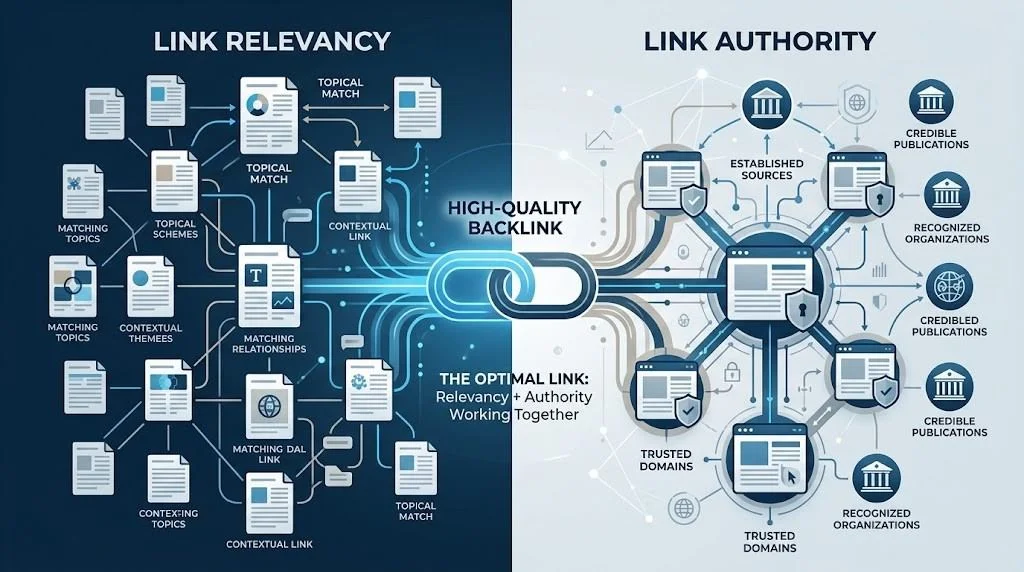
Link relevancy and link authority describe different characteristics of a backlink. Relevancy focuses on how closely the linking website, page, content, and audience relate to the destination. Authority focuses more broadly on the credibility, quality, and strength of the source.
A backlink can be highly relevant without coming from a large publication. Likewise, a link can come from a well-known website but have little contextual value if the subject matter is unrelated.
For that reason, effective backlink evaluation considers both factors alongside editorial quality, natural placement, audience fit, and the usefulness of the link.
What Is Link Relevancy?
Link relevancy describes how naturally a backlink connects the referring website or page with the page being linked to.
The closer the relationship between the two topics, the stronger the contextual relevance may be.
For example, imagine a website publishes an in-depth guide about technical SEO. A backlink from another publication covering website crawling, indexing, or search optimization would have a clear topical relationship.
Now consider a completely unrelated lifestyle article that suddenly links to the same technical SEO guide without explaining why the resource is useful. The backlink may still exist technically, but its contextual relevance is much weaker.
Relevance can exist at several levels:
- Website relevance: Does the referring website cover a related subject?
- Page relevance: Does the specific page discuss a related topic?
- Content relevance: Does the surrounding article naturally support the destination?
- Contextual relevance: Does the sentence or paragraph make the link useful?
- Audience relevance: Would the publication’s readers reasonably benefit from the destination?
This is why evaluating relevance requires more than checking a website’s category.
A website does not have to be an exact match for your niche to provide a relevant backlink. Related industries, complementary subjects, and broader publications can all make sense when there is a legitimate connection.
For a broader explanation of the factors that determine backlink strength, see our guide to understanding link authority.
Example of Strong Link Relevancy
Suppose a digital marketing publication discusses local search visibility and references a detailed guide explaining local citation management.
The relationship is easy to understand. The linked resource expands on a subject already being discussed.
Example of Weak Link Relevancy
Now imagine an unrelated article about home decoration suddenly linking to the same local SEO guide without any meaningful connection.
The website may be legitimate, but the backlink has little contextual relevance.
The key question is:
Would the link make sense to a reader even if SEO were not involved?
If the answer is yes, that is a useful indication that the link has a legitimate contextual purpose.
What Is Link Authority?
Link authority is a broader concept used to evaluate the potential strength and credibility of a backlink source.
It can involve characteristics such as:
- The quality of the referring website
- The credibility of the publisher
- The quality of the linking page
- The website’s topical reputation
- Editorial standards
- Content quality
- Audience credibility
- The context in which the link appears
Importantly, link authority should not be reduced to a single third-party SEO score.
Tools may provide metrics such as Domain Authority (DA), Domain Rating (DR), Authority Score, or URL Rating (UR). These can be useful for research and comparison, but they are third-party measurements rather than official Google scores.
There is also an important distinction between website-level strength and individual link quality.
A reputable website can contain an individual page that is outdated, poorly written, irrelevant, or overloaded with commercial links. Therefore, evaluating the domain alone is not enough.
The actual page containing the backlink deserves attention.
A high-authority publication can also provide a weak opportunity when the link is forced into unrelated content or exists primarily to manipulate rankings.
Link Relevancy vs. Link Authority: Key Differences
Although these concepts are connected, they answer different questions.
| Factor | Link Relevancy | Link Authority |
| Main focus | Topical and contextual fit | Strength and credibility of the source |
| Primary question | Is the link relevant? | How credible or strong is the source? |
| User value | Context and usefulness | Trust and credibility |
| Evaluation | Topic, page, context, audience | Source quality, reputation, editorial standards |
| Potential weakness | Relevant but low-quality source | Strong source but unrelated topic |
| Best outcome | Useful contextual connection | Credible, quality source |

Neither characteristic automatically replaces the other.
A highly relevant link from a poor-quality website may not be a good opportunity. At the same time, a link from a highly reputable website may have limited value when there is no meaningful topical connection.
The strongest opportunities often combine the two.
Which Matters More: Link Relevancy or Link Authority?
There is no universal rule that makes one more important in every situation.
Instead, think of backlink quality as a combination of:
Relevance + quality + authority + editorial value + natural placement
Relevance can be especially important when the purpose of the link is to provide additional information about the subject being discussed.
For example, a specialized cybersecurity resource may benefit from being referenced by a credible publication that regularly discusses cybersecurity, even if that publication is not one of the largest websites on the internet.
Authority can become particularly useful when a backlink comes from a well-established, credible publication with strong editorial standards and a relevant audience.
However, authority alone should not justify a backlink.
A famous website linking to an unrelated page does not automatically make the link a strong opportunity.
The better approach is to ask:
- Is the source credible?
- Is the page relevant?
- Does the content support the link?
- Is the link useful to readers?
- Does the placement look natural?
- Is the publisher producing content for a genuine audience?
If the answer to most of these questions is yes, the opportunity deserves closer consideration.
Can a Relevant Link From a Smaller Website Be Valuable?
Yes.
A smaller website can provide a useful backlink when it has a legitimate purpose, relevant audience, strong content, and a natural reason to reference your page.
Imagine a small but respected website that specializes in technical SEO for small businesses.
It publishes a detailed article about crawlability and references your technical SEO resource because the resource provides additional information for readers.
The publication may not have the same overall reach as a major industry publication, but the backlink has several positive characteristics:
- Strong topical connection
- Relevant audience
- Natural editorial context
- Useful destination
- Genuine reason for the reference
This illustrates why backlink evaluation should not become a contest based solely on domain size.
A smaller relevant publisher can sometimes provide a more logical editorial fit than a much larger website covering an unrelated subject.
Can a High-Authority Link Be Irrelevant?
Yes.
A website can have a strong reputation while still being an inappropriate source for a particular backlink.
Consider a highly established publication covering business and finance. It may have substantial authority within its broader market, but that does not mean every link from the publication is automatically valuable for every website.
If an article about financial markets suddenly contains a backlink to an unrelated gardening product without meaningful context, the connection is weak.
There are several warning signs to watch for:
- The linking topic is unrelated.
- The destination is forced into the article.
- The anchor text feels unnatural.
- The link provides little value to readers.
- The page contains numerous unrelated commercial links.
- The placement appears designed primarily to influence rankings.
The important distinction is between authority of the source and quality of the individual backlink.
A strong domain does not make every possible link from that domain equally useful.
How to Evaluate Link Relevancy and Authority Together
The best backlink evaluation process combines qualitative analysis with supporting SEO data.
1. Check the Website’s Relevance
Start by asking whether the website covers your industry, subject, or a closely related topic.
Exact topical matches are not mandatory, but there should be a reasonable connection.
2. Review the Specific Page
Do not stop at the domain level.
Read the page where the link would appear. Determine whether its topic naturally relates to your destination page.
3. Examine the Context
Look at the paragraph and surrounding sections.
The link should contribute something meaningful rather than appearing as an isolated promotional insertion.
4. Consider Audience Overlap
Ask whether the site’s readers are likely to care about the information you are linking to.
Audience relevance can make a backlink useful even when the publisher is relatively small.
5. Assess Editorial Quality
Look at the quality of the publication’s content.
Does it demonstrate expertise? Is the material useful? Does the site maintain consistent editorial standards?
6. Evaluate Website Credibility
Consider the publisher’s reputation, transparency, content history, and overall quality.
A site that exists primarily to publish large quantities of unrelated articles and backlinks deserves more scrutiny.
7. Check Content Quality
The linking page should provide value independently of the backlink.
Thin or repetitive content created mainly to accommodate links is a warning sign.
8. Examine Link Placement
Contextual placement within useful editorial content is generally more meaningful to users than an unrelated link placed in a generic area.
9. Consider Traffic and Audience Usefulness
Traffic estimates can be imperfect, so they should not be treated as definitive. Still, evidence of a genuine audience can help determine whether a backlink has practical referral potential.
10. Look for Manipulative Patterns
Watch for excessive link exchanges, unrelated outbound links, automated link creation, keyword-stuffed anchors, or content created primarily for links.
A comprehensive process like this provides a better foundation for evaluating SEO link quality than relying on a single authority metric.
Link Relevancy and Guest Posting
Guest posting can be useful when the article genuinely serves the publication’s audience.
The strongest opportunities are usually based on topic fit and editorial value, rather than simply finding websites with the highest available metrics.
Before contributing an article, consider:
- Does the publication cover the subject?
- Does its audience overlap with your target audience?
- Can you provide original and useful information?
- Does the proposed article fit the site’s editorial standards?
- Would the article still be useful without the backlink?
- Does the backlink naturally support the content?
For example, an SEO professional contributing a detailed article about technical website optimization to a digital marketing publication has an obvious topical connection.
A completely unrelated article written solely to insert a keyword-rich backlink is a different situation.
Guest posting should therefore be approached as content contribution first and link acquisition second.
The goal is to create something readers actually want to read.
Common Mistakes When Evaluating Backlinks
Looking Only at DA or DR
Third-party metrics can be useful, but they should not determine the entire decision.
A high score does not automatically mean that a backlink is relevant, useful, or editorially appropriate.
Ignoring Topical Relevance
An authoritative website with no meaningful relationship to your subject may be a weaker opportunity than a smaller but highly relevant publisher.
Choosing Sites Solely Because of High Metrics
Metrics can help with initial screening, but manual evaluation remains important.
Look at the website, specific page, content, audience, and link environment.
Building Links From Unrelated Industries
A backlink should have a logical reason to exist.
If you cannot explain the relationship to a reader, the opportunity may not be worth pursuing.
Using Overly Optimized Anchor Text
Anchor text should fit naturally into the sentence and accurately describe the destination.
Repeatedly forcing exact-match commercial keywords can create an unnatural pattern.
Ignoring the Linking Page
A strong domain can contain weak individual pages.
Always inspect the page where the link will actually appear.
Treating Every Backlink as Equal
Backlinks differ significantly in quality, relevance, context, and purpose.
Counting links without evaluating their characteristics provides an incomplete picture.
Pursuing Links Primarily to Manipulate Rankings
The purpose of a backlink strategy should not be to manufacture artificial ranking signals.
Useful content and legitimate editorial references provide a more sustainable foundation.
Google’s Perspective on Link Practices
Google distinguishes between ordinary links and links that need additional qualification based on their purpose.
For example, Google recommends appropriate rel values for certain types of links, including sponsored, ugc, and nofollow. Its documentation on Google’s guidance on qualifying links explains how these attributes can communicate the relationship between a website and a linked page.
This is particularly relevant when evaluating sponsored placements, advertising, user-generated content, or other situations where the relationship between the publisher and linked website needs to be clearly identified.
The important principle is not simply whether a link exists, but why it exists and how it is presented.
Avoiding Manipulative Link Building Practices
Google’s policies identify link spam as practices involving links created primarily to manipulate search rankings. Examples include buying or selling links for ranking purposes, excessive link exchanges, automated link creation, certain optimized links in guest posts or advertorials, low-quality directory links, and other manipulative patterns.
Website owners should therefore avoid treating backlinks as a numbers game.
Common warning signs include:
- Buying links specifically to pass ranking credit.
- Excessive reciprocal linking.
- Automated backlink generation.
- Large-scale placement on unrelated websites.
- Keyword-rich links inserted unnaturally.
- Low-quality directory or bookmark links.
- Publishing low-value content mainly to obtain links.
- Creating guest posts primarily as link vehicles.
Google’s current Google’s link spam guidelines provide additional information about practices that can violate its search spam policies.
This does not mean every paid placement, advertisement, or sponsored relationship is inherently prohibited. The important distinction is whether the link is appropriately qualified and whether the activity is being used to manipulate search rankings.
For SEO professionals, the safest practical approach is to focus on useful content, legitimate editorial relationships, relevant publications, and transparent link practices.
Frequently Asked Questions
What is the difference between link relevancy and link authority?
Link relevancy describes how closely a backlink relates to the topic and context of the destination page. Link authority refers more broadly to the credibility, quality, and strength of the source providing the link.
Is link relevance more important than link authority?
Neither is universally more important. The strongest backlink opportunities typically combine topical relevance, source quality, credibility, useful context, and natural placement.
Can a low-authority relevant backlink still be valuable?
Yes. A smaller website can provide a useful backlink when it is legitimate, relevant, has an appropriate audience, publishes quality content, and links naturally to a useful resource.
Is a high-authority irrelevant backlink useful?
Not necessarily. A highly reputable website does not make every backlink from that site valuable. If the subject is unrelated or the placement is forced, the contextual value may be limited.
How can you evaluate backlink relevance?
Review the topic of the referring website, the specific page, surrounding content, anchor text, audience, and reason for the link. Ask whether the connection makes sense to a real reader.
Should guest posts always come from highly authoritative websites?
No. Relevance and editorial quality should also be considered. A smaller publication with a highly relevant audience may be a better fit than a larger website with little connection to the subject.
What makes a backlink high quality?
A high-quality backlink opportunity generally comes from a credible source, appears in relevant and useful content, has natural placement, serves the audience, and exists for a legitimate editorial or informational reason.
Conclusion
Link relevancy vs. link authority is not an either-or decision.
Relevance helps determine whether a backlink makes sense in its topical and contextual environment. Authority helps assess the credibility and strength of the source. Both can contribute to a more complete understanding of backlink quality.
The strongest opportunities typically combine:
Topical relevance + credible source + quality content + natural placement + genuine user value
Third-party metrics such as DA and DR can assist with research, but they should not replace manual evaluation or be treated as official Google measurements.
For website owners and SEO professionals, the practical takeaway is simple: do not choose backlinks based on authority alone.
Look at the website, the specific page, the topic, the audience, the surrounding context, the editorial quality, and the purpose of the link.
When relevance and credibility come together naturally, the result is a backlink opportunity that makes sense for both users and a long-term SEO strategy.