
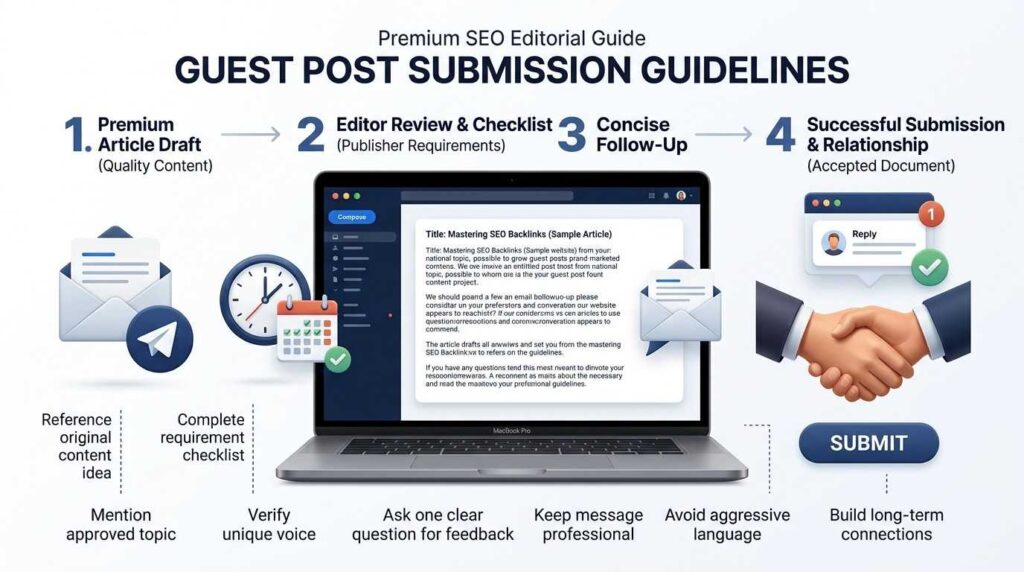
Submitting a guest article is not simply a matter of writing a few paragraphs and sending them to a website. Most publications have standards for the topics they cover, the quality they publish, the audiences they serve, and the way contributors should submit material.
That is why guest post submission guidelines matter. They give writers a clearer idea of what a publication expects before an editor spends time reviewing an article. Following those requirements can make your submission easier to evaluate, reduce avoidable revisions, and show that you have taken the publication seriously.
The most successful approach is to think beyond promotion. A strong guest article should solve a real reader problem, fit the publication naturally, offer original value, and meet the publisher’s editorial expectations. This guide explains how to evaluate those requirements and prepare a submission professionally.
What Are Guest Post Submission Guidelines?
Guest post submission guidelines are instructions provided by a publication for people who want to contribute articles. They can appear on a dedicated “Write for Us” page, contributor page, editorial policy page, or submission form.
Depending on the publication, the guidelines may explain:
- Which topics the publication accepts
- Who the target audience is
- Whether contributors must pitch before writing
- Preferred article length
- Formatting requirements
- Image and media requirements
- Link policies
- Author bio requirements
- Whether previously published content is accepted
- How articles should be submitted
- Whether promotional or commercial content is allowed
- Editorial review and revision expectations
Some publishers provide detailed instructions, while others provide only a short explanation of what they are looking for.
The important point is that there is no universal set of guest article guidelines. One publication might request a short pitch before seeing a full draft, while another might ask for the complete article. One may permit one relevant author-bio link, while another may have stricter policies.
Read the individual publication’s instructions rather than assuming that requirements are the same everywhere.
Why Following Guest Post Guidelines Matters
Following a publisher’s requirements does not guarantee acceptance. Editors may reject an article for many reasons, including topic fit, editorial priorities, quality, or limited publishing capacity.
However, following the requirements removes many avoidable problems.
It makes editorial review easier
An editor should be able to understand what you are proposing without searching through a poorly formatted document or trying to determine which version of the article is final.
It demonstrates professionalism
Reading instructions before contacting a publisher shows that you care about the publication rather than sending the same message to every website.
It reduces unnecessary revisions
If a publisher asks for specific headings, formatting, image dimensions, or a particular submission method, following those instructions from the beginning can save time for both sides.
It improves content quality
Good editorial guidelines often exist because the publisher has learned what works for its readers. Requirements about structure, sourcing, tone, and formatting can help contributors produce more useful articles.
This people-first approach is consistent with Google’s guidance, which emphasizes original, useful, reliable content created primarily to benefit readers rather than manipulate search rankings .helpful content principles
What to Check Before Choosing a Publication
Before spending hours writing an article, make sure the publication is actually a sensible destination for your content.
Topical relevance
Look at the publication’s recent articles and major categories. Does your proposed subject belong there?
For example, an article about technical SEO may make sense on a digital marketing publication but may be a poor fit for a website focused exclusively on travel.
Target audience
Ask who reads the publication.
A technically advanced audience may appreciate detailed terminology, examples, and implementation advice. Beginners may need clearer explanations and more context.
Content quality
Review several recently published articles.
Look for:
- Depth of coverage
- Writing style
- Article structure
- Use of examples
- Original insights
- Editorial consistency
- Quality of supporting references
The goal is not to copy the publication’s writing. It is to understand the level of usefulness readers have come to expect.
Recent publishing activity
Check whether the publication is still actively publishing. A website with outdated content and no recent activity may not be accepting contributors even if an old contributor page remains online.
Editorial standards
Look for signs that the publication actively edits and maintains its content. Clear author information, consistent formatting, well-organized categories, and regularly updated articles can indicate an established editorial process.
Contributor requirements
Some publications require:
- A pitch before a draft
- Previous writing samples
- An author profile
- Specific credentials
- A particular file format
- A certain number of proposed topics
Check these requirements before preparing your submission.
Does the publication accept outside contributions?
Do not assume that every website with a “Write for Us” page currently accepts guest articles. Some pages may be outdated, temporarily closed, or intended for a different type of contributor.
How to Find a Publication’s Submission Guidelines
Submission instructions can appear in several places.
Start by checking:
- Write for Us pages
- Contributor pages
- Editorial guidelines
- Submission pages
- Contact pages
- Author instructions
- Guest contributor pages
Search the website’s navigation menu and footer as well as its search function.
If you cannot find guidelines, check whether the publication has recently published articles from outside contributors. An author profile or contributor section may reveal how external writers normally work with the publication.
If there is still no clear information, a short and respectful inquiry can be better than sending a large unsolicited article.
Common Guest Post Submission Requirements
Every publisher has its own rules, but the following requirements appear frequently.
Topic Requirements
The topic should be relevant to the publication and useful to its readers.
A strong topic usually has three characteristics:
- It fits the site’s subject area.
- It addresses a genuine audience need.
- It offers a clear angle rather than repeating a generic explanation.
Before choosing a topic, examine existing content. If the publication already has several detailed articles on the exact same subject, simply rewriting the topic may not give the editor a reason to publish another version.
Instead, look for an underserved question, a different audience segment, a practical process, or a more specific angle.
Originality Requirements
Many publishers expect guest articles to be original and unpublished elsewhere.
Originality means more than changing a few sentences from an existing article. The structure, explanations, examples, and presentation should provide genuine value of their own.
Avoid submitting:
- Previously published articles
- Rewritten competitor articles
- Content assembled from multiple sources without meaningful original contribution
- Duplicate versions of articles published on other websites
If you use research from other sources, interpret it responsibly and add your own useful explanation rather than simply reproducing it.
Word Count
Some publishers specify a minimum or maximum length. Others simply say that articles should be comprehensive.
Follow the publisher’s stated range when one exists.
Do not add unnecessary sections just to reach a particular number. A focused 1,500-word article can be more useful than a padded 3,000-word article.
There is no universal word count that makes a guest post successful. The appropriate length depends on the subject, audience, and publication requirements.
Formatting
Good formatting makes an article easier to review and easier to read.
Depending on the publisher’s rules, use:
- Clear headings and subheadings
- Short paragraphs
- Bullet points where appropriate
- Numbered steps for processes
- Tables when they genuinely improve comparison or clarity
- Consistent capitalization
- Consistent formatting throughout the article
Avoid excessive formatting, decorative elements, or complicated layouts unless the publisher specifically requests them.
Images and Media
A publication may ask contributors to provide a featured image, screenshots, original graphics, or other supporting media.
Before submitting an image, check:
- Who owns the image
- Whether you have permission to use it
- Whether attribution is required
- Whether the publisher has specific image dimensions
- Whether screenshots contain confidential information
- Whether the image actually improves the article
Do not simply download copyrighted images from search results and submit them as your own. When in doubt, use material you created yourself or media that you have appropriate permission to use.
Links and References
Links should serve a legitimate editorial purpose.
A useful link can:
- Provide additional context
- Support a factual claim
- Direct readers to a relevant resource
- Explain a technical term
- Help readers continue their research
Avoid adding links simply because you want to place as many URLs as possible.
Follow the publisher’s specific link policy. If the publication permits links, that does not mean every paragraph needs one.
Guest posting should not be treated as a mechanism for inserting large numbers of promotional links. Relevant content and reader usefulness should come first.
Anchor Text
Anchor text should make sense in the sentence and help the reader understand what they will find after clicking.
For example, descriptive wording such as SEO content audit guide can be more natural than repeatedly forcing an exact commercial keyword into unrelated sentences.
Avoid:
- Repeated exact-match commercial keywords
- Awkward anchor text
- Irrelevant links
- Multiple links pointing to the same destination without a reason
- Anchors written primarily for search engines
If the publisher specifies how links should be handled, follow that policy instead of trying to negotiate around it.
Author Bio
A good author bio briefly explains who you are and why readers should care about your perspective.
A useful bio might mention:
- Your professional role
- Your area of expertise
- Your relevant experience
- Your company or publication, when appropriate
Keep the bio informative rather than turning it into an advertisement.
For example:
Alex Morgan is a content strategist who writes about SEO, editorial workflows, and digital marketing. He helps small businesses develop practical content strategies.
That is generally more useful than a paragraph filled with promotional claims.
Promotional Content
There is an important difference between educational content and advertising.
A guest article should primarily teach, explain, analyze, or help the reader solve a problem. Excessive promotion can make an article feel like a sales page.
Avoid turning every section into an opportunity to mention:
- Your company
- Your product
- Your service
- Your clients
- Your promotional offer
If a product or company genuinely belongs in an example, explain its relevance naturally and follow the publisher’s disclosure and promotional policies.
AI-Assisted Content
Publishers have different policies regarding AI-assisted writing. Some may allow it with conditions; others may restrict or prohibit certain uses.
The safest approach is to follow the specific publisher’s policy.
Regardless of how an article is produced, the final submission should be:
- Original
- Factually accurate
- Well edited
- Relevant to the audience
- Free from obvious errors
- Useful beyond generic information
AI can assist with research, organization, brainstorming, or drafting, but it should not replace editorial judgment. Google’s current guidance similarly emphasizes accuracy, quality, relevance, and added value when generative AI is used. content creation guidelines
How to Choose the Right Topic for Submission
Choosing the right topic can be more important than simply writing a longer article.
Start by studying the publication’s existing content.
Look for:
- Frequently discussed subjects
- Questions readers may still have
- Topics that receive regular coverage
- Areas where existing articles are outdated
- Narrow subjects that deserve a dedicated guide
- Practical problems that have not been thoroughly addressed
For example, suppose a digital marketing publication already has several beginner-level articles about SEO.
Instead of pitching another broad article titled “What Is SEO?”, consider a more specific angle such as:
“How to Audit Internal Links on a Small Business Website: A Practical Workflow”
The second topic gives the editor a clearer reason to consider it. It addresses a defined task, audience, and outcome.
You can also review the publication’s search intent coverage. If readers are likely looking for instructions, provide a practical process. If the subject involves comparison, build a clear comparison. If readers need an explanation, focus on clarity rather than forcing a tutorial structure.
For additional topic development, resources such as article proposal ideas can help organize possible angles before you approach a publisher.
How to Prepare Your Article Before Submission
Use the following process before sending a final draft.

1. Review the guidelines
Read the entire submission page instead of only checking the word count.
2. Confirm topic relevance
Make sure the subject belongs naturally within the publication.
3. Research the publication
Understand its audience, tone, content depth, and recent coverage.
4. Create an outline
Organize the article before drafting. A clear structure reduces repetition and helps maintain a logical flow.
5. Write the article
Focus on answering the reader’s actual question rather than satisfying a keyword target.
6. Fact-check important claims
Check statistics, dates, technical statements, quotations, names, and other verifiable information.
7. Edit for clarity
Remove unnecessary sentences, repetition, vague claims, and excessive jargon.
8. Check formatting
Compare your final draft against the publisher’s formatting requirements.
9. Review links
Ask whether every link genuinely helps the reader and whether the destination matches the surrounding text.
10. Check images
Confirm ownership, attribution, permissions, quality, and formatting requirements.
11. Prepare author information
Have your requested bio, credentials, social profile, or other contributor information ready.
12. Proofread the final draft
Check grammar, spelling, punctuation, headings, links, and consistency one final time.
If you are building your overall process, it can help to understand the broader publisher outreach workflow before you begin individual submissions.
How to Submit a Guest Post Professionally
Once your article is ready, follow the publisher’s preferred submission method exactly.
If the site asks for a Google Doc, do not automatically attach a Word document. If it requests a pitch first, do not send the full article unless the guidelines allow it.
A professional submission should:
- Use the requested channel
- Include the requested information
- Clearly identify the proposed topic
- Explain the article’s value briefly
- Follow the specified formatting
- Avoid unnecessary sales language
- Use a professional tone
Your communication should make the editor’s job easier.
If you are contacting a publisher for the first time, email communication examples can help you understand how to keep outreach clear and professional.
Guest Post Submission Email Example
Here is a concise example that can be adapted to a publication’s specific requirements.
Subject: Guest Article Submission: [Article Title]
Hi [Editor’s Name],
I’m [Your Name], a [role/area of expertise] who writes about [relevant subject].
I’d like to submit an article titled “[Article Title]” for consideration. The article covers [one-sentence description of the topic] and is designed to help your readers [specific benefit].
I’ve reviewed your contributor requirements and prepared the article according to the stated guidelines. It is original and has not been published elsewhere.
If the topic is a fit for your editorial calendar, I’d be happy to provide the draft for review.
Best regards,
[Your Name]
[Website or professional profile, if requested]
Keep the message short. The article itself should demonstrate its quality rather than relying on a long sales pitch.
Why Guest Posts Get Rejected
Rejection does not always mean an article is badly written. Sometimes a publication simply has different editorial priorities.
However, common problems include:
Irrelevant topic
The article may be well written but unsuitable for the publication’s audience.
Poor writing quality
Grammar problems, unclear explanations, weak transitions, or awkward phrasing can make an article difficult to publish.
Duplicate content
Previously published or heavily recycled material may violate the publication’s originality requirements.
Excessive promotion
An article that reads like an advertisement is less likely to fit an educational publication.
Too many links
A large number of unnecessary links can make a submission look promotional and distract readers.
Manipulative anchor text
Repeated commercial or exact-match anchors can make otherwise useful content feel artificially optimized.
Ignoring guidelines
Submitting the wrong format, exceeding stated limits, skipping a required pitch, or ignoring specific instructions creates unnecessary editorial work.
Weak research
Unsupported claims, outdated information, and superficial explanations reduce trust.
Poor formatting
Large blocks of text, inconsistent headings, missing sections, or broken formatting make the article harder to review.
Generic pitch
A message that could have been sent to hundreds of unrelated websites suggests that the publication was not researched carefully.
Topic already covered
An editor may reject an article because the site already has a strong article addressing essentially the same reader need.
Thin content
An article can be technically long while still providing little substance. Adding words without adding useful information rarely solves the problem.
Unsupported claims
Strong claims should be supported appropriately. Avoid presenting assumptions, rumors, or unverified statistics as facts.
Failure to follow submission instructions
Even a strong article can be delayed or rejected if it does not follow the publisher’s stated process.
How to Improve a Guest Post Before Sending It
Before pressing send, read the article as if you were the editor.
Ask yourself:
- Does the introduction quickly explain the problem or opportunity?
- Does the article deliver what the title promises?
- Is the subject genuinely relevant to this publication?
- Does every major section provide useful information?
- Are examples specific enough to be practical?
- Are factual claims accurate?
- Have I removed unnecessary repetition?
- Is the article easy to scan on mobile?
- Are headings descriptive?
- Are links genuinely useful?
- Is any section unnecessarily promotional?
- Have I followed every stated guest post rule?
- Does the article provide something more useful than a generic summary?
A particularly useful test is this: If the links to my website and company were removed, would this still be a valuable article for the publication’s readers?
If the answer is yes, you are probably approaching the contribution from the right perspective.
Guest Post Submission Checklist
| Requirement | What to Check |
| Website relevance | Does the publication serve an audience interested in the topic? |
| Topic approval | Does the publisher require a pitch before the full article? |
| Originality | Is the article original and unpublished elsewhere? |
| Word count | Does it follow the publisher’s stated range? |
| Formatting | Are headings, paragraphs, lists, and tables formatted correctly? |
| Images | Are images original, permitted, properly attributed, and suitable? |
| Links | Does every link provide genuine reader value? |
| Anchor text | Is the wording natural rather than forced or repetitive? |
| Author bio | Does the bio meet the publisher’s requirements? |
| Editorial requirements | Have you followed tone, style, sourcing, and promotional rules? |
| Proofreading | Have grammar, spelling, links, and factual details been checked? |
| Submission method | Are you using the exact method requested by the publication? |
Save this checklist and use it before every submission. A few minutes of review can prevent simple mistakes that would otherwise require an editor to request changes.
Guest Post Submission Guidelines vs. Guest Post Pitch
These terms describe different stages of the contribution process.
Submission guidelines are the publisher’s rules. They explain what the publication accepts and how contributors should submit material.
A guest post pitch is your proposal for an article. It normally explains the topic, angle, audience benefit, and sometimes the proposed title.
An outreach email is the communication you use to contact the publisher. It may contain a pitch, a question about contribution opportunities, or a complete submission, depending on the publisher’s process.
A final article submission is the completed piece provided for editorial review.
The process may therefore look like:
Research publication → Read guidelines → Develop topic → Send pitch if required → Receive approval → Write article → Edit and proofread → Submit final draft → Respond to editorial feedback
Not every publisher follows every step. Some accept complete articles immediately, while others require approval before writers begin drafting.
If you are new to the overall process, start with these guest posting fundamentals before moving into more advanced outreach and submission work.
Frequently Asked Questions
What are guest post submission guidelines?
They are instructions provided by a publication explaining what contributors should submit and how submissions should be prepared. They may cover topics, originality, length, formatting, links, images, author information, and the submission process.
What should I check before submitting a guest post?
Check topic relevance, audience, originality, word count, formatting, link rules, image requirements, author information, editorial standards, and the required submission method.
How long should a guest post be?
There is no universal ideal length. Follow the publisher’s stated range when one exists and write enough to address the subject properly without adding filler.
Can I include links in a guest post?
Possibly. The answer depends on the publication’s policy. Links should be relevant, useful to readers, and naturally placed. Do not assume that every guest article should contain multiple promotional links.
Should guest posts be original?
In most cases, yes. Unless a publication explicitly says otherwise, prepare an original article that has not already been published elsewhere.
What makes a guest post get rejected?
Common reasons include poor topic fit, weak writing, duplicate content, excessive promotion, unnecessary links, manipulative anchor text, weak research, poor formatting, thin information, and failure to follow the publisher’s requirements.
Should I follow the publisher’s exact formatting requirements?
Yes. If the publication specifies a particular document format, heading structure, word range, image format, or submission process, follow it as closely as practical.
Can I submit an article without a pitch?
It depends on the publication. Some publishers accept complete articles, while others require a topic pitch or approval first. Follow the stated process.
How should I write a guest post submission email?
Keep it concise and professional. Introduce yourself briefly, identify the article or proposed topic, explain the reader benefit, confirm relevant requirements, and make a simple request for consideration.
How many links should a guest post contain?
There is no universal number. Use only the links that genuinely improve the article and comply with the publisher’s policy. A useful article with fewer relevant links is generally better than one filled with unnecessary promotional URLs.
Conclusion
Good guest posting starts before the article is written.
The strongest submissions combine relevance, originality, reader value, editorial quality, and careful attention to publisher requirements. Instead of treating a guest article as a place to insert promotional links, approach it as a genuine contribution to another publication’s audience.
Read the guidelines first. Research the publication. Choose a topic that adds something useful. Write for the audience rather than for a keyword target. Fact-check important claims, edit carefully, use links responsibly, and follow the requested submission process.
There is no formula that guarantees acceptance. Publishers have different audiences, standards, schedules, and editorial priorities. But when your article genuinely fits the publication and provides something readers would be glad to read, you give the editor a much stronger reason to consider it.