
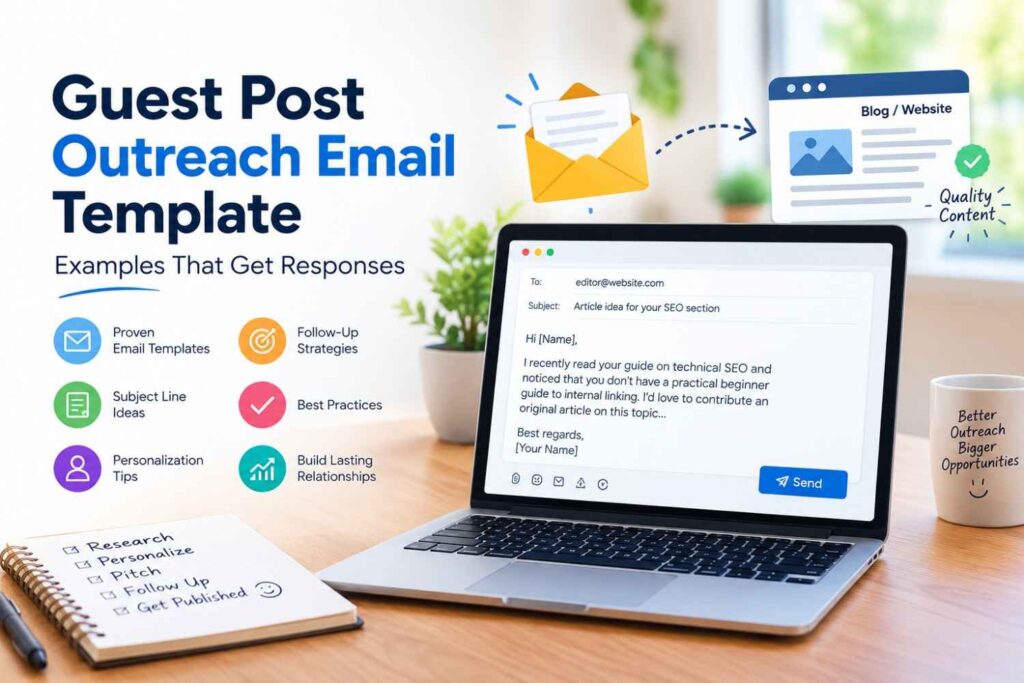
A strong guest post starts long before the article is written. It starts with the first email you send to a website owner, blogger, publisher, or editor.
A generic message such as “I want to write a guest post for your website” is easy to ignore. A well-researched pitch, on the other hand, shows that you understand the publication, have a relevant idea, and can provide something useful to its readers.
This guide provides a practical guest post outreach email template, along with multiple examples, subject lines, follow-up emails, personalization techniques, and outreach best practices.
You’ll learn how to find relevant publishing opportunities, write better pitches, avoid spammy outreach, and build genuine relationships with publishers.
What Is a Guest Post Outreach Email?
A guest post outreach email is a message sent to a website owner, editor, blogger, or content manager to propose writing an article for their publication.
The basic process usually looks like this:
- Find relevant websites.
- Research their audience and content.
- Check their guest posting or contributor guidelines.
- Identify the appropriate contact.
- Develop a useful article idea.
- Send a personalized pitch.
- Follow up politely if necessary.
- Submit the article if the publisher accepts the idea.
- Maintain the relationship for future collaboration.
The purpose should not be simply to obtain a backlink. A good guest contribution should provide genuine editorial value to the publication and its readers.
If you’re new to guest posting, you can first learn the basics of guest posting before starting your outreach campaign.
What Makes a Good Guest Post Outreach Email?
A good guest post email is short, relevant, personalized, and easy to respond to.
Personalization
Personalization is one of the most important parts of outreach.
However, personalization does not simply mean replacing “[Name]” with the recipient’s first name.
Good personalization can involve mentioning:
- A recent article
- A specific section of the website
- A recurring topic
- The site’s target audience
- An editorial guideline
- A content gap
- A relevant article that your proposed topic would complement
For example:
I read your recent guide on technical SEO, particularly the section about crawlability. I noticed that your site has several technical SEO resources but doesn’t appear to have a practical beginner guide to internal linking.
That gives the editor a reason to believe you actually researched the website.
Relevance
Your proposed article should make sense for the publication.
If a website focuses on SEO, digital marketing, content strategy, and PPC, an article about internal linking could be relevant.
A completely unrelated topic will probably be ignored regardless of how well-written the email is.
Clear value proposition
Explain why the article would be useful to the publisher’s audience.
For example:
The article would give small businesses a simple process for identifying important pages and improving internal links without requiring expensive enterprise software.
That is more persuasive than simply saying:
I will provide a high-quality article.
Concise writing
Editors don’t need your entire biography in the first email.
A practical outreach email usually needs:
- Personalized opening
- Short introduction
- Reason for contacting them
- One to three topic ideas
- Relevant credibility
- Simple call to action
Appropriate subject line
Your subject line should be clear rather than promotional.
Examples include:
- Article idea for [Website Name]
- Guest article idea: [Topic]
- Content idea for your SEO section
- Contributor pitch: [Topic]
- Possible article for [Website Name]
Avoid excessive capitalization, fake urgency, and clickbait.
Credibility
If you have relevant experience or published work, mention it briefly.
Useful credibility can include:
- Your professional role
- Relevant expertise
- Previous publications
- A portfolio
- An author page
- Experience with the proposed subject
Don’t exaggerate your credentials.
Clear call to action
Don’t make the recipient answer five questions.
A simple CTA works well:
Would either of these topics be a fit for your editorial calendar?
It gives the editor an easy way to respond.
Professional tone
Be confident but respectful.
Avoid:
I need a dofollow backlink from your website.
Instead, focus initially on the article and its relevance to the publication.
How to Write a Guest Post Outreach Email Step by Step

1. Research the website
Before sending a pitch, understand the publication.
Check:
- Recent articles
- Main categories
- Target audience
- Content style
- Existing contributors
- Author pages
- Guest posting guidelines
- Linking policies
- Topics already covered
Read several recent articles instead of looking at only one page.
2. Find the right contact
Whenever possible, contact the person responsible for editorial decisions.
Depending on the publication, this could be:
- Editor
- Content manager
- Managing editor
- Founder
- Website owner
- Contributor manager
Sending the same email to unrelated contacts can look like mass outreach.
3. Write a relevant subject line
The subject should tell the recipient what the email is about.
Weak:
AMAZING GUEST POST OPPORTUNITY!!!
Better:
Article idea for your SEO section
The second subject is clear, professional, and specific.
4. Personalize the opening
Mention something you actually found while researching the website.
Don’t write:
I love your amazing website!
Instead, identify something meaningful:
I recently read your guide to local SEO and noticed that your site has several practical resources for small businesses.
5. Introduce yourself briefly
One or two sentences are enough.
For example:
I’m a content strategist focused on SEO and organic growth, and I regularly create practical resources for marketers and small business teams.
Don’t turn your introduction into a résumé.
6. Explain why you’re contacting them
Connect your idea to their existing content.
For example:
Your site covers keyword research and technical SEO extensively, so I thought a practical guide to internal linking workflows could complement those resources.
7. Suggest specific topics
Don’t say:
I can write anything you want.
Instead, suggest specific ideas:
- Internal Linking for Growing Websites
- How to Build an Internal Linking Workflow
- Common Internal Linking Mistakes and How to Fix Them
Specific ideas make it easier for the publisher to evaluate your pitch.
8. Explain the reader benefit
Tell the editor what the audience will get.
For example:
The article would provide a step-by-step process with examples that small websites can follow without enterprise SEO software.
9. Add credibility where appropriate
Include one or two relevant examples of your work.
Avoid sending a long list of unrelated links.
10. End with a simple CTA
Try:
Would one of these topics be suitable for your editorial calendar?
That’s enough.
Guest Post Outreach Email Template
Here is a reusable framework you can adapt for different publications:
Subject: Article idea for [Website Name]
Hi [Name],
I was reading your recent article about [specific topic] and particularly liked [specific detail].
I’m [brief introduction], specializing in [relevant subject].
I’d like to contribute a practical article for [Website Name]. Based on the topics you cover, I thought these ideas could be a good fit:
1. [Topic idea]
2. [Topic idea]
3. [Topic idea]
The article would be original, practical, and written specifically for your audience. I’d also follow your editorial and formatting requirements.
For reference, here’s a relevant example of my previous work:
[Relevant article or portfolio link]
Would any of these topics be a fit for your editorial calendar?
Best,
[Name]
Why this template works
The template gives the publisher the information they need without overwhelming them.
More importantly, it leaves room for personalization.
Don’t send this exact message unchanged to hundreds of websites. The structure can be reused, but the introduction, topic ideas, and value proposition should reflect each publication.
Guest Post Outreach Email Template for Beginners
If you are new to guest posting and don’t have an extensive portfolio, keep your email simple and honest.
Subject: Guest article idea for [Website Name]
Hi [Name],
I recently found your website while researching [topic], and I enjoyed your article on [specific article/topic].
I’m interested in contributing an original article to your site about [subject].
Here are a few ideas:
– [Topic 1]
– [Topic 2]
– [Topic 3]
I would write the article specifically for your readers and follow any editorial guidelines you have.
Would you be open to reviewing one of these ideas?
Thanks,
[Name]
You don’t need to invent impressive credentials.
A relevant topic, thoughtful research, and professional communication are more valuable than exaggerated claims.
Guest Post Pitch Email for a Specific Website
The more important the publication is to your strategy, the more effort you should put into research and personalization.
Imagine you’re contacting a marketing publication that regularly covers SEO.
Instead of:
I want to write an SEO article for your website.
Try:
Subject: Content idea for your SEO audience
Hi [Editor Name],
I came across your SEO resources while researching internal linking strategies and noticed that you have several guides covering keyword research and technical SEO.
One area that could complement those resources is the practical side of internal link planning for sites with hundreds of articles.
I’d like to propose:
“An Internal Linking Workflow for Growing Content Sites”
The article would explain how to identify priority pages, map related content, choose useful contextual links, and review internal-link coverage.
I can provide an original, practical article written specifically for your audience and follow your editorial requirements.
Would this be relevant to your content calendar?
Best,
[Name]
The difference is research.
The second pitch explains why the proposed article belongs on that specific website.
Guest Post Outreach Email for a Marketing Website
Niche-specific outreach can make your pitch more convincing because it connects the proposed article directly to the publication’s audience.
Subject: Marketing article idea: SEO reporting for small teams
Hi [Name],
I enjoyed your recent content on practical digital marketing strategies for small businesses.
I’d like to propose an article that builds on that audience:
“How Small Marketing Teams Can Build a Simple SEO Reporting Workflow”
It would explain which metrics are worth monitoring, how to separate useful signals from vanity metrics, and how to turn monthly SEO data into actionable decisions.
The article would be original and practical, with examples that small marketing teams can follow without enterprise software.
I can send a brief outline first if the topic sounds useful.
Would you be interested in reviewing it?
Best,
[Name]
How to Personalize a Guest Post Email in 3 Minutes
You don’t need to spend an hour researching every prospect.
A simple three-minute process can make your pitch considerably more relevant.
Minute 1: Read recent content
Open the website’s blog and look at several recent articles.
Identify:
- Main topics
- Audience
- Content format
- Recurring subjects
Minute 2: Find a content connection
Look for something your proposed article can naturally complement.
For example:
Existing content:
A guide to keyword research.
Potential pitch:
A practical guide to turning keyword research into an SEO content calendar.
The proposed topic should add something rather than simply repeat an existing article.
Minute 3: Rewrite your opening
Mention the specific connection in the first paragraph.
Instead of:
I found your website and would like to contribute.
Write:
I noticed your recent keyword research guide covers search-volume analysis in detail. I thought a follow-up article showing how to turn that research into a practical content calendar could complement it.
That single change can make the email feel much less automated.
Guest Post Follow-Up Email Template
If you don’t receive a response, a polite follow-up can be appropriate.
Wait several business days before following up.
First follow-up
Subject: Re: Article idea for [Website Name]
Hi [Name],
Just following up on my article ideas below.
I think “[Topic]” could be a useful fit for your audience because [brief reason].
If you’re interested, I’m happy to send a short outline.
Thanks,
[Name]
Keep the follow-up shorter than the original email.
Final follow-up
If the first follow-up receives no response, you can close the conversation politely:
Subject: Re: Article idea for [Website Name]
Hi [Name],
I’ll close the loop here so I don’t clutter your inbox.
If guest contributions become relevant in the future, I’d be happy to discuss a topic that fits your editorial guidelines.
Thanks for your time,
[Name]
After that, move on.
Repeatedly contacting someone who hasn’t responded can turn legitimate outreach into unwanted email.
Guest Post Outreach Subject Lines
Here are some practical subject-line ideas:
| Situation | Subject Line |
| General pitch | Article idea for [Website] |
| Specific topic | Guest article idea: [Topic] |
| Content gap | Content idea for your [Category] section |
| Contributor pitch | Contributor idea for [Website] |
| Follow-up | Re: Article idea for [Website] |
| Specific publication | Possible article for [Website Name] |
| Practical topic | Practical [Topic] guide for your readers |
Avoid:
- URGENT!!!
- Amazing opportunity!!!
- Guaranteed traffic
- Exclusive offer
- Best backlink opportunity
- You won’t believe this
Your subject line should make the email easier to understand, not more sensational.
Common Guest Post Outreach Mistakes
Generic mass emails
A message that could have been sent to any website usually feels like spam.
Better approach: Mention something genuinely specific about the publication.
Poor personalization
Using the recipient’s first name isn’t enough.
Better approach: Personalize the reason you’re contacting that particular website.
Overly long emails
Your first message isn’t the article.
Better approach: Give the editor enough information to decide whether they want to continue the conversation.
Aggressive backlink requests
Starting with anchor text, destination URLs, and demands for specific link attributes can make the pitch appear purely link-driven.
Better approach: Lead with editorial fit and audience value.
Google’s spam policies include guidance on link spam and manipulative linking practices.
Irrelevant topics
A website may accept guest contributions but still reject topics that don’t fit its audience.
Better approach: Match your proposal to the site’s actual content.
Excessive follow-ups
Sending several messages within a few days can become annoying.
Better approach: Follow up sparingly and respect silence.
Fake compliments
Your website is the best website I’ve ever seen!
Generic praise can make an email sound automated.
Better approach: Mention a real article, resource, or editorial feature.
Poor grammar
Your email is also an example of your writing quality.
Better approach: Read the message before sending it and verify names, publication titles, and links.
Ignoring editorial guidelines
Some publishers clearly explain how they accept contributions.
Ignoring those instructions wastes both your time and the editor’s.
Better approach: Read the guidelines before pitching.
How to Improve Guest Post Outreach Response Rates
There is no email template that guarantees responses.
Your results can depend on the publication, contact person, topic, timing, editorial policy, and many other factors.
However, you can improve the quality of your outreach.
Build a smaller, better prospect list
Don’t judge your campaign only by the number of websites contacted.
Prioritize publications that are:
- Relevant to your industry
- Relevant to your audience
- Actively publishing
- Editorially credible
- Appropriate for your proposed subject
A smaller list of well-researched websites can be more valuable than a huge list of poorly matched prospects.
You can use relevant publishing opportunities as a starting point, but always evaluate each website individually.
Read several recent articles
Don’t base your pitch on a single article.
Look at several recent posts and identify:
- Typical article length
- Writing style
- Topics
- Target audience
- Content formats
- Linking patterns
- Contributor requirements
This gives you a better understanding of what the publication actually wants.
Pitch the article, not the backlink
Think about the publisher’s perspective.
Ask yourself:
Why would this article make the website better?
If your only answer is “because I can get a backlink,” the pitch probably needs improvement.
Google’s guidance explains that contributor and guest articles can be useful when they inform audiences, while large-scale campaigns created primarily to build links can become problematic. See Google’s guidance on large-scale guest posting and links.
Make the topic easy to evaluate
A specific title and short description help an editor make a quick decision.
Instead of:
I can write about SEO.
Try:
“A Practical SEO Content Audit for Small Websites” — a step-by-step guide covering content inventory, search intent, outdated pages, internal links, and prioritization.
Use relevant proof
If you have published work related to your proposed subject, include one or two examples.
If you don’t have relevant examples, don’t invent them.
Track your outreach
A simple spreadsheet can help you avoid duplicate outreach.
| Field | What to Record |
| Website | Publication name |
| Contact | Editor or owner |
| Topic | Proposed article |
| Date Sent | Initial outreach date |
| Follow-Up | Follow-up date |
| Status | Sent, replied, accepted, declined |
| Notes | Guidelines or preferences |
Tracking also helps you remember previous conversations.
Improve your pitch based on replies
If publishers repeatedly ask the same question, improve your initial email.
For example, if editors regularly ask for article outlines, you may want to include a short outline with future pitches.
Treat outreach as an iterative process rather than searching for one perfect email.
How to Build Genuine Relationships With Publishers
Guest posting becomes more valuable when publishers aren’t treated as one-time link opportunities.
Respect editorial decisions
A rejection doesn’t necessarily mean your idea is bad.
It may simply not fit the publication’s current editorial plans.
Deliver what you promised
If you pitch a detailed tutorial, don’t submit a thin promotional article.
The finished article should match the proposed subject and the publication’s standards.
Follow the site’s style
Pay attention to:
- Formatting
- Heading structure
- Tone
- Citation requirements
- Image rules
- Author bios
- Linking policies
- Word-count expectations
Keep future pitches relevant
If a publisher accepts an SEO tutorial, that doesn’t mean every future topic you send will be appropriate.
Maintain the same level of relevance.
Focus on audience fit
A healthy guest posting relationship can benefit everyone:
- The publisher gets useful content.
- Readers get valuable information.
- Contributors gain appropriate exposure.
- The relationship can lead to future editorial opportunities.
For businesses that prefer to outsource the process, professional guest posting help can be considered, provided the provider is transparent about its methods and focuses on relevant, quality publications.
How to Avoid Spammy Outreach
Good outreach is selective and relevant.
Before sending an email, ask:
Would I still send this pitch if I couldn’t include a backlink?
If the answer is no, reconsider the pitch.
Avoid:
- Sending identical emails at scale
- Using misleading subject lines
- Contacting irrelevant websites
- Repeatedly emailing people who have declined
- Hiding commercial relationships
- Demanding keyword-rich anchor text
- Promising guaranteed rankings
- Publishing the same low-value article across unrelated websites
- Prioritizing backlinks over editorial value
Google’s Search Essentials emphasize creating helpful, reliable, people-first content and following spam policies.
The important point is that guest posting itself isn’t automatically bad. The quality, purpose, relevance, and way links are handled matter.
Guest Post Outreach Best Practices
Before sending your next pitch, review these principles:
- Research the website.
- Understand its audience.
- Check its editorial guidelines.
- Find the right contact.
- Use a specific subject line.
- Personalize the opening.
- Explain why your topic fits.
- Suggest specific article ideas.
- Focus on reader value.
- Mention relevant credentials only when useful.
- Keep the email concise.
- Use a simple CTA.
- Follow up politely.
- Don’t pressure publishers.
- Track your outreach.
- Respect editorial decisions.
- Build relationships instead of chasing individual backlinks.
Frequently Asked Questions
What should a guest post outreach email include?
A good email should include a personalized opening, brief introduction, reason for contacting the publisher, relevant article ideas, useful credibility information, and a simple call to action.
How long should a guest post outreach email be?
Keep the first message concise. A few short paragraphs and a small list of topic ideas are usually enough. You can provide a detailed outline after the publisher shows interest.
How do I ask a website for a guest post?
Research the website first, check its contribution guidelines, identify the appropriate contact, and send a personalized pitch explaining why your proposed article would benefit its readers.
Should I follow up after sending a guest post pitch?
Yes. If you haven’t received a response after several business days, a brief follow-up can be appropriate.
How many times should I follow up?
There is no universal rule, but one or two polite follow-ups are generally more respectful than repeatedly contacting someone. If there is still no response, move on.
What subject line should I use for guest post outreach?
Use a straightforward subject such as “Article idea for [Website Name]” or “Guest article idea: [Topic]”. Avoid clickbait and fake urgency.
How do I personalize a guest post email?
Read several recent articles from the website and identify something that genuinely connects to your proposed topic. Then mention that connection in your opening.
What should I do if a website does not respond?
Send a short follow-up after giving the publisher enough time to review your message. If there is still no response, stop contacting them and focus on other relevant prospects.
Should I include a backlink in the first email?
Your first email should primarily explain the article idea and its value to the publication. Avoid making the entire pitch about obtaining a backlink.
Can I use the same guest post email template for every website?
You can reuse the basic structure, but you should customize the subject, introduction, topic ideas, and value proposition for every relevant publication.