
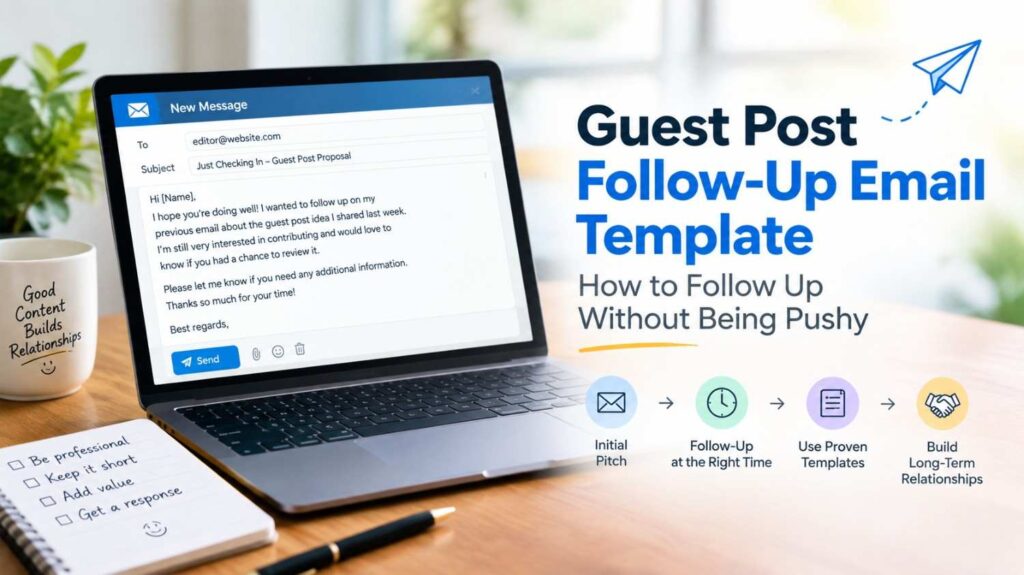
Sending a guest post pitch does not always mean you will receive an immediate response. Editors, publishers, and website owners often have busy inboxes, editorial calendars, and other submissions to review.
That is where a thoughtful guest post follow up email template can help.
A good follow-up is not about repeatedly asking for an answer. It is about continuing the conversation professionally, reminding the recipient about your original proposal, and making it easy for them to decide what happens next.
The challenge is finding the right balance. Follow up too quickly and you may appear impatient. Send too many messages and your outreach can become intrusive. Write a long, repetitive email and the recipient may not have a reason to read it.
This guide explains how to follow up on a guest post with practical timing advice, copy-and-adapt templates, subject-line ideas, personalization tips, and examples for different stages of the guest posting process.
What Is a Guest Post Follow-Up Email?
A guest post follow-up email is a short message sent after your initial pitch, outreach email, or article submission when you need to continue the conversation.
For example, you might follow up because:
- You sent a guest post pitch but received no response.
- A publisher asked for more information.
- An editor expressed interest in your topic.
- You submitted an article and are waiting for an update.
- You were asked to make revisions and need to confirm the next step.
- You want to check whether a previously discussed opportunity is still relevant.
The follow-up should connect naturally with the previous conversation.
Instead of sending another complete pitch, remind the recipient what you previously discussed and give them one clear next step.
The goal is professional persistence, not pressure.
Why Follow-Ups Matter in Guest Post Outreach
A strong pitch can still go unanswered for reasons that have nothing to do with its quality.
Editors have busy inboxes
Website owners and editors may receive contributor pitches, article submissions, partnership requests, reader questions, and other business emails.
Your message can therefore be overlooked even when the topic is relevant.
Emails get buried
An editor may have intended to review your proposal but become distracted by newer messages or an immediate editorial deadline.
A concise follow-up can bring the original conversation back to their attention.
Timing can affect a response
Your pitch may arrive when the publisher is working on another content project, taking time away from email, or not currently planning articles on your proposed subject.
A later follow-up gives the recipient another opportunity to consider the idea.
Professional persistence keeps the conversation open
There is an important difference between persistence and pressure.
One thoughtful follow-up can show that you are organized and genuinely interested. Repeated messages that demand a response can have the opposite effect.
Follow-ups can support relationships
Guest posting should not be treated solely as a way to obtain a backlink.
A better approach is to think about the relationship between:
Writer → Publisher → Audience → Content
When your communication demonstrates that you understand the publication and care about its readers, the conversation becomes more useful for everyone involved.
For a broader look at managing these conversations, see our guide to publisher communication strategies.
Google’s Search Essentials recommends creating helpful, reliable, people-first content and following its spam policies. Its current guidance also warns against manipulative link practices, including certain forms of low-quality guest-post campaigns created primarily to influence rankings.
When Should You Send a Guest Post Follow-Up?
There is no universal number of hours or days that guarantees the right timing.
The appropriate interval depends on the publication, the editor’s instructions, the type of submission, and the previous conversation.
If the website has contributor guidelines that specify a response period, follow those instructions first.
For a general outreach process, this framework is a useful starting point:
| Stage | Suggested action |
| Initial pitch | Send a personalized, relevant proposal |
| First follow-up | Allow a reasonable amount of time, then check in |
| Second follow-up | Keep it shorter and acknowledge the previous message |
| No response | Consider sending a final, low-pressure message |
| Clear rejection | Thank the publisher and close the conversation |
What if the publisher gave you a timeline?
Follow the timeline they provided.
For example, if an editor says, “We’ll review this next week,” there is little reason to send another message the following day.
Wait until the stated period has passed before checking in.
What if there is no stated timeline?
For an unsolicited pitch, allowing several business days before the first follow-up is generally more considerate than sending another email immediately.
The exact timing can vary considerably by publication.
A small website operated by one person may have a different workflow from a publication with several editors.
The principle is simple: give the recipient enough time to reasonably review the message before following up.
How Many Times Should You Follow Up?
More follow-ups do not automatically mean more opportunities.
For many guest post conversations, one or two thoughtful follow-ups are enough.
A practical sequence might look like this:
- Send the original pitch.
- Wait a reasonable period.
- Send the first follow-up.
- If appropriate, wait again and send a shorter second follow-up.
- If there is still no response, close the conversation.
This is a guideline rather than a universal rule.
If a publisher specifically invites contributors to follow up, their process should take priority. Likewise, if they ask you not to send additional messages, stop immediately.
Quality matters more than quantity
Your second follow-up should not simply say:
“Just following up again.”
Instead, make it useful by briefly clarifying the topic, offering an outline, mentioning a relevant adjustment, or giving the recipient an easy way to decline.
How to Write a Guest Post Follow-Up Email
A good guest post follow-up message can often be written in a few sentences.
1. Keep it short
The recipient already has your original email.
Do not force them to read the entire pitch again.
A short follow-up is usually easier to scan and respond to.
2. Reference the original email
Make the context immediately clear.
For example:
I wanted to follow up on my previous email about the proposed article, “[Topic].”
3. Remind them of the topic
Mention the proposed subject rather than expecting the recipient to search through their inbox.

4. Explain why it is relevant
If appropriate, add one sentence explaining why the topic fits their audience.
Keep this genuine. Do not manufacture personalization simply to make the email look customized.
5. Give one clear CTA
Ask one straightforward question.
Examples:
- “Would this topic be a fit for your editorial calendar?”
- “Would you like me to send an outline?”
- “Is this topic still relevant to your publication?”
One clear question is easier to answer than several requests in the same email.
6. Make declining easy
A useful follow-up does not trap the recipient into saying yes.
You can say:
If the topic isn’t a fit, no problem at all.
This keeps the tone professional.
7. Avoid pressure
Do not use phrases such as:
- “I need an answer immediately.”
- “Why haven’t you replied?”
- “Please respond ASAP.”
- “This is your last chance.”
- “You are missing a major opportunity.”
The purpose of the message is to reopen a conversation, not pressure the publisher.
First Guest Post Follow-Up Email Template
Here is a practical template you can adapt after sending an initial pitch.
Subject: Following up on [Topic]
Hi [Name],
I wanted to follow up on my previous email about the proposed guest post, “[Proposed Topic].”
I believe the topic could be useful for [Publication Name]’s audience because [brief, genuine reason].
Would this be a fit for your editorial calendar? If so, I’m happy to send an outline or additional details.
If the topic isn’t a fit, no problem at all.
Best,
[Your Name]
Why this template works
It does four important things:
- Reminds the recipient about the original pitch.
- Identifies the proposed topic.
- Provides a reason for relevance.
- Offers a simple next step without demanding a response.
For more copy-and-adapt outreach messages, see our collection of outreach message examples.
Short Guest Post Follow-Up Template
Sometimes the best follow-up is extremely simple.
Subject: Re: [Original Subject]
Hi [Name],
Just following up on my email about [Proposed Topic].
Would this be something you’d be interested in reviewing? I’m happy to provide an outline if helpful.
Thanks,
[Your Name]
This works especially well when you continue the original email thread.
Keeping the same thread also gives the recipient access to the previous conversation without requiring them to search for it.
Second Follow-Up Email Template
A second follow-up should normally be shorter than the first.
Subject: Re: [Proposed Topic]
Hi [Name],
One quick follow-up regarding [Proposed Topic].
If guest contributions aren’t a priority right now, I completely understand. If the topic is still relevant, I’m happy to provide an outline or adjust the angle to better fit your editorial needs.
Thanks for considering it.
Best,
[Your Name]
Notice that this message does not repeat the entire pitch.
It also gives the recipient two easy options: continue the conversation or let you know that the timing is not right.
Guest Post Follow-Up After No Response
If your original pitch and first follow-up have both gone unanswered, avoid making the language more aggressive.
Instead, consider a polite closing message.
Subject: Re: Guest Post Idea — [Topic]
Hi [Name],
I wanted to make one final check regarding my proposed article, “[Topic].”
If it isn’t a fit for the publication or the timing isn’t right, no worries at all. I’ll close the loop for now.
Thanks for your time,
[Your Name]
This is a useful approach for a guest post follow up after no response because it respects the recipient’s inbox while making your position clear.
If there is still no response, move on rather than continuing indefinitely.
Follow-Up After a Positive Reply
Not every follow-up is about an unanswered pitch.
Sometimes the publisher has already replied positively.
For example:
“The topic sounds interesting. Please send an outline.”
At this point, your job is to make the next step easy.
Subject: Re: [Proposed Topic]
Hi [Name],
Thanks for getting back to me.
I’ve prepared the outline for “[Article Topic].”
The proposed structure covers:
- [Section 1]
- [Section 2]
- [Section 3]
I’ve kept the angle focused on [publication audience/topic].
Please let me know if you’d like any changes before I proceed with the full draft.
Best,
[Your Name]
Follow the publisher’s process
If an editor asks for an outline, send an outline.
If they ask for a draft, follow their requirements.
If they provide word-count, formatting, linking, or submission instructions, follow them carefully.
The easiest contributor for an editor to work with is usually the one who reduces unnecessary back-and-forth.
Before sending your initial proposal, it can also help to review our guide to effective pitch approaches.
Follow-Up After Sending a Guest Post
Following up after submitting a finished article is slightly different from following up on a pitch.
The publisher already has the content. Your purpose is usually to confirm receipt or ask about the review status.
Subject: Re: [Article Title] Submission
Hi [Name],
I hope you’re doing well.
I wanted to check in regarding the [Article Title] I sent on [Date].
I understand your editorial team may need time to review submissions. I just wanted to confirm that the article was received and ask whether there is an estimated timeline for the next step.
I’m happy to make any revisions if needed.
Best,
[Your Name]
Don’t ask for publication immediately
A better question is:
“Is there an estimated timeline for the next step?”
rather than:
“When will you publish my article?”
The first recognizes that the publisher may have an internal review process.
Guest Post Follow-Up Subject Lines
Your subject line does not need to be clever.
Clarity is more useful than clickbait.
Here are natural examples:
- Re: [Original Subject]
- Following up on [Article Topic]
- Checking in about [Article Topic]
- Re: Guest Post Proposal — [Topic]
- Quick follow-up on [Topic]
- Following up on my article idea
- Re: [Article Title] Submission
- Checking in on [Article Title]
Continuing the original email thread is often useful because it preserves the context of the conversation.
For broader email delivery recommendations, Mailchimp notes that delivery can be affected by factors such as sending reputation, email content, and recipients, and recommends following responsible email practices. email delivery recommendations
How to Personalize a Follow-Up Email
Personalization is more than adding someone’s first name.
The best follow-ups demonstrate that you understand the actual conversation.
Reference the previous conversation
Instead of:
“I’m following up on my guest post.”
Try:
“I wanted to follow up on the article idea we discussed about ecommerce product photography.”
The second version immediately establishes context.
Reference the proposed topic
Mention the specific topic, working title, or content angle.
This saves the recipient from searching through old emails.
Reference the publication
Explain why the article makes sense for that publication.
For example:
“I thought the topic could complement your existing content on small-business marketing.”
Only use this type of statement when you have actually reviewed the website.
Reference editorial requirements
If the publication has contributor guidelines, show that you have read them.
For example:
“I’ve kept the proposed article educational and focused on practical examples, in line with your contributor guidelines.”
Reference a relevant article
A specific observation can make your follow-up more useful:
“I noticed your recent article covers basic local SEO, so I thought a practical follow-up focused on Google Business Profile optimization could complement that topic.”
The important point is authenticity.
Personalization should demonstrate relevance—not become an excuse for writing the same mass email with different names.
What to Add When You Need a Stronger Follow-Up
If your first follow-up is unlikely to give the publisher enough information to make a decision, add one useful piece of context.
For example:
Offer an outline
“I can send a short outline if you’d like to review the structure before I write the full article.”
Offer a revised angle
“I can also narrow the topic toward beginner-friendly strategies if that better fits your audience.”
Clarify the audience
“The article would be aimed at small-business owners who are new to SEO.”
Mention an editorial fit
“The proposed article could complement your existing beginner SEO resources without duplicating them.”
Do not add all four points to one email.
Choose the information that actually helps the publisher make a decision.
Common Guest Post Follow-Up Mistakes
1. Following up too quickly
Sending another message shortly after your original pitch can create unnecessary pressure.
Give the recipient reasonable time.
2. Sending too many emails
Repeated messages can turn professional outreach into spam.
If your previous messages have not generated engagement, sending more of the same rarely improves the situation.
3. Repeating the same message
A follow-up should not be a copy of the original pitch with “Just checking in” added at the top.
4. Using aggressive language
Avoid demands, guilt, threats, or exaggerated claims.
5. Talking only about backlinks
A publisher’s primary concern should be whether the content is useful for its readers and appropriate for its site.
If every sentence revolves around link placement, the outreach can appear transactional.
6. Sending generic follow-ups
A message such as:
“Hi, just following up. Please let me know.”
does not give the recipient enough context.
Mention the topic or previous conversation.
7. Writing extremely long emails
Your recipient should not need to read another 700-word pitch just to understand your follow-up.
8. Ignoring editorial guidelines
If the publication asks writers to use a submission form, follow that process instead of repeatedly emailing an editor.
9. Using fake urgency
Do not invent deadlines, competing publishers, limited slots, or other pressure tactics.
10. Continuing after a clear rejection
If a publisher says no, accept the decision.
A respectful response can leave the relationship in good standing for a future opportunity.
Google’s current spam policies identify manipulative link practices as spam and specifically discuss low-quality or overly optimized guest-post links. Keeping the focus on useful content and legitimate editorial relevance is therefore the safer approach.
When Should You Stop Following Up?
Knowing when to stop is one of the most important parts of guest post outreach.
You should generally close the conversation when:
- The publisher clearly rejects the idea.
- The website says it is not accepting guest posts.
- The editor asks you not to follow up.
- You have already sent reasonable follow-ups without engagement.
- The topic is no longer relevant.
- The publication has changed its editorial direction.
- You no longer have a genuine reason to continue the conversation.
Silence does not always mean rejection.
However, silence also should not be interpreted as permission to keep emailing forever.
A polite closing message is often enough:
Thanks for your time. I’ll close the loop for now. If the topic becomes relevant in the future, I’d be happy to reconnect.
Then move on to other relevant publishers.
Guest Post Follow-Up Best Practices
Before sending your next follow-up, run through this checklist:
- [ ] Review your original email.
- [ ] Check the publisher’s submission guidelines.
- [ ] Make sure enough time has passed.
- [ ] Keep the follow-up concise.
- [ ] Mention the original topic or submission.
- [ ] Personalize the message when personalization is genuinely relevant.
- [ ] Ask one clear question.
- [ ] Offer an easy way to decline.
- [ ] Avoid fake urgency.
- [ ] Avoid aggressive language.
- [ ] Do not repeatedly ask about backlinks.
- [ ] Avoid copying the same follow-up multiple times.
- [ ] Stop when the publisher clearly declines.
- [ ] Keep useful conversations organized for future reference.
If you’re new to the overall process, our guide to getting started with guest blogging provides useful background before you move into outreach, pitching, and follow-up.
Frequently Asked Questions
How long should I wait before following up on a guest post?
There is no universal waiting period. For a normal pitch, allowing several business days before the first follow-up is a reasonable starting point. However, always follow the publication’s stated response or submission timeline when one exists.
How many times should I follow up?
One or two follow-ups are often sufficient for a normal guest post pitch. The right number depends on the publisher, previous communication, and their submission process.
What should I say in a guest post follow-up email?
Briefly reference your original email, mention the proposed topic, and ask one simple question. Keep the message easy to scan and respond to.
What should I do if a publisher doesn’t respond?
Send a polite follow-up after a reasonable interval. If appropriate, send one final short message. If there is still no response, close the conversation and focus on other relevant opportunities.
Should I follow up after sending a guest post pitch?
Yes. A professional follow-up can be appropriate when enough time has passed and the publisher’s guidelines do not prohibit it. The purpose is to bring the original proposal back to the recipient’s attention.
Is it okay to send a second follow-up?
Yes, if there is still a legitimate reason to pursue the opportunity. Keep the second message shorter and avoid simply repeating the first follow-up.
How do I follow up without sounding pushy?
Be brief, respectful, and specific. Reference the previous conversation, ask one clear question, and make it easy for the recipient to decline. Avoid demands, fake deadlines, and repeated messages.
What subject line should I use for a guest post follow-up?
The original email subject is often the simplest choice. You can also use “Following up on [Topic]” or “Checking in about [Article Topic].” Keep the subject descriptive rather than sensational.
Should I follow up after submitting an article?
Yes, when a reasonable review period has passed or the publisher’s stated timeline has elapsed. Ask whether the article was received and whether there is an estimated next step.
Final Takeaway
The best guest post follow-up is not the one that sends the most reminders. It is the one that respects the publisher’s time while making the next step clear.
A strong process looks like this:
Research → Personalized Pitch → Reasonable Wait → Concise Follow-Up → Final Check → Move On
Use the templates in this guide as starting points, not scripts that should be copied word for word.
Replace the placeholders with real details about the publication, topic, previous conversation, and editorial requirements. If you have something genuinely useful to add, include it. If you do not, keep the message short.
Most importantly, know when to stop.
Professional guest posting is built around useful content, clear communication, and mutually relevant opportunities—not pressure. A respectful follow-up protects that relationship while giving your original pitch a fair opportunity to be seen.