
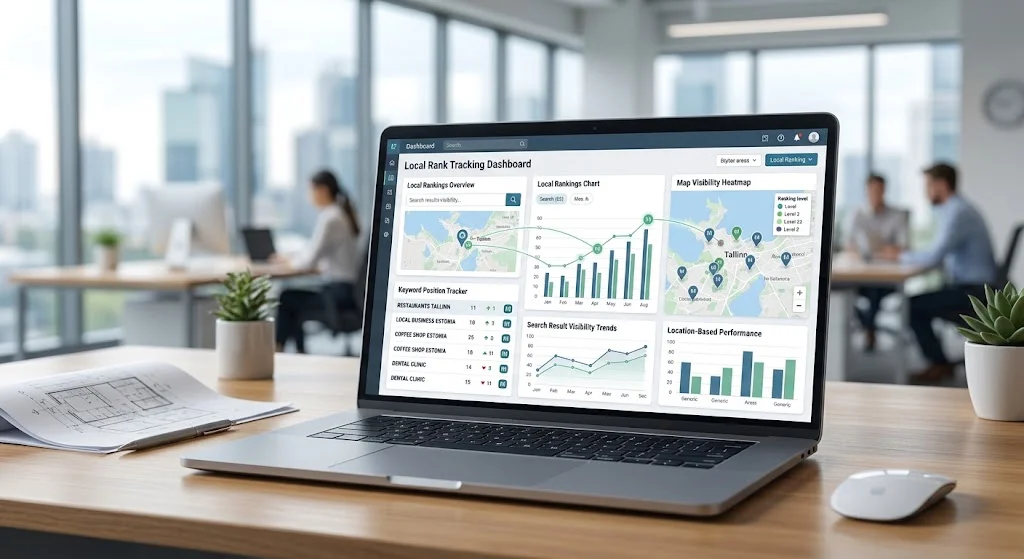
Local search rankings can vary significantly depending on where a search is performed. A business may appear prominently for a service-related query in one part of a city but much lower in another. That makes traditional, one-location rank checking less useful for businesses that depend on local visibility.
Local rank tracking software helps solve this problem by monitoring search positions within defined geographic areas. Depending on the platform, it can track local organic results, local pack visibility, keywords, competitors, historical ranking changes, and multiple locations.
The goal, however, should not be to collect ranking numbers simply because they are easy to measure. Ranking data becomes valuable when it helps a business understand where visibility is improving, where opportunities exist, and what should be investigated next.
This guide explains how local rank tracking works, which features matter, how geographic tracking can reveal differences within a market, and how to choose software according to your actual SEO requirements.
What Is Local Rank Tracking Software?
Local rank tracking software is a type of SEO technology designed to monitor how a website or business appears in search results for specific keywords and geographic locations.
Unlike a basic rank checker that may report one general position, a local ranking tracker can provide location-based data. Depending on the platform, users may configure cities, postal codes, neighborhoods, coordinates, or other geographic settings.
For businesses evaluating the wider category of local SEO tools, rank tracking is one of the most useful capabilities because it provides an ongoing view of local search visibility.
Common tracking capabilities include:
- Local organic rankings
- Local pack visibility
- Keyword positions
- Competitor rankings
- Location-specific results
- Historical ranking data
- Mobile and desktop tracking
- Geographic or grid-based tracking
- Ranking reports
The exact capabilities vary between providers, so businesses should evaluate the tracking methodology and limits rather than assuming every platform works in the same way.
Why Local Rank Tracking Is Different From Standard Rank Tracking
Standard rank tracking often focuses on a website’s position for a keyword in a particular search environment. Local SEO requires more geographic context.
For example, a dental practice could rank differently for “dentist” depending on whether the search is performed near the practice, several miles away, or in another neighborhood.
Local tracking can therefore involve:
| Tracking Context | What It Helps Measure |
|---|---|
| National | Broad search visibility |
| City | Visibility within a city |
| Neighborhood | More granular local visibility |
| Postal code | Ranking within a defined area |
| Coordinates | Search visibility from a specific point |
| Local pack | Visibility in local business results |
| Organic results | Traditional website rankings with local intent |
A single average ranking can hide these differences. A business might perform well close to its location while having weaker visibility farther away.
That is why local rank tracking should be interpreted as geographic performance data rather than a single universal position.
Why Businesses Need Local Rank Tracking
Local rank tracking can help businesses answer practical questions that are difficult to answer through occasional manual searches.
Measure Local Visibility
Businesses can monitor whether important services and products are becoming more visible in their target areas.
Identify Opportunities
Ranking data can highlight keywords where a business is close to stronger visibility but may still have room for improvement.
Monitor Changes
Historical data makes it easier to distinguish a sustained trend from a temporary ranking fluctuation.
Compare Markets
Businesses with multiple locations can compare performance between cities, neighborhoods, or branches.
Monitor Competitors
Tracking competitors can show whether changes in local visibility are occurring across the market or primarily affecting one business.
Support SEO Decisions
Rankings should help guide investigation and prioritization rather than become a vanity metric.
A ranking improvement is useful, but it becomes more meaningful when it is accompanied by increased visibility, qualified traffic, leads, calls, or other relevant business outcomes.
How Local Rank Tracking Software Works
Most local rank tracking systems follow a relatively simple process:
Keyword Selection → Location Configuration → Search Collection → Ranking Data → Historical Comparison → Analysis
Select Target Keywords
Start with keywords that reflect real customer searches.
Useful categories can include:
- Core services
- Products
- Service + location searches
- Commercial queries
- High-value local searches
- Important branded searches
- Relevant long-tail searches
For example, a local plumbing company might track service-related searches such as “emergency plumber” or “boiler repair” alongside relevant location-specific queries.
The objective is not to track every possible keyword. A smaller set of commercially meaningful terms can often provide more useful information than hundreds of irrelevant queries.
Define Locations
Location configuration is one of the most important parts of local tracking.
Depending on the software, locations may be defined using:
- City
- Postal or ZIP code
- Neighborhood
- Coordinates
- Search radius
- Specific geographic points
Available options vary by provider, so check how precisely the platform can reproduce the search environment you actually care about.
Collect Search Results
The software checks search results according to the configured keywords, locations, devices, and other settings.
The resulting data can then be stored for future comparison.
Store Historical Data
Historical rankings help answer questions such as:
- Did visibility improve after a website change?
- When did rankings begin declining?
- Which locations are improving?
- Are competitors gaining visibility?
- Is a change temporary or persistent?
Analyze Ranking Changes
The most useful analysis looks for meaningful patterns rather than reacting to every daily movement.
For example, a ranking moving from position 7 to 9 for one day may not justify a strategic response. A sustained decline across several important keywords and locations deserves closer investigation.
Local Pack Rank Tracking
The local pack is the group of local business results that can appear prominently for searches with local intent.
For businesses that depend on local customers, local pack visibility can be highly relevant because it provides a different form of search exposure from traditional organic listings.
Local pack tracking can help monitor:
- Visibility for local searches
- Position changes
- Competitor presence
- Differences between geographic areas
- Changes in the businesses appearing for a query
Local results can vary according to search context, so tracking should always be interpreted within the geographic configuration used by the software.
Local Organic Rank Tracking
Local organic rankings refer to website pages appearing in traditional search results for queries with local intent.
These may include:
- Location pages
- Service pages
- Product pages
- Local landing pages
- Other pages relevant to a geographic search
A business can have strong local pack visibility but weaker organic visibility, or the reverse.
For that reason, businesses should monitor both types of visibility when both contribute meaningfully to their customer acquisition strategy.
Important Features of Local Rank Tracking Software
Not every business needs every feature. The right combination depends on location count, keyword volume, competition, reporting requirements, and SEO goals.
Location-Level Tracking
The platform should allow rankings to be associated with meaningful geographic locations.
This is especially important for businesses serving specific cities, neighborhoods, service areas, or multiple branches.
Keyword Tracking
Useful keyword tracking should allow businesses to organize terms by:
- Service
- Product
- Location
- Search intent
- Keyword group
- Priority
Good organization makes ranking data easier to interpret.
Local Pack Monitoring
If local pack visibility is important to the business, verify that the software provides relevant local result tracking and clearly explains how those results are measured.
Competitor Tracking
Competitor tracking can help identify:
- Which businesses appear for important searches
- Where competitors outperform the business
- Which keywords have competitive gaps
- Whether market-level visibility is changing
Historical Ranking Data
Historical information is more valuable than isolated snapshots because it allows users to identify trends and connect changes with SEO activity.
Mobile and Desktop Tracking
Search visibility may differ across devices. If mobile search is important to the target audience, businesses should check whether the platform supports device-specific tracking.
Geographic Grid Tracking
Some platforms provide grid-based tracking, where rankings are measured at multiple points across a defined geographic area.
This can provide a more detailed picture than tracking from one central location.
Alerts and Notifications
Alerts can help users identify significant ranking changes without manually reviewing every keyword every day.
However, alerts should trigger investigation rather than automatic assumptions about what caused a change.
Reporting
Ranking information becomes more useful when it can be converted into understandable reports showing:
- Ranking trends
- Important keyword movements
- Location differences
- Competitor changes
- Visibility patterns
- Historical performance
Businesses that want to evaluate local SEO tools more broadly can use a local SEO software overview to understand how rank tracking fits into the wider local optimization workflow.

Geographic Grid Rank Tracking Explained
Geographic grid rank tracking measures local search visibility from multiple points within a target market.
Imagine a city represented by a grid. Instead of checking rankings from only one central point, the software checks the target keyword from several points across the area.
This can reveal patterns such as:
- Strong visibility near a business
- Weaker visibility farther away
- Different competitor strengths across neighborhoods
- Areas where local visibility appears limited
The result is a more detailed geographic picture.
Grid tracking does not guarantee better rankings. Its value is diagnostic: it can help businesses understand where visibility differs and provide information that can support further SEO analysis.
How to Choose Keywords for Local Rank Tracking
Keyword selection should be driven by business value rather than the desire to create a large tracking list.
Prioritize:
- Core services
- Important products
- Service + location searches
- High-intent commercial queries
- Important branded searches where appropriate
- Relevant long-tail local searches
Consider grouping keywords according to search intent.
For example:
Service group:
emergency plumber, boiler repair, drain cleaning
Location group:
plumber in [city], plumber near [area]
Commercial group:
best plumber, affordable plumber, emergency plumbing service
Tracking meaningful groups makes it easier to identify patterns and connect ranking changes with specific SEO work.
Businesses comparing different platforms can also review top tools for local rank tracking to evaluate options for monitoring local search visibility.
Businesses expanding their keyword lists can use local keyword research tools to discover relevant local queries, service terms, and location-based searches before adding them to a tracking campaign.
Local Rank Tracking for Multiple Locations
Businesses with several branches should avoid treating all locations as one ranking campaign.
Each location may have different:
- Target keywords
- Competitors
- Search behavior
- Ranking patterns
- Market opportunities
- Historical trends
A useful structure can include separate keyword groups and dashboards for each location, followed by regional comparisons.
For businesses managing a larger network, location-level organization becomes especially important because aggregated ranking data can hide differences between branches.
Local Rank Tracking for SEO Agencies
Agencies typically need more than simple keyword-position monitoring. They may manage multiple clients, locations, keyword sets, competitors, reporting schedules, and user accounts.
Important agency requirements can include:
- Multiple campaigns
- Client-specific keywords
- Multiple locations
- Historical data
- Competitor tracking
- Scheduled reports
- Dashboards
- User access
- Data organization
Agencies evaluating SEO platforms should consider how rank tracking fits into the complete reporting and workflow system.
The goal is to reduce repetitive data handling while keeping enough flexibility for different client strategies.
How to Interpret Local Ranking Changes
A ranking change does not automatically mean an SEO campaign succeeded or failed.
Possible reasons for movement include:
- Changes in search results
- Increased competition
- Algorithm changes
- Website changes
- Content updates
- Technical issues
- Changes to business information
- Search location
- Device differences
- Competitor activity
For example, if rankings decline for one keyword in one location but remain stable elsewhere, the issue may require a different investigation from a broad decline across dozens of keywords and locations.
Look for patterns across:
Keywords + Locations + Time + Competitors + Business Outcomes
This approach provides much more context than reacting to a single position number.
Local Rank Tracking vs Manual Rank Checking
| Factor | Manual Checking | Rank Tracking Software |
|---|---|---|
| Repeatability | Limited | High |
| Location tracking | Basic | More structured |
| Historical data | Difficult to maintain | Usually organized automatically |
| Competitor tracking | Manual | Can be integrated |
| Keyword volume | Time-consuming | Scalable within plan limits |
| Geographic grids | Usually impractical | Available on some platforms |
| Reporting | Manual | Automated or semi-automated |
| Automation | Limited | Stronger |
| Analysis | Human-led | Data-assisted |
Manual checking can still be useful for validating individual search results or investigating specific situations.
Software becomes more valuable when tracking needs become repetitive, geographic, or large-scale.
How Often Should Local Rankings Be Tracked?
There is no single tracking frequency that is appropriate for every business.
The right frequency depends on:
- Business size
- Competition
- Number of locations
- SEO activity
- Keyword importance
- Reporting requirements
- How quickly decisions need to be made
A business in a highly competitive market with frequent SEO changes may require more frequent monitoring than a small business with a stable campaign.
Consistency is generally more useful than constantly checking rankings.
The important thing is to use comparable tracking settings and review data over meaningful periods.
Common Local Rank Tracking Mistakes
Tracking Too Many Irrelevant Keywords
Large keyword lists can create noise and make important movements harder to identify.
Tracking Only One Location
A single location can give an incomplete picture of local visibility.
Ignoring Local Pack Results
For businesses dependent on local discovery, monitoring only organic rankings may leave out an important part of search visibility.
Ignoring Competitors
Your ranking position becomes more meaningful when you understand who else is competing for the same searches.
Mixing Locations
Combining several branches into one dataset can hide location-specific problems.
Comparing Inconsistent Dates
Changes should be compared using consistent tracking settings and meaningful time periods.
Focusing on One Ranking Position
A single position does not explain the complete visibility picture.
Ignoring Search Intent
A ranking for an irrelevant query may have little business value.
Treating Rankings as the Only Success Metric
Rankings should be considered alongside traffic, leads, calls, conversions, and other meaningful outcomes where available.
Reacting to Temporary Fluctuations
Short-term movement should not automatically trigger major SEO changes.
How to Use Local Rank Tracking Data for SEO Decisions
A practical process is:
1. Identify meaningful ranking changes.
Focus on important keywords rather than every movement.
2. Segment results by location.
Find markets where visibility differs.
3. Compare competitors.
Determine whether the change is isolated or market-wide.
4. Identify opportunity keywords.
Look for valuable terms where rankings could potentially be improved.
5. Investigate major declines.
Review relevant pages, technical factors, competitors, and business information.
6. Review relevant landing pages.
Make sure the page ranking for the query is appropriate and useful.
7. Check local business information where appropriate.
Inaccurate or outdated business information can create local SEO problems that deserve investigation.
8. Compare rankings with traffic and conversions.
Search performance should ultimately connect with business outcomes.
9. Prioritize actions by business value.
Not every ranking movement deserves the same response.
10. Monitor after making changes.
Use historical tracking to evaluate whether visibility changes persist.
How to Choose Local Rank Tracking Software
Before purchasing a platform, evaluate the following areas.
Check Location Accuracy
Confirm whether the software supports the geographic locations relevant to your customers.
Review Keyword Limits
Check how many keywords can be tracked and whether limits differ by location, campaign, or subscription level.
Check Local Pack Tracking
If local pack visibility matters to your strategy, verify that the platform supports the type of local result you need to monitor.
Evaluate Geographic Tracking
Check whether the software supports cities, postal codes, coordinates, or geographic grids where required.
Review Competitor Tracking
Determine how many competitors can be monitored and how competitor data is presented.
Check Historical Data
Find out how far historical ranking information extends and what data is retained.
Evaluate Reporting
Look for reports that make ranking trends easy to understand rather than simply exporting large amounts of raw data.
Check Device Tracking
If mobile visibility is important, confirm whether mobile and desktop tracking are available.
Review Integrations
Consider whether the platform works with the analytics, reporting, business listing, or other systems already used by your team.
Assess Ease of Use
A sophisticated platform is not useful if the team cannot efficiently configure and interpret it.
Calculate Total Cost
Do not evaluate the subscription price alone. Consider:
- Keyword limits
- Location limits
- Additional users
- Additional campaigns
- Reporting features
- Historical data
- Add-ons
- Integrations
- Data exports
Always verify current pricing, limits, and features directly with the provider before purchasing.
What Metrics Should You Track Alongside Rankings?
Rankings are useful, but they should be interpreted with other relevant performance signals.
| Metric | What It Adds |
|---|---|
| Organic traffic | Shows visits from search |
| Search impressions | Indicates how often pages appear in search |
| Search clicks | Shows visits generated from search results |
| Conversions | Connects SEO activity with business outcomes |
| Local visibility | Provides broader visibility context |
| Listing activity | Helps monitor local business presence |
| Calls or leads | Useful when properly tracked |
| Competitor visibility | Adds market context |
For example, Google Search Console can provide search-performance information such as queries, impressions, clicks, and position. Businesses can review search performance measurement resources for additional information on using search data in an SEO workflow.
search performance measurement resources
These metrics should complement local rank tracking rather than replace it.
For broader guidance on how Google evaluates and documents search visibility, businesses can also consult Google’s documentation for search visibility.
Google’s documentation for search visibility
Frequently Asked Questions
What is local rank tracking software?
It is software that monitors search rankings for specific keywords and geographic locations. Depending on the platform, it can track organic rankings, local pack visibility, competitors, historical trends, and multiple locations.
How does local rank tracking work?
The software checks configured keywords from defined geographic locations and records the resulting search visibility. The data can then be compared over time.
Why do local rankings vary by location?
Local search results can differ according to geographic context. A business may therefore have stronger visibility close to its location than in another part of the same city.
Can local rank tracking software monitor Google Maps results?
Some platforms provide local pack or map-related rank tracking. Capabilities vary, so verify exactly what the provider measures and how its local results are reported.
What is geographic grid rank tracking?
It is a method of measuring local rankings from multiple geographic points within an area instead of relying on one central search location.
How many local keywords should a business track?
There is no universal number. Focus on commercially meaningful services, products, locations, and search intents instead of tracking large numbers of irrelevant keywords.
Can agencies use local rank tracking software?
Yes. Agencies can use it to organize rankings across clients, locations, keywords, competitors, and reporting campaigns, provided the platform supports their required scale.
How do you track rankings for multiple locations?
Create location-specific keyword groups and configure each location separately. Then compare rankings by branch, city, region, or market.
How often should local rankings be checked?
The appropriate frequency depends on competition, SEO activity, location count, keyword importance, and reporting needs. Consistent measurement is more important than checking rankings constantly.
Do local rank tracking tools guarantee better rankings?
No. Tracking software measures search visibility; it does not guarantee ranking improvements. Better rankings depend on the overall SEO strategy and many other factors.
Final Thoughts
Local search visibility cannot always be understood through one ranking number.
A business may perform strongly in one neighborhood and less strongly elsewhere. It may appear in the local pack for some searches while relying on organic results for others. Competitors can also vary from one market to another.
That is why local rank tracking software is most useful when it adds geographic context to ranking data.
The most effective approach is to:
- Track meaningful keywords
- Use accurate locations
- Monitor both local and organic visibility where relevant
- Compare competitors
- Maintain historical data
- Segment multi-location performance
- Connect rankings with traffic and conversions
- Investigate significant changes before taking action
Good rank tracking software should make local search visibility easier to measure, compare, understand, and act on.
The objective is not to collect more ranking data. The objective is to turn useful ranking data into better SEO decisions and better business outcomes.