
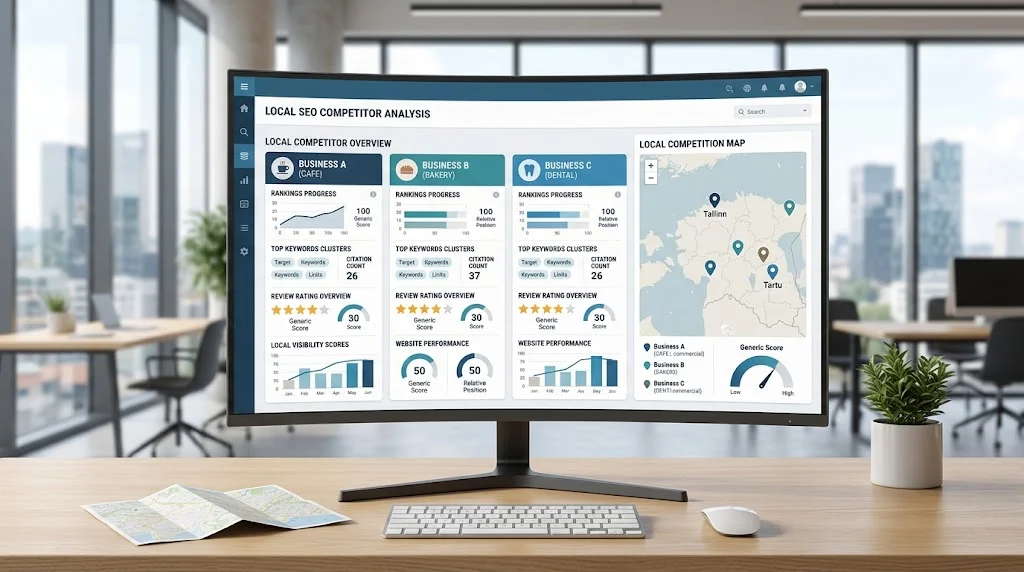
Local SEO competition is not limited to businesses that offer the same products or services. A company may compete with nearby businesses in Google Maps, websites in organic search results, directories, marketplaces, and publishers targeting local informational searches.
This is why competitor research is an important part of local SEO. Local SEO competitor analysis tools can help businesses, SEO professionals, freelancers, and agencies identify competitors, compare local rankings, discover keyword gaps, review competitor websites, and understand opportunities in the local search landscape.
However, competitor analysis should be used for research rather than imitation. A competitor’s ranking does not mean every tactic they use is effective or appropriate for another business. The goal is to understand what is happening in the market and use those insights to make better SEO decisions.
What Are Local SEO Competitor Analysis Tools?
Local SEO competitor analysis tools are software platforms designed to help businesses research competitors across geographically targeted search results.
Depending on the platform, local SEO competitor analysis software may provide information about:
- Local keyword rankings
- Google Maps and local pack visibility
- Competitor websites
- Search queries
- Business profile information
- Reviews
- Citations and listings
- Backlinks
- Local content
- Search visibility
- Keyword gaps
- Content gaps
The capabilities of these platforms vary. Some focus heavily on local rank tracking, while others combine competitor research with keyword research, citation monitoring, backlink analysis, review monitoring, or reporting.
These tools are most useful when they make research more efficient. They should not be treated as systems that reveal every ranking factor or guarantee better rankings.
Why Local Competitor Analysis Is Different
General SEO competitor research often focuses on websites competing across a broad market. Local SEO adds geography to the equation, which can significantly change the competitive landscape.
Local search results can vary based on:
- City
- Neighborhood
- Service area
- Search query
- User location
- Local business relevance
- Google Maps visibility
- Location-specific landing pages
- Reviews
- Business listings
For example, a business might compete against one set of companies for a city-level service search and a different group for a neighborhood-specific query.
Google Maps competitors can also differ from organic search competitors. A business may appear prominently in the local pack while another company’s website ranks well in traditional organic results.
For this reason, local search competitor analysis should consider several types of competitors rather than relying on a single search result.
Types of Local SEO Competitors
Direct Local Competitors
Direct competitors are businesses offering similar products or services within the same geographic market.
For example, several dental practices in the same city may compete for searches related to dental services.
Organic Search Competitors
Organic search competitors are websites ranking for relevant queries even when they are not direct business competitors.
These may include directories, publishers, marketplaces, informational websites, or businesses operating in related markets.
Local Pack Competitors
Local pack competitors are businesses appearing in local search results for commercially important queries.
Studying these businesses can help reveal which companies are consistently visible for specific local searches.
Content Competitors
Content competitors target informational searches related to local services, customer questions, industry topics, or geographic markets.
They may not compete for the same customers directly, but they can still compete for organic visibility.
Marketplace and Directory Competitors
Directories and marketplaces can occupy prominent positions for local searches.
Understanding their presence helps businesses determine whether a particular search is dominated by individual businesses, directories, marketplaces, or other types of websites.
These competitor categories should be analyzed separately because each provides different strategic information.
What Should You Analyze in a Local SEO Competitor?
A useful competitor analysis looks beyond rankings and examines several areas of local search performance.
| Competitor Area | What to Analyze | Why It Matters |
|---|---|---|
| Keywords | Service, location, commercial and long-tail searches | Helps identify relevant search opportunities |
| Local rankings | Local pack and organic visibility | Shows where competitors appear |
| Website | Structure, service pages and user experience | Reveals useful website patterns |
| Location pages | Relevance, depth and local information | Shows how competitors address locations |
| Business profile | Categories, information, services and reviews | Provides public local business signals |
| Reviews | Customer expectations and recurring themes | Reveals experience opportunities |
| Citations | Directories and business information | Helps identify listing gaps |
| Content | Guides, FAQs and service information | Reveals content opportunities |
| Backlinks | Referring domains and relevant sources | Provides authority context |
| Local visibility | Presence across important searches | Creates a broader competitive picture |
No individual metric provides a complete picture of a competitor. The strongest analysis combines several sources of information and then applies human judgment.
Local Keyword Competitor Analysis
Keyword research can reveal competitors that may not be obvious from traditional business research.
Start by examining searches related to:
- Core services
- Service + location searches
- Long-tail local queries
- Commercial local searches
- Informational local searches
- Customer problems and questions
For example, instead of analyzing only a broad service term, examine variations involving cities, neighborhoods, specific services, and customer needs.
A keyword gap occurs when a competitor has visibility for a relevant search that your website does not currently target or rank for. However, not every gap is worth pursuing.
Before creating a page or targeting a keyword, evaluate:
- Search intent
- Relevance to your business
- Potential business value
- Ability to provide genuinely useful information
- Existing competition
Businesses can use local keyword research software to discover and organize potential local search opportunities more efficiently.
Google Maps and Local Pack Competitor Analysis
Google Maps competitor analysis provides another important view of the local market.
When researching competitors, examine publicly available information such as:
- Business categories
- Business information
- Reviews
- Photos
- Services
- Website connections
- Local visibility
Geographic differences are particularly important. A business that appears prominently from one location may have different visibility from another location.
Competitor research should be used to understand the local search environment, not to manipulate business profiles or artificially influence reviews.
For businesses managing their own listings, Google search guidance for website owners can provide useful first-party information about Google’s search systems and website-related guidance.
Businesses should also ensure that their own public business information is accurate and maintained appropriately.
Competitor Website Analysis for Local SEO
Competitor websites can provide useful insights into how businesses present their services and locations online.
Compare areas such as:
- Site structure
- Service pages
- Location pages
- Page titles
- Headings
- Local content
- Internal links
- Calls to action
- Mobile experience
- Technical basics
The goal is not to reproduce another website.
Instead, look for patterns that help answer questions such as:
- What services are competitors clearly explaining?
- What information do customers appear to need?
- How are important services organized?
- Are location pages genuinely useful?
- Is the website easy to navigate?
- Where could your own website provide a better experience?
Competitor research becomes more valuable when it leads to original improvements rather than copied pages.
Local Landing Page Competitor Analysis
Location pages require careful evaluation because businesses can easily create unnecessary or repetitive pages.
When comparing competitor landing pages, look at:
- Location relevance
- Service coverage
- Unique local information
- Page depth
- Internal links
- Business information
- User experience
- Search intent
A competitor having a location page does not automatically mean your business needs an equivalent page.
Before creating a new location page, determine whether there is a genuine audience and whether the page can provide useful, location-specific information.
Avoid creating near-duplicate pages simply to target multiple geographic variations.
Competitor Google Business Profile Analysis
Public business profile information can provide useful competitive context.
Depending on what is publicly visible, businesses can compare:
- Business categories
- Business information
- Reviews
- Photos
- Services
- Website connections
- Local visibility
This research can reveal patterns among businesses appearing for similar searches.
However, observation does not establish causation. For example, if a highly visible competitor has a particular category or a certain number of reviews, that does not prove that the specific profile element caused its ranking.
Competitive data should therefore be treated as context rather than a definitive explanation of Google’s ranking decisions.
Competitor Review Analysis
Customer reviews can reveal information that traditional SEO tools may not provide.
Review research can help identify:
- Customer expectations
- Common complaints
- Frequently praised services
- Service gaps
- Experience issues
- Reputation patterns
For example, if customers repeatedly praise fast communication, that may indicate an important service expectation in the market.
Likewise, recurring complaints can highlight areas where a business could improve its own customer experience.
The objective should be to learn from customer expectations rather than manipulate reviews. Fake reviews and other forms of review manipulation should not be part of a local SEO strategy.
Local Citation and Listing Competitor Analysis
Local citations can help businesses understand how competitors are represented across directories and industry websites.
Compare:
- Directory presence
- Business information
- Listing consistency
- Industry-specific directories
- Local directories
- Duplicate listings
The objective is not to submit a business to every directory available.
Instead, focus on relevant platforms where accurate business information can provide genuine value to customers or support a well-maintained local presence.
Businesses that manage many listings may use local SEO audit tools to identify inconsistencies and other local SEO issues that deserve attention.
Competitor Content Gap Analysis
A content gap exists when competitors cover a relevant topic that your website does not address adequately.
Potential areas include:
- Service content
- Local guides
- FAQs
- Location information
- Informational topics
- Commercial pages
- Customer questions
However, a competitor covering a topic does not automatically make that topic suitable for your website.
Evaluate each opportunity based on:
- Audience relevance
- Search intent
- Business relevance
- Information quality
- Ability to provide original value
The objective should be to create genuinely useful resources rather than reproduce competitor pages.
Competitor Backlink and Authority Analysis
Competitor backlink analysis can help identify where competing websites receive references from.
Depending on the platform, research may include:
- Referring domains
- Local websites
- Industry publications
- Business directories
- Community websites
- Relevant partnerships
The number of backlinks should not be treated as the primary objective.
A smaller number of relevant, high-quality references can provide more useful competitive context than a large number of unrelated links.
Competitor backlink research can help identify legitimate relationships or promotional opportunities, but businesses should evaluate relevance and quality before pursuing any opportunity.
Local SEO Competitor Analysis for Small Businesses
Small businesses usually do not need to monitor dozens of competitors.
A practical workflow is:
- Identify 3–5 meaningful competitors.
- Choose important local searches.
- Compare local visibility.
- Review competitor websites.
- Analyze customer reviews.
- Identify keyword and content gaps.
- Find legitimate local opportunities.
- Prioritize improvements.
Start with businesses that actually compete for the same customers.
A website that ranks for a related keyword but operates in a different market may be a search competitor without being a meaningful business competitor.
Local SEO Competitor Analysis for Multiple Locations
Multi-location businesses face a more complex competitive environment because each market can have different competitors and search patterns.
Research may need to account for:
- Location-level competitors
- Different local markets
- Keyword differences
- Local pack differences
- Competitor differences
- Location landing pages
- Reviews
- Local listings
- Location-level reporting
A competitor that dominates one city may have little visibility in another.
This means businesses should avoid applying one competitive strategy to every location without examining the individual market.
Centralized workflows can help organize data across locations, but competitive decisions should still account for local differences.
Local SEO Competitor Analysis for Agencies
Agencies often require more scalable competitor research because they may manage multiple clients, locations, and markets.
Important workflow requirements may include:
- Multiple clients
- Multiple markets
- Competitor monitoring
- Scheduled research
- Reports
- Data exports
- Client comparisons
- Local market segmentation
The best workflow depends on the agency’s client base and reporting requirements. Competitive research should be organized so that meaningful findings can be compared over time without overwhelming clients with unnecessary data.
How to Perform a Local SEO Competitor Analysis
A repeatable process makes local competitor research easier to manage.
Step 1: Define the Target Market
Identify the city, neighborhood, region, or service area you want to analyze.
Step 2: Identify Relevant Competitors
Separate direct business competitors from search competitors such as directories and publishers.
Step 3: Select Important Search Queries
Focus on commercially meaningful local searches instead of collecting every possible keyword.
Step 4: Analyze Local Search Visibility
Review local pack and organic visibility for the searches that matter most.
Step 5: Compare Keywords
Identify keyword overlaps and relevant gaps.
Step 6: Review Competitor Websites
Analyze service pages, location pages, site structure, content, and user experience.
Step 7: Analyze Business Profiles and Listings
Review publicly available business information and listing patterns.
Step 8: Analyze Reviews
Look for recurring customer expectations, complaints, and positive experiences.
Step 9: Review Content and Authority Signals
Identify legitimate opportunities to improve your own website and local presence.
Step 10: Prioritize Findings
Rank opportunities based on relevance, effort, and potential business value.
How to Turn Competitor Research Into an SEO Action Plan
Competitive research becomes useful when findings are converted into decisions.
| Finding | Priority | Recommended Action |
|---|---|---|
| Missing high-value service page | High | Create a useful page |
| Weak location page | High | Improve local relevance |
| Keyword gap | Medium/High | Evaluate search intent |
| Listing inconsistency | High | Correct information |
| Content opportunity | Medium | Create a useful resource |
| Low-value competitor tactic | Low | Ignore |
This framework helps prevent competitive research from becoming a list of observations without implementation.
Competitors may rank despite weaknesses, so their tactics should never be treated as automatic recommendations.
Local SEO Competitor Analysis Tools vs Manual Research
Both tools and manual research have important roles.
| Factor | Manual Research | Competitor Analysis Tools |
|---|---|---|
| Competitor discovery | Useful for direct observation | Faster at scale |
| Keyword comparison | Time-consuming | Easier to organize |
| Ranking data | Limited and manual | More scalable |
| Website analysis | Strong qualitative context | Faster comparison |
| Backlink analysis | Difficult manually | More efficient |
| Review research | Detailed qualitative insight | Easier to monitor |
| Local market comparison | Time-intensive | Better for repeated analysis |
| Scalability | Limited | Stronger |
| Human interpretation | Essential | Still required |
Tools improve efficiency, but human judgment provides context.
A tool may show that two competitors rank for the same keyword, but it cannot automatically determine whether that keyword is valuable for your business.

How to Choose Local SEO Competitor Analysis Tools
When evaluating local SEO competitor analysis tools, focus on the capabilities that match your actual workflow.
The right tool depends on your business size, location count, reporting needs, and the type of competitor research you want to perform. Before choosing a platform, compare its local ranking capabilities, keyword research features, competitor insights, citation data, review monitoring, and reporting options.
If you are comparing broader local SEO platforms before choosing a competitor analysis solution, review our local SEO software selection guide for a wider look at the features and use cases to consider.
Local SERP Data
Check whether the platform provides useful geographic search data and supports the locations you need.
Competitor Discovery
Look for practical methods for identifying relevant local and organic search competitors.
Keyword Gap Analysis
Determine whether the platform can compare competitor keyword visibility and identify potential gaps.
Local Rank Tracking
Check how local rankings are collected and whether the system supports your target locations.
Website Analysis
Review whether the software provides useful information about competitor websites, pages, and structures.
Backlink Data
If authority research matters to your workflow, evaluate the quality and scope of backlink information.
Review Monitoring
Review monitoring may be valuable when reputation and customer feedback are important parts of the competitive landscape.
Citation Data
Citation features can help businesses compare listing coverage and identify inconsistencies.
Multi-Location Support
Businesses with several locations should verify whether competitor information can be organized at the location level.
Reporting
Agencies may need scheduled reports, client segmentation, and exportable data.
Data Export
Check whether competitor data can be exported for custom analysis and reporting.
Pricing and Limits
Always verify current pricing, feature limits, location coverage, data availability, and export restrictions directly with providers. Software features and pricing can change.
Common Local SEO Competitor Analysis Mistakes
Competitor research becomes less useful when businesses focus too heavily on copying what competitors do.
Common mistakes include:
- Copying competitors
- Choosing irrelevant competitors
- Looking only at rankings
- Ignoring geographic differences
- Treating tool metrics as exact
- Focusing only on backlinks
- Ignoring customer reviews
- Ignoring local search intent
- Creating unnecessary location pages
- Copying competitor content
- Pursuing every keyword gap
- Treating competitors as the complete SEO strategy
- Failing to prioritize findings
Competitor analysis should support your SEO strategy rather than become the strategy itself.
How Often Should You Analyze Local SEO Competitors?
There is no universal schedule for every business.
The appropriate frequency depends on:
- Market competitiveness
- Business size
- Number of locations
- SEO activity
- Website changes
- Market changes
It is useful to distinguish between:
Ongoing monitoring: Tracking important competitor movements and meaningful local search changes.
Periodic competitive analysis: Reviewing the broader market to identify new opportunities.
Deep analysis after strategic changes: Conducting a more detailed review after significant website, service, market, or SEO changes.
The right frequency depends on how quickly the competitive landscape changes and how much competitive research the business can realistically act on.
Local SEO Competitor Analysis and Reporting
Competitive insights can become part of recurring local SEO reporting.
Useful reporting areas may include:
- Ranking changes
- Competitor movement
- Keyword visibility
- Local pack presence
- New competitor opportunities
- Content gaps
- Market changes
Avoid reporting every minor competitor movement. Instead, focus on changes that could affect business priorities or create meaningful opportunities.
Competitive reporting becomes more useful when every major finding is connected to a recommendation or decision.
Frequently Asked Questions
What are local SEO competitor analysis tools?
They are software platforms that help businesses analyze competitors across local rankings, keywords, websites, business profiles, reviews, citations, content, backlinks, and other local search signals.
How do I analyze local SEO competitors?
Define your target market, identify relevant competitors, select important searches, compare local visibility, review websites and business profiles, analyze reviews and listings, identify gaps, and prioritize actionable findings.
How do I find my local SEO competitors?
Search important service and location queries and identify businesses that repeatedly appear in relevant local and organic results. Separate direct competitors from directories, publishers, and other search competitors.
Can SEO tools analyze Google Maps competitors?
Some SEO platforms provide local search or Google Maps-related competitive data. Capabilities and methodologies vary, so verify exactly what each platform measures.
What should I compare between local competitors?
Compare keywords, local rankings, websites, location pages, business profile information, reviews, citations, content, backlinks, and overall local visibility.
Can competitor analysis reveal keyword opportunities?
Yes. Competitor research can reveal relevant searches where other businesses have visibility but your website does not. Each opportunity should still be evaluated for relevance and search intent.
Should I copy what my competitors are doing?
No. Competitor analysis should help you understand the market and identify opportunities to provide more useful information or a better customer experience.
How often should local competitors be analyzed?
The frequency depends on market competitiveness, business size, number of locations, SEO activity, and changes in the market. Some businesses need ongoing monitoring, while others may benefit from periodic analysis.
Are local competitor analysis tools accurate?
Tools can provide useful datasets and estimates, but their metrics should not be treated as exact representations of Google’s ranking systems. Coverage and methodology vary by provider.
What is the best way to use competitor data?
Use competitor data to understand the market, validate assumptions, identify meaningful gaps, and prioritize improvements. Your final SEO strategy should still be based on customer needs, business goals, resources, and search intent.
Final Thoughts
Local SEO competition can change significantly depending on the search query, location, service, and type of search result.
Local SEO competitor analysis tools make competitive research more efficient by helping businesses organize information about keywords, local rankings, competitors, websites, reviews, listings, content, and other search signals.
But software should support decision-making rather than replace it.
The strongest approach combines competitive data with manual research, business knowledge, customer feedback, and careful evaluation of search intent. Instead of copying competitors, identify areas where your business can provide more useful information, stronger local relevance, and a better customer experience.
The goal of local SEO competitor analysis is not to copy the businesses that rank today. It is to understand the local search landscape, identify meaningful gaps, and make better decisions about where your own business can provide more value.