
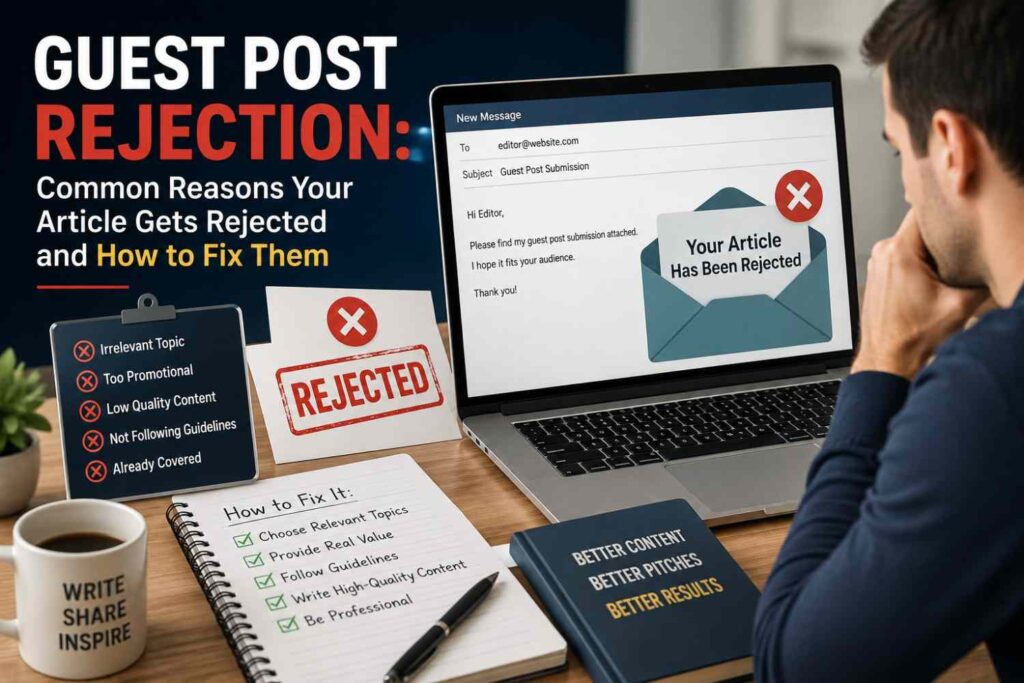
Introduction
A guest post rejection can be disappointing, particularly when you have spent time researching a topic, writing the article, editing it, and preparing your submission. However, rejection does not automatically mean that your writing is poor or that the article has no value.
Publishers make editorial decisions for many reasons. A topic may not fit the publication’s audience, the pitch may be too generic, the article may be overly promotional, or the submission may not follow the site’s requirements. Sometimes an editor simply does not need that subject at the moment.
Understanding why guest posts get rejected makes it easier to improve your next submission.
The goal should not be to find a formula that guarantees publication. Instead, focus on producing original, useful content for a relevant audience, following editorial requirements, and communicating professionally.
That approach also aligns with Google’s current Search Essentials, which emphasize helpful, reliable, people-first content and identify spam policies that can affect search visibility.
What Does Guest Post Rejection Mean?
Guest post rejection means a publisher has decided not to accept your proposed contribution at that point in the submission process.
There are several forms of rejection:
- Pitch rejection: The editor declines your proposed topic before you write the article.
- Article rejection: You submit a completed article and the publication decides not to publish it.
- Revision request: The editor sees potential but asks you to make changes.
- No response: You hear nothing, which is different from receiving an explicit rejection.
A rejected guest post does not necessarily mean the article is bad.
For example, an excellent article about technical SEO may be rejected by a website whose readers are primarily interested in social media marketing. The article may be well researched but simply unsuitable for that audience.
Different publications also have different editorial voices, content standards, submission rules, and publishing schedules. The same article can therefore be appropriate for one website and unsuitable for another.
15 Common Reasons Guest Posts Get Rejected
1. The Topic Is Not Relevant
Relevance is one of the most important considerations when proposing a guest article.
Publishers build their websites around particular audiences and subject areas. If your topic does not naturally fit what readers expect from the publication, an editor may reject it regardless of how well written it is.
Example
Imagine a website focused on small-business accounting receives this pitch:
“10 Instagram Reels Ideas for Travel Influencers”
The article could be useful, but it does not solve a problem for the publication’s core audience.
A better proposal would connect directly with the site’s subject matter, such as:
“How Small Businesses Can Track the ROI of Social Media Campaigns”
How to fix it
Before submitting, ask:
- Who reads this publication?
- What problems are those readers trying to solve?
- What topics does the website regularly cover?
- Does my article naturally belong alongside its existing content?
A strong topic should feel like a useful addition to the publication rather than an unrelated article looking for somewhere to be published.
2. The Topic Has Already Been Covered
An editor may reject a topic because the publication already has several articles covering essentially the same subject.
That does not mean the subject itself is worthless. The problem may be that your proposal does not add enough new value.
Instead of abandoning the subject, look for a more specific angle.
Generic idea
How to Improve Your SEO
More specific idea
How to Audit Internal Links Before Publishing a New Service Page
The second topic addresses a narrower problem and gives the editor a clearer reason to consider it.
Before pitching, search the publication for related articles. Look at what has already been covered and ask:
“What can my article explain that the existing content does not?”
A fresh angle can be more valuable than simply rewriting a familiar topic.
3. The Article Is Too Promotional
One of the most common guest post mistakes is turning an educational article into an advertisement.
Publishers may reject content that repeatedly promotes:
- A company
- A product
- A service
- A specific landing page
- A commercial offer
- The author’s business
There is a difference between mentioning a relevant resource and writing an article primarily to promote that resource.
How to fix it
Review every promotional statement and ask:
“Would this paragraph still be useful if my company or product were removed?”
If the answer is no, consider rewriting it.
Use explanations, examples, processes, comparisons, and practical advice instead of sales language.
The article should provide value before asking the reader to do anything commercially useful for you.
4. The Content Is Too Thin
Short content is not automatically bad. A concise article can be extremely useful when it completely answers a focused question.
The problem occurs when an article is short because it has little substance.
Thin content often consists of broad statements such as:
- Create quality content.
- Know your audience.
- Improve your SEO.
- Build relationships.
- Promote your article.
Those statements may be true, but they do not tell the reader how to act.
Google’s current guidance does not recommend writing to an arbitrary word count. Instead, it emphasizes original, substantial, useful information and a satisfying experience for readers.
How to fix it
Strengthen the article with:
- Specific examples
- Clear processes
- Relevant explanations
- Original analysis
- Useful comparisons
- Practical steps
- Carefully verified information
Do not make an article longer simply to hit a word-count target.
5. Poor Writing Quality
An editor is usually looking for content that can be published without extensive rewriting.
Problems that can hurt a submission include:
- Grammar mistakes
- Spelling errors
- Awkward wording
- Repetitive sentences
- Poor transitions
- Excessive jargon
- Unclear explanations
- Very long paragraphs
- Weak structure
Even useful research can be difficult to publish if the writing requires substantial editorial work.
How to fix it
After completing the first draft, perform a separate editing pass.
Look for sentences that can be simplified. Remove unnecessary words. Break up long paragraphs. Check whether headings accurately describe the content beneath them.
Reading the article aloud is also useful because awkward sentences are often easier to notice when spoken.
6. The Article Is Not Original
Publishers generally expect contributors to submit original work.
Submitting an article that has already been published elsewhere can create editorial and duplication problems. Similarly, taking another article and changing a few words is not a meaningful way to create original content.
Google explains that when pages contain substantially similar content, its systems may group them and select a representative canonical version.
How to fix it
Create the contribution specifically for its intended publication.
Use your own:
- Structure
- Examples
- Analysis
- Explanations
- Wording
If you have previously written about the same subject, develop a genuinely different article rather than submitting the same piece to another website.
Do not send identical content to multiple publications simply because the first one rejected it.
7. The Submission Guidelines Were Ignored
A publisher may provide detailed requirements covering:
- Word count
- Topics
- Formatting
- Images
- Links
- Author information
- File format
- Submission method
- Contributor requirements
Ignoring those instructions can make an otherwise good submission look careless.
Before submitting, read the submission requirements and compare your article with the publisher’s requirements.
How to fix it
Create a pre-submission checklist.
Confirm:
- The topic is allowed.
- The requested format is being used.
- The word count is appropriate.
- The links comply with the rules.
- Images meet the requirements.
- The author information is complete.
- The article was submitted through the requested method.
Following instructions shows that you respect the editor’s time.
8. The Pitch Is Too Generic
A generic pitch gives an editor little reason to continue the conversation.
Weak example
Hi, I want to write a guest post for your website. I can provide a high-quality article about SEO. Please let me know if you are interested.
This pitch does not identify a specific article, audience problem, or reason the topic belongs on the publication.
Improved example
Hi Sarah,
I noticed your publication regularly covers practical SEO strategies for small businesses. I’d like to contribute an article titled “How to Audit Internal Links Before Publishing a New Service Page.” The article would show readers how to identify poorly connected pages, review contextual anchor text, and prioritize useful internal links.
Thanks,
Alex
The second pitch is more specific and gives the editor enough information to evaluate the idea.
If you are preparing new outreach, start your outreach with a publication-specific approach instead of relying on the same message for every website.

9. The Pitch Does Not Explain Reader Value
A publisher needs to understand what its readers will gain from the proposed article.
A pitch focused entirely on the writer can therefore be weak.
For example:
“I have experience in digital marketing and would love to write for your website.”
That statement says something about the writer but little about the audience.
A stronger pitch explains the reader outcome:
“The article will give small-business owners a practical process for identifying pages that receive little internal-link support and deciding which contextual links to add first.”
The second version makes the benefit much clearer.
When preparing your next proposal, refine your pitch so the topic, audience, and reader benefit are immediately understandable.
10. Too Many Links or Unnatural Links
Links can be useful when they provide additional information or help readers explore a relevant resource. Problems arise when links become the main reason the article exists.
Potential warning signs include:
- Too many links
- Irrelevant links
- Keyword-stuffed anchor text
- Repeated commercial URLs
- Promotional links that add little value
- Links inserted into sentences where they do not belong
A useful editorial test is:
“Would this link still make sense if there were no SEO benefit?”
If not, reconsider whether it belongs in the article.
Use natural anchor text and link only when the destination genuinely helps the reader.
For broader search guidance, see Google’s recommendations for webmasters, now presented by Google as its Search Essentials. The guidance covers technical requirements, spam policies, and key best practices.
11. The Article Does Not Match the Publication’s Style
Every publication develops its own editorial style.
One website may prefer short, conversational articles. Another may expect detailed technical explanations. Some publications use first-person writing, while others prefer a formal editorial voice.
A technically advanced article may therefore be unsuitable for a beginner-focused publication even when its information is correct.
How to fix it
Study several recent articles before writing.
Pay attention to:
- Headline style
- Paragraph length
- Tone
- Heading structure
- Technical depth
- Examples
- Tables
- Images
- Author bios
- Citation practices
The goal is not to copy the publication. It is to understand what a natural contribution looks like there.
12. Weak Research or Unsupported Claims
A publisher may reject an article that contains questionable statistics, inaccurate claims, outdated information, or unsupported conclusions.
Be especially careful with:
- Statistics
- Industry benchmarks
- Research findings
- Technical claims
- Search engine policies
- Legal information
- Financial claims
- Health-related information
Never invent a statistic simply because it makes an article appear more authoritative.
How to fix it
Verify important claims before submission.
Where possible, use reliable primary sources. If you cannot verify a statistic, remove it or qualify the statement instead of presenting an assumption as fact.
Good research should strengthen an article’s usefulness and credibility.
13. Poor Formatting
Editors need to review submissions efficiently, while readers need content that is easy to scan.
Poor formatting can include:
- Large blocks of text
- Missing headings
- Inconsistent headings
- Excessive bold formatting
- Poorly structured lists
- Unclear tables
- Inconsistent spacing
- Missing image information
How to fix it
Use a logical structure:
- One clear title
- Descriptive H2 headings
- H3 headings when necessary
- Short paragraphs
- Bulleted lists for grouped information
- Tables when they genuinely improve clarity
Also check how the article looks on a mobile screen. A submission that is easy to scan is easier for both editors and readers to work with.
14. The Article Uses Generic or Low-Value Content
An article can be grammatically correct and still offer very little.
For example:
“Create valuable content by understanding your audience and using SEO best practices.”
There is nothing obviously wrong with the sentence, but it does not give the reader much to act on.
A stronger explanation would identify a specific process, example, or decision the reader can use.
What about AI-assisted content?
AI assistance is not automatically a reason for rejection. What matters is the quality and usefulness of the finished contribution, as well as the publisher’s own policies.
If AI is used, the writer should still apply human judgment for:
- Research
- Accuracy
- Originality
- Editing
- Examples
- Fact-checking
- Audience relevance
Google’s guidance says generative AI can be useful in content creation, but producing large amounts of content without adding value can conflict with its spam policies.
The safest editorial approach is to judge the finished article by its value to readers rather than by the tool used to help produce it.
15. The Article Does Not Fit the Publisher’s Current Needs
Sometimes the article is good and the publication simply does not need it.
An editor may already have:
- A similar article scheduled
- A full editorial calendar
- A temporary pause on contributions
- Different audience priorities
- Limited publishing capacity
- A new editorial direction
This is why every guest article rejection should not be treated as a quality failure.
How to fix it
If the editor provides a reason, use that feedback.
If there is no clear criticism, consider whether another topic would be a better fit. If the publication is not interested in the subject, another relevant website may be a more appropriate destination.
Guest Post Pitch Rejected vs. Article Rejected
The appropriate response depends on what was rejected.
| Situation | Possible reason | What to do |
| Pitch rejected | Topic mismatch | Improve topic selection |
| Pitch ignored | Timing, inbox volume, or weak outreach | Follow up appropriately |
| Article rejected | Quality or guideline issue | Review and revise where possible |
| Article declined | Editorial fit | Try another relevant publication |
A pitch rejection usually means you should improve the idea or find a better editorial fit.
An article rejection may require a deeper review of the actual content.
Do not assume that one type of rejection automatically means the other.
How to Respond to a Guest Post Rejection
Professional communication matters even when the answer is no.
A simple response can be enough:
Hi [Name],
Thanks for letting me know. I appreciate you taking the time to review the idea.
If you’re open to it, I’d be happy to consider a different topic that better fits your editorial needs.
Best,
[Name]
Avoid arguing with the editor.
If they provide feedback, thank them and use it to improve future submissions.
A professional response can also leave the door open for a better opportunity later without putting pressure on the publisher.
Should You Follow Up After a Rejection?
A clear rejection and a lack of response are not the same thing.
If an editor explicitly declines your pitch, another immediate follow-up is usually unnecessary unless they invite another proposal.
If you have received no response, a brief and professional follow-up may be reasonable after an appropriate amount of time.
For an unanswered pitch, send a polite reminder rather than repeatedly asking whether the editor has made a decision.
Respect a clear “no.” Follow-up should be professional, not persistent to the point of becoming unwanted.
How to Improve a Rejected Guest Post
If an editor provides feedback, start with that feedback.
If no detailed explanation was provided, use this process.
1. Review the rejection
Look for any specific reason or editorial comment.
2. Identify the likely problem
Determine whether the issue may be relevance, topic selection, writing quality, research, links, formatting, or editorial fit.
3. Re-read the publication
Review recent content and compare its subjects and style with your article.
4. Review the submission requirements
Check that every requirement was followed.
5. Improve the topic
If the topic is too broad or repetitive, develop a narrower angle.
6. Edit the article
Remove repetition, weak sections, unnecessary introductions, and unclear explanations.
7. Reduce unnecessary promotion
Keep commercial references limited and relevant.
8. Review links
Remove irrelevant URLs and unnatural anchor text.
9. Strengthen examples
Replace vague advice with realistic scenarios and actionable explanations.
10. Proofread
Check grammar, spelling, headings, formatting, and consistency.
11. Decide whether to resubmit
Resubmit only when the publisher’s policies or feedback make that appropriate. Otherwise, consider another relevant publication.
How to Reduce Guest Post Rejections
Use this practical checklist before submitting:
- Choose a publication that genuinely matches the topic.
- Understand the publication’s audience.
- Search for existing coverage.
- Develop a specific angle.
- Write original content.
- Research important claims.
- Avoid unsupported statistics.
- Follow the publication’s submission requirements.
- Limit promotional language.
- Use links only when they help readers.
- Avoid unnatural or keyword-stuffed anchors.
- Match the publication’s general editorial style.
- Format the article clearly.
- Proofread carefully.
- Personalize the pitch.
- Explain the reader benefit.
- Communicate professionally.
This process cannot eliminate every rejection. Editors make decisions based on factors writers cannot always see.
The purpose of the checklist is to reduce avoidable guest post mistakes.
Guest Post Rejection Checklist
| Check | Question |
| Relevance | Does the topic fit the publication? |
| Originality | Is the article original? |
| Value | Does it solve a real reader problem? |
| Quality | Is it properly edited? |
| Links | Are all links genuinely useful? |
| Promotion | Is promotional content limited? |
| Guidelines | Did I follow every requirement? |
| Formatting | Is the article easy to read? |
| Pitch | Is the proposal specific and personalized? |
If several answers are “no,” fix those issues before submitting.
If every answer is “yes,” the submission is better prepared, but acceptance is still a publisher’s editorial decision.
When Should You Submit to Another Website?
Moving on can be the right decision after a guest post rejection.
Consider another publication when:
- The audience is clearly different.
- The editor says the topic is unsuitable.
- The publication has stopped accepting contributions.
- Your subject fits another publication better.
- The site’s editorial style conflicts with your article.
- The editor has clearly declined future submissions.
Do not respond to rejection by sending the exact same article to dozens of unrelated websites.
Instead, adapt your contribution to the publication and its audience. The objective is to create a useful editorial contribution, not simply to find somewhere to place an article.
Frequently Asked Questions
Why do guest posts get rejected?
Common reasons include topic mismatch, repetitive subjects, weak writing, insufficient research, excessive promotion, poor formatting, irrelevant links, failure to follow guidelines, and lack of editorial fit. Sometimes a good article is rejected because the publication simply does not need that topic.
What is the most common reason for guest post rejection?
There is no universal single reason because every publisher has different standards. Topic relevance, weak pitches, guideline violations, low-value content, and excessive promotion are common issues worth checking.
What should I do if my guest post is rejected?
Review the rejection and any feedback, identify the likely issue, check the publication’s requirements, improve the article or pitch where appropriate, and decide whether resubmission makes sense.
Should I ask why my guest post was rejected?
You can politely ask if the publisher has not provided a reason and appears open to feedback. Keep the request brief and respectful. Do not demand an explanation.
Can I resubmit a rejected guest post?
Sometimes. If the publisher invites revisions or welcomes another version, you can make the requested changes and resubmit. If the editor clearly declines the topic or asks you not to resubmit, respect that decision.
How do I improve a rejected guest post?
Start with the rejection reason. Then review relevance, originality, research, writing quality, structure, formatting, promotional content, links, and reader value. Fix the actual weakness instead of simply increasing the word count.
Why are guest post pitches rejected?
A pitch may be rejected because it is generic, irrelevant, repetitive, overly promotional, poorly researched, or unclear about the value it provides to readers.
Should I follow up after a guest post rejection?
If you received a clear rejection, another immediate follow-up is generally unnecessary. If you received no response, a brief and appropriately timed follow-up may be reasonable.
Can poor formatting cause guest post rejection?
Yes. Poor formatting can make an article difficult to review and may indicate that the writer did not follow the publication’s requirements. Clear headings, readable paragraphs, lists, and consistent formatting make submissions easier to evaluate.
Can too many links cause a guest post to be rejected?
Yes. Excessive, irrelevant, promotional, or unnatural links can make an article look more like a marketing asset than an editorial contribution. Links should provide genuine value and comply with the publication’s rules.
Conclusion
A guest post rejection is not necessarily a judgment on your writing ability. An editor may decline an article because the topic does not fit, the publication already covered it, the pitch was unclear, the submission missed a requirement, or the editorial calendar simply did not have room.
The most productive response is to focus on what you can control.
Improve your relevance, topic selection, content quality, originality, research, pitch, formatting, link choices, and professional communication. Most importantly, create the article for the publication’s readers rather than treating it primarily as a promotional asset.
A strong guest contribution should solve a real reader problem, add something useful to the existing conversation, and respect the publication’s editorial standards.
Rejection may close one opportunity, but it can also reveal what needs improvement before your next submission.