
If you’re new to SEO or digital marketing, guest posting for beginners can seem complicated at first. You may have heard that guest blogging can help build backlinks, increase website visibility, attract referral traffic, and introduce your brand to a new audience. But knowing where to begin is often the hardest part.
Guest posting becomes much more effective when you stop thinking about it as simply “getting a backlink” and start treating it as a content marketing and relationship-building strategy.
In this guide, you’ll learn what guest posting is, how it works, how to find relevant websites, how to pitch editors, how to write a useful guest article, how to use links naturally, and which mistakes beginners should avoid.
What Is Guest Posting?
Guest posting is the process of writing an original article for publication on another website.
For example, suppose you have a website about SEO. You could write an educational article about keyword research for a digital marketing website. If the editor accepts your contribution, the article is published on their site and may contain a relevant link to a useful page on your website.
A successful guest post can help you:
- Reach a new audience
- Build brand awareness
- Generate referral traffic
- Establish industry relationships
- Demonstrate your expertise
- Earn relevant editorial links when appropriate
The important word is relevant.
Publishing an article on a random website simply because it offers a backlink is not a strong guest posting strategy. The website, topic, audience, and links should all make sense together.
How Does Guest Posting Work?
The process is relatively simple, but every step deserves attention.
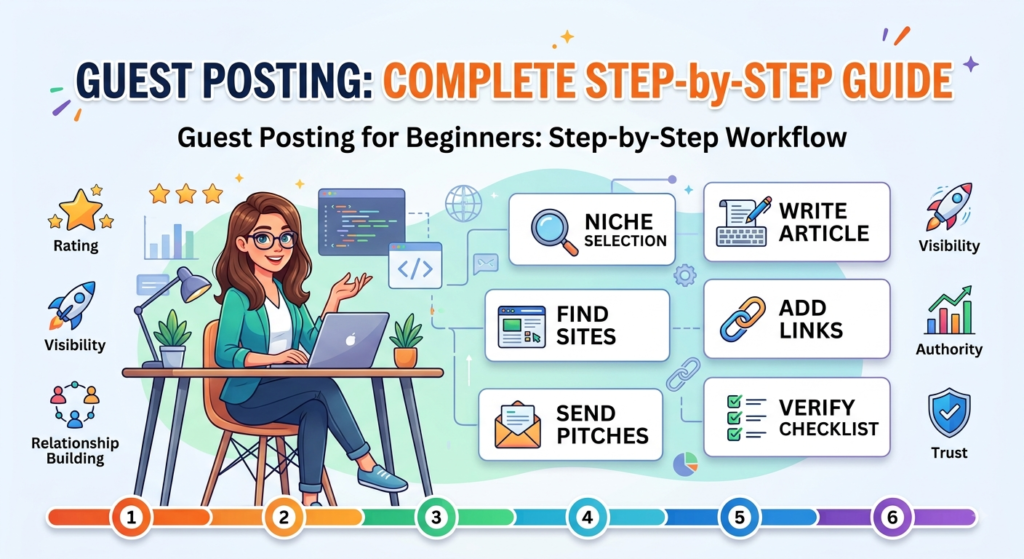
1. Choose Your Niche
Start by identifying the subject you know well.
For example:
- SEO
- Digital marketing
- Technology
- SaaS
- Business
- Finance
- Education
- Web development
- Entrepreneurship
Staying close to your expertise makes it easier to produce genuinely useful content.
2. Find Relevant Websites
Search for websites that already publish content related to your subject.
You can use searches such as:
- “write for us” + SEO
- “guest post” + digital marketing
- “contribute an article” + technology
- “guest author” + business
- “submit an article” + SaaS

Don’t limit your research to websites with a “Write for Us” page. Some relevant publications accept expert contributions without publicly advertising the opportunity.
You can also use a dedicated guest post outreach guide to understand how to approach potential publishers and organize your outreach process.
3. Research the Website
Before contacting a website, spend a few minutes understanding it.
Look at:
- Its main topic
- Target audience
- Recent articles
- Content quality
- Organic visibility
- Publishing frequency
- Existing external links
- Editorial standards
A website should be evaluated as a real publication—not simply as a backlink opportunity.
Why Is Guest Posting Useful for SEO?
Guest posting can support SEO when it is used naturally as part of a broader content strategy.
A useful article published on a relevant website can introduce your business to people who may never have discovered it otherwise. If the article earns a natural editorial link, that link can also help users discover relevant resources on your website.
However, backlinks should not be the only objective.
Google’s guidance emphasizes creating helpful, reliable, people-first content rather than content created primarily to manipulate search rankings. Google Search Central: Creating Helpful, Reliable, People-First Content
Google also provides guidance about qualifying links appropriately when necessary, particularly for links that may not represent a normal editorial recommendation. Google Search Central: Qualify Outbound Links
This is why a good guest post should provide value even if the reader never clicks a link.
How to Find High-Quality Guest Posting Websites
Not every website that accepts guest posts is worth pursuing.
Use the following criteria when building your prospect list.
Topical Relevance
The website should be related to your industry or have an audience that would reasonably benefit from your article.
For example, an SEO article could fit:
- Marketing websites
- Business publications
- Technology blogs
- Startup websites
- Entrepreneurship publications
A completely unrelated website is usually a poor fit.
Content Quality
Read several articles before submitting a pitch.
Ask yourself:
- Are the articles original?
- Are they well written?
- Do they provide useful information?
- Are they edited properly?
- Do they appear to be created for readers?
If a website is filled with thin, repetitive, automatically generated, or heavily promotional content, consider looking elsewhere.
Real Audience
Look beyond SEO metrics.
Metrics such as Domain Rating or Domain Authority can help with prospecting, but they don’t tell the entire story.
A website with a real audience, relevant traffic, quality content, and strong topical alignment may be more valuable than a site with impressive third-party metrics but little genuine engagement.
How to Choose the Right Guest Post Topic
Choosing the right topic can make the difference between acceptance and rejection.
Start by studying the target website.
Look for:
- Questions its readers frequently ask
- Topics that have not been covered recently
- Existing articles that could be expanded
- New developments in the industry
- Beginner questions
- Practical problems that readers need to solve
For example, if a marketing website already has several basic SEO articles, don’t submit another generic article titled “What Is SEO?”
Instead, provide something more specific:
“Guest Posting for Beginners: How to Find Websites, Pitch Editors, and Publish Your First Article”
Specific topics often provide more practical value because they solve a clearly defined problem.
How to Write a High-Quality Guest Post
Once your topic is approved, focus on making the article genuinely useful.
Write for the Reader First
Don’t start by thinking about where you can place your backlinks.
Start with the reader’s question.
What problem are they trying to solve?
What information do they need?
What practical steps can you give them?
This approach naturally produces better content.
Use a Clear Structure
Break your article into logical sections using H2 and H3 headings.
For example:
- What is guest posting?
- Why guest posting matters
- How to find opportunities
- How to choose websites
- How to pitch editors
- How to write the article
- Common mistakes
- Final checklist
A clear structure makes long articles easier to scan.
Give Practical Examples
Don’t only explain concepts.
Show readers what to do.
For example, when discussing outreach, explain what a good pitch should contain rather than simply saying “contact the website owner.”
Avoid Fluff
Long content isn’t automatically better content.
Google states that there is no preferred word count that guarantees ranking. The goal should be to provide enough useful information to satisfy the reader’s needs.
How to Add Links Naturally
Links should be added when they genuinely help the reader.
For example, someone researching guest posting may need additional resources about finding opportunities, outreach, or content placement.
A useful internal resource such as GetGuestPosts can give readers a place to explore guest posting-related resources beyond this article.
The key is not to force links into every paragraph.
Use Natural Anchor Text
Avoid repeatedly using exact-match commercial keywords such as:
best guest posting service
Instead, use natural anchors such as:
- guest post outreach guide
- guest posting resources
- learn more about guest posting
- this guide
- relevant resource
The anchor should accurately describe what the reader will find after clicking.
How to Pitch a Guest Post
Your outreach message should be concise and personalized.
A basic pitch should include:
A short introduction: Explain who you are.
A relevant topic: Suggest one or two specific article ideas.
The value: Explain why the topic would benefit the website’s readers.
A simple question: Ask whether the editor would be interested.
Avoid sending a generic message to hundreds of websites without researching them.
Instead of:
“Hi, I want to submit a guest post. Please tell me your price.”
try to demonstrate that you understand the publication.
For example:
“I noticed your website regularly covers practical SEO strategies. I have an original beginner-friendly article idea covering the complete process of finding and pitching guest post opportunities.”
That immediately sounds more relevant and professional.
A strong first message can make it easier for a publisher to understand your idea and decide whether it fits their audience. If you need help structuring your initial message, these practical outreach emails provide useful examples that you can adapt to different guest posting situations.
Guest Posting Mistakes Beginners Should Avoid
1. Choosing Websites Only for Backlinks
A backlink should not be your only reason for selecting a website.
Consider relevance, content quality, audience, and overall website credibility.
2. Overusing Exact-Match Anchor Text
Using the same keyword repeatedly can make links look unnatural.
Keep anchor text varied and contextually appropriate.
3. Publishing Duplicate Articles
Don’t submit the exact same article to multiple websites.
Create original content and adapt each contribution to the publication’s audience.
4. Writing Promotional Content
A guest article should educate rather than read like an advertisement.
You can mention your brand where appropriate, but the majority of the article should provide useful information.
5. Ignoring Editorial Guidelines
If the publisher specifies:
- Word count
- Number of links
- Image requirements
- Formatting
- Author bio
- Topic restrictions
follow those requirements carefully.
6. Focusing Too Much on SEO Metrics
DR, DA, traffic estimates, and other metrics can be useful for research, but they shouldn’t replace manual website evaluation.
Always inspect the actual website.
Is Guest Posting Still Worth It for Beginners?
Yes—but the strategy matters.
Guest posting can be valuable when it helps you reach a relevant audience, demonstrate expertise, build relationships, and provide useful information.
It becomes much less valuable when the entire process is reduced to producing articles solely to place backlinks.
Google has warned against large-scale guest-post campaigns where the primary purpose is obtaining links, especially when the content contains excessive keyword-rich links or provides little value to users.
The distinction is simple:
Quality guest posting: Create useful content for a relevant audience.
Low-quality guest posting: Create articles mainly to manipulate link signals.
The first approach is much more sustainable.
A Simple Guest Posting Strategy for Beginners
If you’re starting from zero, follow this workflow:
Step 1: Select Your Topic
Choose an industry where you have knowledge and experience.
Step 2: Build a Prospect List
Find 30–50 websites that publish content related to your niche.
Step 3: Qualify the Websites
Remove websites that are irrelevant, low quality, suspicious, or clearly created only for link placement.
Step 4: Research Each Website
Read recent articles and identify content gaps.
Step 5: Create Personalized Pitches
Suggest topics that match the publication’s audience.
Step 6: Write Original Content
Once accepted, create an article specifically for that website.
Step 7: Add Relevant References
Include internal and external links only where they improve the article.
Step 8: Follow Editorial Requirements
Check formatting, word count, images, links, and other requirements before submission.
Step 9: Track Results
Keep a spreadsheet containing:
- Website name
- Article topic
- Publication date
- Published URL
- Target page
- Anchor text
- Referral traffic
- Ranking changes
Step 10: Build Relationships
Don’t disappear after your article is published.
If an editor likes your work, future contributions may become easier.

Guest Posting Checklist
Before submitting your article, ask:
- Is the website relevant to my niche?
- Does it have a genuine audience?
- Is the topic useful to its readers?
- Is my article original?
- Does it provide practical information?
- Are the headings clear?
- Are the links relevant?
- Are the anchor texts natural?
- Did I follow the publisher’s guidelines?
- Would the article still be useful without the backlink?
If the answer is yes, you’re much closer to a quality guest post.
Final Thoughts
Guest posting for beginners doesn’t have to be complicated.
The strongest approach is to find relevant publications, understand their audience, create genuinely useful content, and build relationships with editors.
Don’t judge your campaign only by the number of links you acquire. Look at the quality of the publication, relevance of the audience, referral traffic, brand exposure, and overall value of the content.
Don’t write an article simply because you want Google to rank a backlink.
Write an article that deserves to be published.
When guest posting is approached as genuine content marketing rather than a shortcut for manipulating rankings, it becomes a much stronger part of a sustainable SEO strategy.
If you’re ready to start, focus on one niche, build a small list of relevant websites, research each publication carefully, and create content that genuinely helps its readers. Quality and relevance will always be more valuable than simply chasing a larger number of guest post links.