


Imagine an SEO agency that wants to share practical advice with a wider business audience. Instead of publishing another article only on its own website, the agency contributes a useful guide to a relevant marketing publication. The publication reviews the article, publishes it for its readers, and the article may contain a relevant contextual link to additional information from the agency.
That is a simple guest posting example.
Guest posting becomes much easier to understand when you see how the people, website, topic, content, links, and audience fit together. The examples in this guide are hypothetical and are designed to show what a useful guest post can look like in different situations.
We will cover examples involving SEO agencies, small businesses, contextual links, outreach, topic selection, publishing workflows, turnaround time, and common mistakes.
What Is Guest Posting?
Guest posting is the practice of contributing an original article to another website where the content is appropriate for that publication’s audience and editorial standards.
The contributor brings useful knowledge or perspective, while the host publication provides access to its existing audience.
For a broader explanation of the concept, see our SEO guest posting explained guide.
A good guest post should make sense even if you remove the backlink from the equation. The article should have a reason to exist for the host publication’s readers.
Simple Guest Posting Example
Let’s start with a straightforward hypothetical scenario.
The Writer
An SEO agency has experience helping small businesses improve their online visibility.
The Host Website
A marketing publication regularly publishes practical articles for entrepreneurs, marketers, and small-business owners.
The Topic
The agency proposes an article called:
“How to Build a Search-Friendly Content Plan for a Small Business”
The Audience
The host publication’s readers are business owners and marketing professionals who need practical content advice.
The Article
The agency writes an original article explaining how to identify customer questions, organize topics, create useful content, and evaluate performance.
The article is educational rather than a sales pitch.
The Contextual Link
Within a section explaining how businesses can organize their SEO strategy, the article may reference a relevant resource from the agency.
The link supports the explanation rather than interrupting it.
The Reader Benefit
A reader receives useful information from the article and can explore the linked resource if they want additional information.
That is a healthy way to think about guest posting: the article comes first, and the link supports the reader’s journey.
Guest Posting Example for an SEO Agency
Consider another hypothetical scenario.
An SEO agency specializes in local search for service businesses. It wants to reach business owners who are actively learning about local marketing.
Instead of pitching a generic article such as:
“Why Our SEO Agency Is the Best”
the agency researches a relevant marketing publication and notices that its readers frequently ask about local content planning.
The agency proposes:
“A Practical Local Content Calendar for Service Businesses”
The article could explain:
- How to identify local customer questions
- How to organize location-specific topics
- How to avoid repetitive pages
- How to build useful supporting content
- How to measure engagement
The agency may include a contextual reference to one of its own resources if that resource genuinely helps explain a point.
The important distinction is that the agency is contributing expertise, not simply placing promotional text on another domain.
This also aligns better with Google’s broader emphasis on useful content and its warnings against content and links created primarily to manipulate search rankings.
Guest Posting Example for a Small Business
Guest posting is not limited to SEO agencies.
Imagine a small home-improvement company that specializes in energy-efficient renovations.
The company discovers a home-design publication whose audience includes homeowners planning renovation projects.
Instead of submitting an advertisement, the business owner proposes:
“7 Questions to Ask Before Choosing Energy-Efficient Windows”
The article could explain:
- Window performance considerations
- Installation questions
- Maintenance requirements
- Budget considerations
- Common planning mistakes
The business may be introduced as the contributor, but the article remains focused on helping homeowners make better decisions.
This example shows why audience relevance matters. A home-improvement publication makes much more sense for this article than an unrelated technology or cryptocurrency website.
Guest Posting Example With a Contextual Link
A contextual link is a link placed within relevant surrounding content where it can help the reader.
Good Example
Suppose a guest article discusses content planning for small businesses.
The article says:
Businesses can organize related topics into clusters so readers can move from broad information to more specific resources. A detailed guide to content clustering can help explain how those relationships work.
The linked resource is relevant to the sentence and provides additional information.
Poor Example
Now imagine the same article suddenly contains:
For the best SEO services, visit our SEO services page.
The sentence does not naturally support the surrounding topic. It feels promotional and may provide little value to the reader.
The difference is not simply the presence of a link. It is context, relevance, usefulness, and intent.
Google’s guidance on guest-post links and link spam specifically identifies paid articles or guest posts containing links intended to pass ranking credit, including optimized anchor text in distributed guest posts, as examples of link spam.
Guest Posting Outreach Example
Outreach should be personalized rather than sent as a generic mass message.
Here is a short hypothetical example:
Subject: Article idea for your small-business marketing audience
Hi [Editor Name],
I recently read your articles about small-business marketing and noticed your publication covers practical content strategies for growing businesses.
I have an original article idea: “How Small Businesses Can Build a Content Calendar Around Customer Questions.”
It would cover topic research, content organization, search intent, and practical planning without turning the article into a promotional piece.
If the topic fits your editorial calendar, I’d be happy to prepare an original draft for consideration.
Best,
[Name]
Why Does This Example Work?
It works because the message:
- Identifies the publication’s audience
- Proposes a specific topic
- Explains what readers will learn
- Avoids exaggerated claims
- Does not demand publication
- Keeps the message concise
A poor outreach email would send the same generic pitch to hundreds of unrelated websites.
Guest Post Topic Example
Choosing the right topic is often more important than simply finding a website that accepts contributions.
Suppose a marketing publication’s audience consists primarily of small-business owners.
A contributor has expertise in SEO.
Possible topics might include:
Weak idea:
“Why SEO Is Important”
Stronger idea:
“How to Turn Customer Questions Into a Small-Business Content Calendar”
The second idea is more specific and practical.
A strong guest-post topic should generally consider five things:
1. Host Audience
Who reads the publication?
2. Content Gap
What useful topic has not been adequately covered?
3. Contributor Expertise
What can the writer explain from genuine experience or knowledge?
4. Search Intent
What information is the intended reader actually looking for?
5. Usefulness
Will the finished article help the reader accomplish something?
The best topic usually sits where audience need, publisher relevance, and contributor expertise overlap.
Good vs Poor Guest Posting Examples
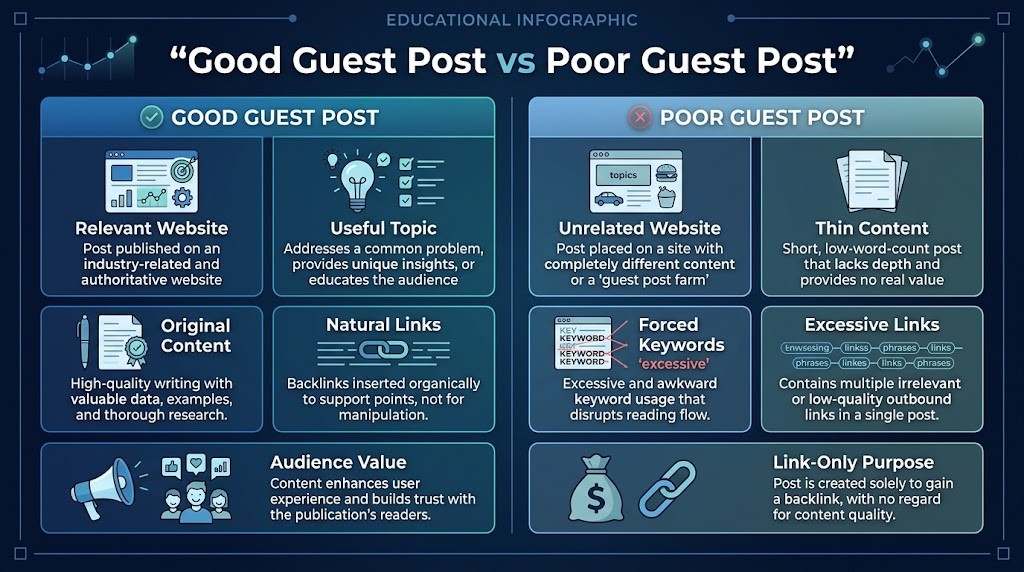
| Good Guest Post | Poor Guest Post |
|---|---|
| Published on a relevant website | Published on an unrelated website |
| Addresses a real audience need | Exists mainly for a link |
| Provides original information | Thin or recycled content |
| Uses links where they help readers | Forces multiple promotional links |
| Uses natural language | Overuses commercial keywords |
| Fits the publication’s editorial style | Ignores editorial requirements |
| Gives readers a useful takeaway | Provides little independent value |
The strongest difference is the reason the article was created.
A good guest post is created to provide useful editorial content to another audience. A poor guest post is often created primarily to obtain links or exploit another site’s visibility.
Google’s current site reputation guidance also distinguishes legitimate editorial third-party content from third-party content placed mainly to exploit a host site’s established ranking signals.
Example of the Complete Guest Posting Workflow
A guest post usually involves more than writing an article.
A hypothetical campaign might follow this sequence:
Research → Prospect → Qualify → Pitch → Topic Approval → Writing → Review → Publication → Measurement
Research
The contributor identifies relevant publications and studies their existing content.
Prospect
Potential websites are collected based on subject relevance and audience fit.
Qualify
The contributor evaluates content quality, editorial standards, audience relevance, publishing activity, and overall suitability.
Pitch
A personalized article idea is sent to the publication.
Topic Approval
The publisher accepts the proposed subject or suggests an alternative.
Writing
The contributor creates an original article according to the publication’s requirements.
Review
The editor reviews the submission and may request revisions.
Publication
The approved article is published.
Measurement
The contributor can monitor useful outcomes such as referral traffic, engagement, audience discovery, brand exposure, and relationships.
For a detailed breakdown of these stages, see our complete guest posting workflow guide.
Example of Guest Post TAT
Turnaround time can also be part of a guest posting campaign.
Imagine a hypothetical publication that tells a contributor that its stated TAT covers editorial processing after submission.
The process could look like:
Submission → Editorial Review → Revision Request → Final Approval → Scheduling → Publication
In this situation, the quoted TAT may not necessarily mean that the article will be live at the end of the stated period.
Another publisher could define TAT as the period from submission through publication.
This is why contributors should ask what a publisher’s turnaround time actually includes.
For a detailed explanation, see our guest post turnaround explained article.
Common Mistakes Shown Through Examples
Keyword Stuffing
Poor example:
Our SEO company provides SEO services for SEO companies looking for SEO services and SEO strategies.
The phrase is repetitive and unnatural.
Better approach:
Explain the topic naturally and use terminology only where it genuinely helps the reader.
Irrelevant Links
A gardening article suddenly linking to an unrelated cryptocurrency service provides little contextual value.
A relevant link to a gardening resource, planting guide, or supporting research would make more sense.
Generic Outreach
Poor example:
Hello, I want to submit a guest post. Please tell me your price and publish my article.
This gives the editor no reason to believe the proposed content fits the publication.
A stronger pitch demonstrates that the contributor understands the publication and has a useful topic idea.
Poor-Quality Publication
A website may technically accept guest posts but still be a poor fit if its content is unrelated, low quality, heavily promotional, or inconsistent.
Acceptance alone does not make a publication valuable.
Over-Optimized Anchor Text
Suppose an article about small-business marketing repeatedly uses exact commercial phrases as links.
That can make the article feel unnatural and overly focused on ranking signals.
Anchor text should make sense in the sentence and accurately describe the destination.
Thin Article
An article containing several headings but little useful information is unlikely to provide a satisfying reader experience.
A guest post should contain enough substance to justify its publication.
Guest Posting for Beginners
For someone completely new to guest posting, the best starting point is to understand the basic relationship between writer, publisher, audience, topic, content, and editorial process.
Do not begin by collecting hundreds of websites simply because they accept guest posts.
Start with a smaller group of relevant publications. Study what they publish, identify genuine content opportunities, and prepare useful article ideas.
Our guest posting for beginners resource can provide a starting point without repeating the examples in this article.
How to Recognize a Strong Guest Posting Example
Before considering a guest post successful, ask these questions:
Is the Website Relevant?
Would the host publication’s audience reasonably care about the subject?
Is the Topic Useful?
Does the article answer a real question or solve a genuine problem?
Is the Content Original?
Does it provide original explanations, examples, experience, analysis, or useful synthesis?
Are Links Natural?
Do links support the surrounding discussion rather than interrupt it?
Does the Article Stand Alone?
Would readers still find the article useful if they ignored every link?
Does It Fit the Publication?
Does the writing style, structure, length, and subject match the publication?
Is the Purpose Primarily Editorial?
The strongest guest-post examples are created to contribute useful content to another audience—not simply to place a backlink.
This distinction is especially important because Google treats link manipulation and low-value content created primarily to influence ranking signals as spam.
Frequently Asked Questions
What is a guest posting example?
A guest posting example is a hypothetical or real scenario showing how a writer contributes an original article to another relevant website. For example, an SEO professional might write a practical content-planning article for a marketing publication.
What does a good guest post look like?
A good guest post is relevant to the host audience, provides useful original information, follows editorial requirements, and uses links naturally where they help readers.
What is an example of a guest post backlink?
Imagine an article about small-business content planning that naturally references a detailed resource about content clustering. If that resource belongs to the contributor and the link genuinely helps readers understand the subject, it can serve as an example of a contextual guest-post link.
How do I create a guest post?
Start by identifying a relevant publication, studying its audience and existing content, proposing a useful topic, writing an original article that meets its editorial requirements, and responding to any requested revisions before publication.
What makes a guest post valuable?
Its value comes from relevance, usefulness, originality, editorial quality, audience fit, and the information it provides—not simply from whether it contains a backlink.
Can a guest post be useful without a backlink?
Yes. A guest post can build awareness, demonstrate expertise, introduce a contributor to a new audience, generate referral traffic, and develop publisher relationships even when a backlink is not the primary outcome.
What is the difference between guest posting and ordinary blogging?
Ordinary blogging generally means publishing on your own website or platform. Guest posting means contributing content to another publication or website, subject to that publisher’s editorial requirements.
Conclusion
The easiest way to understand guest posting is to look at the relationship between the writer, host publication, topic, audience, article, and reader benefit.
A strong example might be an SEO agency contributing a practical marketing article to a relevant publication. Another might involve a small business sharing specialist advice with a publication whose readers need that information. In both cases, the article should provide genuine value before considering the link.
The best guest posts are not simply articles placed on other websites. They are useful editorial contributions designed for a specific audience.
If removing the backlink would make the article pointless, that is a sign that the content strategy may need reconsideration. If the article remains useful because it teaches, explains, or helps the reader solve a problem, it has a much stronger foundation.
That reader-first approach makes guest posting easier to understand—and gives every example a clear purpose beyond simply acquiring a link.