

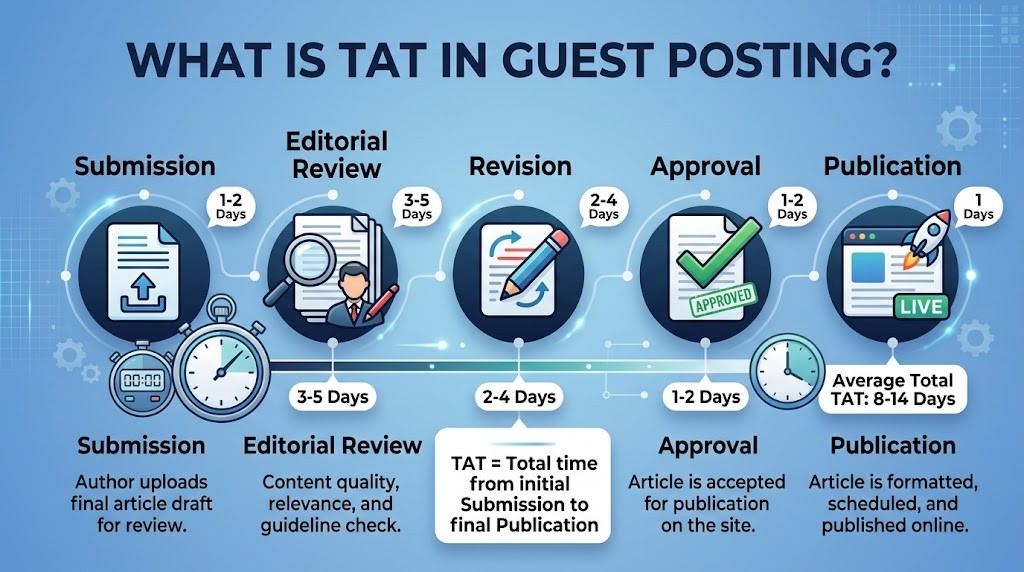
TAT in guest posting means Turnaround Time—the period required to move a guest post through a defined stage of the publishing process. Depending on the publisher, agency, or service provider, that period may cover editorial review, revisions, approval, scheduling, or publication.
Understanding TAT matters because a guest posting campaign rarely involves only writing an article and sending it away. There may be several steps between submission and the article going live. If those steps are not clearly defined, a stated “TAT” can create unrealistic expectations.
For clients, publishers, agencies, and outreach professionals, knowing what TAT actually covers makes campaign planning much easier. This guide explains what TAT means in guest posting, which stages it can include, what can affect it, how it differs from the actual publication date, and what questions to ask before starting a campaign.
What Does TAT Mean?
TAT stands for Turnaround Time.
In general, turnaround time is the amount of time required to complete a particular process or request. The starting point and finishing point depend on the service being provided.
For example, a business might describe the TAT for a support request as the time between submitting the request and receiving a resolution. A publication might use TAT to describe the time between receiving an article and completing its editorial process.
The important point is that TAT is not a universal measurement with one fixed definition.
Whenever someone gives you a TAT, ask what event starts the clock and what event marks the end.
What Does TAT Mean in Guest Posting?
In guest posting, TAT generally refers to the time required to process a guest article from one defined stage to another.
However, the exact meaning can vary.
One publisher may use TAT to mean:
Article submission → Editorial review
Another may define it as:
Article submission → Approval
A guest posting service could instead use TAT for:
Order confirmation → Publication
Because these definitions are different, two providers could quote the same number of days while offering very different timelines.
This is why asking “What does your TAT include?” is more useful than asking only for a number.
A clear TAT should identify both the starting event and the expected completion point.
What Can Guest Post TAT Include?
Depending on the arrangement, guest post turnaround time can involve several stages.
1. Submission
The process may begin when the completed article is submitted to the publisher or service provider.
If the article does not meet the submission requirements, however, the effective processing period may not begin until the required information or corrections are provided.
2. Editorial Review
The publisher may review the article for relevance, originality, accuracy, structure, tone, formatting, and compliance with its editorial requirements.
The length and complexity of this review can vary significantly between publications.
3. Revisions
A publisher may request changes before accepting the article.
For example, the editor might ask for:
- A clearer introduction
- Additional supporting information
- Removal of promotional language
- Better formatting
- More relevant examples
- Changes to links or references
If revisions are required, the timeline can change because another review cycle may be necessary.
4. Approval
After editorial review and any requested revisions, the article may receive final approval.
Approval does not necessarily mean that the article is already live.
5. Scheduling
Some publications schedule approved content according to their editorial calendar. An article may therefore be approved but remain unpublished until a suitable publishing slot becomes available.
6. Publication
In some arrangements, TAT may continue through the point at which the article is actually published.
This is why the phrase “TAT” should always be clarified before a campaign begins.
Why Does TAT Matter in Guest Posting?
TAT is important because guest posting is often part of a larger content or outreach campaign.
Campaign Planning
If several guest articles are being prepared, unclear timelines can make it difficult to coordinate submissions.
Knowing the expected processing period helps you organize the campaign in stages rather than treating every publication as having the same schedule.
Content Calendars
Businesses may plan announcements, campaigns, product launches, or supporting content around expected publication dates.
A realistic understanding of TAT helps prevent content calendars from being built around assumptions.
Client Expectations
Agencies and service providers need to communicate timelines accurately.
Saying that an article has a particular TAT without explaining what that TAT covers can create confusion when the article is approved but not yet published.
Reporting
A campaign report may need to distinguish between:
- Submitted
- Under review
- Revision requested
- Approved
- Scheduled
- Published
This makes reporting more useful than simply saying an article is “in progress.”
Outreach Management
Outreach professionals may manage multiple publishers simultaneously. Understanding each publication’s process makes it easier to prioritize follow-ups and avoid unnecessary messages.
Launch Timing
If a guest article is connected to a specific campaign, timing can matter. However, a publication timeline should not be treated as guaranteed unless the publisher explicitly guarantees it.
What Factors Affect Guest Post TAT?
There is no single industry-wide guest post TAT that applies to every publisher. Timelines can vary based on the actual workflow.
Editorial Workload
A publication handling many submissions may take longer to review new content.
Content Quality
Well-prepared content that follows the publisher’s requirements may move more smoothly through review. Articles requiring substantial corrections can take longer.
Revisions
Every additional revision cycle can extend the overall process.
Topic Complexity
Some topics require more editorial attention, fact-checking, specialist review, or source verification than others.
Publication Schedule
An editor may approve an article but schedule it for a later date because the publication already has content planned.
Publisher Requirements
Some publications have detailed contributor guidelines, formatting requirements, image specifications, author requirements, or editorial review processes.
Weekends and Holidays
If a publisher’s editorial team works on a limited schedule during weekends or holidays, processing can take longer.
Communication Speed
Delays can also occur when questions, revisions, approvals, or requested materials are not answered promptly.
For this reason, a TAT should be viewed as a process expectation, not an automatic guarantee of a specific outcome.
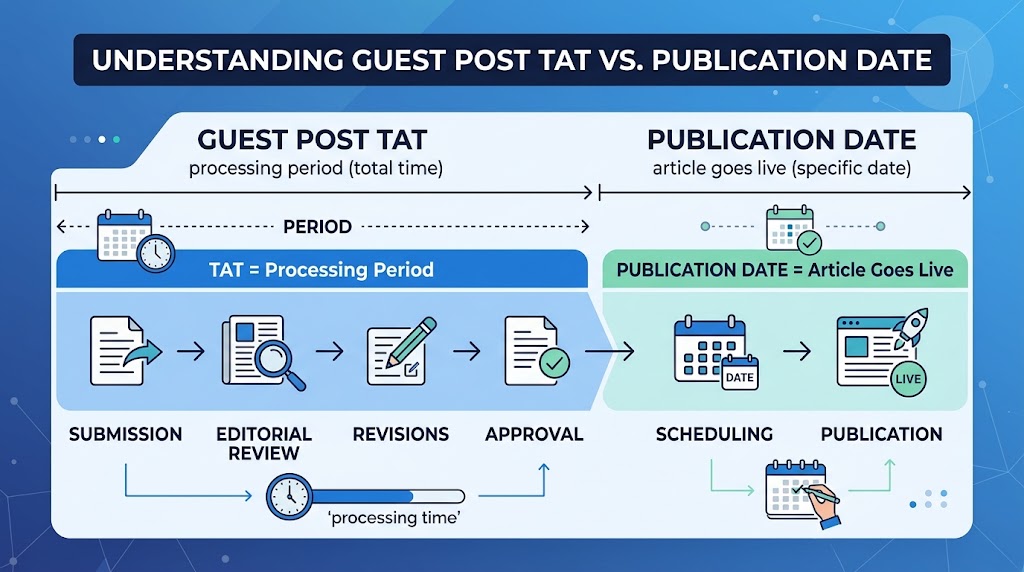
TAT vs Publication Date
TAT and publication date are related, but they are not necessarily the same thing.
TAT describes a period of processing.
Publication date identifies when the article actually becomes live.
For example, suppose a publisher says its review TAT begins after article submission. The editorial team may review the article, request revisions, and approve it within that processing period. The publication itself might then be scheduled for another date.
A simple workflow could look like this:
Submission → Review → Revision → Approval → Scheduling → Publication
Therefore, asking only “What is the TAT?” may not give you enough information.
Ask:
“Does your stated TAT end at approval, scheduling, or live publication?”
That single question can prevent many misunderstandings.
Example of Guest Post TAT
The following scenarios are hypothetical examples, not industry-standard timelines.
Scenario 1: Editorial Review
A marketing publication receives an article from a contributor.
Its process is:
Submission → Editorial Review → Revision Request → Final Review → Approval
In this example, the publisher’s TAT may refer only to the editorial review and approval process.
The actual publication could happen later.
Scenario 2: Publication Included
A guest posting service may define its TAT differently:
Order Confirmation → Content Submission → Publisher Processing → Publication
In this case, the stated turnaround period may extend through publication.
The key difference is not the number of days. It is what the provider promises to complete within that period.
How to Avoid Guest Posting Delays
You can reduce avoidable delays by preparing before submission.
Follow Publisher Guidelines
Check word count, formatting, topic restrictions, author requirements, image specifications, and linking rules before sending the article.
Submit Complete Content
Avoid sending an incomplete article and expecting the publisher to fill in missing sections.
Use Clear Sources
Where factual claims need support, provide appropriate references or source information.
Minimize Unnecessary Revisions
Proofread the article before submission. Check grammar, formatting, links, headings, images, and promotional language.
Respond Quickly
If an editor requests clarification or revisions, a prompt response can prevent unnecessary pauses.
Confirm the TAT Definition
Before starting, establish whether the quoted TAT covers review, approval, scheduling, publication, or another stage.
Avoid Assuming Every Publisher Works the Same Way
A process that works for one publication may not apply to another. Treat each publisher’s stated workflow as its own set of requirements.
Questions to Ask Before Starting a Guest Posting Campaign
Before agreeing to a guest posting timeline, ask:
- What does your TAT include?
- When does the TAT clock start?
- Does editorial review count within the stated TAT?
- Does revision time count?
- Is the publication date guaranteed or estimated?
- What happens if the editor requests revisions?
- Are weekends and holidays included?
- Does approval mean the article is live?
- Is scheduling handled separately from approval?
- When will I receive confirmation that the article has been published?
These questions turn a vague timeline into a much clearer process.
How Guest Posting Fits Into SEO
TAT is a process and planning concept, not an SEO ranking factor by itself.
The broader value of guest posting depends on factors such as audience relevance, editorial quality, useful content, relationships, brand exposure, and legitimate referral opportunities.
If you want to understand the broader role of guest posting in search marketing, explore our guide to guest posting and SEO fundamentals.
It is also important to avoid treating guest posting simply as a method for manipulating rankings. Google’s current spam policies identify practices such as paid articles or guest posts containing links intended to pass ranking credit, particularly when optimized anchor text is involved, as examples of link spam.
Where links are commercial or sponsored, publishers should handle them according to the appropriate link qualification requirements rather than assuming every guest-post link should pass ranking credit.
How Does the Guest Post Workflow Work?
TAT becomes easier to understand when you know the complete process behind a guest article.
A typical workflow may involve:
Goal setting → Website research → Website evaluation → Topic selection → Outreach → Writing → Submission → Editorial review → Revisions → Approval → Publication → Measurement
Each publisher may remove, combine, or add steps.
For a detailed explanation of that process, see our guest post workflow guide.
Understanding the workflow also helps you identify exactly where a delay has occurred instead of assuming that every delay means the publisher has rejected the article.
Guest Posting Example
Sometimes the easiest way to understand TAT is to see how it fits into a realistic publishing situation.
Imagine a software company submitting a practical marketing article to an industry publication. The article is submitted, reviewed by an editor, returned for two revisions, approved, and then placed into the publication’s content calendar.
In this hypothetical case, the processing period and the final publication date could be different.
For a complete example of how the stages can connect, explore this practical guest post scenario.
Common Misunderstandings About TAT
“TAT Always Means Publication Time”
Not necessarily.
TAT may refer to review, approval, processing, or publication depending on the provider.
“A Faster TAT Is Always Better”
Speed is useful, but it should not be the only consideration.
A publication that takes additional time for thoughtful editorial review may provide a better publishing experience than one that publishes immediately with little quality control.
“Once an Article Is Approved, It Must Go Live Immediately”
Approval and publication can be separate stages.
An approved article may still need scheduling or final formatting.
“Every Publisher Uses the Same TAT Definition”
They do not necessarily do so.
The definition should be confirmed directly with the publisher or service provider.
“A TAT Is Automatically a Guaranteed Deadline”
Unless the terms explicitly say otherwise, a stated processing period should not automatically be interpreted as a guaranteed live publication date.
Frequently Asked Questions
What does TAT mean in guest posting?
TAT means Turnaround Time. In guest posting, it describes the time required to complete a defined stage or series of stages in the publishing process. The exact definition depends on the publisher or service provider.
What does guest post TAT include?
It can include submission processing, editorial review, revisions, approval, scheduling, or publication. Always confirm which stages are included in the stated TAT.
Is TAT the same as publication time?
No. TAT can refer to a processing period, while publication time or date refers to when the article actually goes live. They can overlap, but they are not automatically identical.
What can delay a guest post?
Editorial workload, requested revisions, topic complexity, publisher requirements, scheduling constraints, weekends or holidays, and slow communication can all affect the timeline.
Can guest post TAT vary between publishers?
Yes. Different publishers can have different editorial workflows, workloads, review requirements, and publishing schedules.
What should I ask before agreeing to a guest post timeline?
Ask what the TAT includes, when the clock starts, whether revisions are included, whether weekends count, whether publication is guaranteed, and whether approval is separate from going live.
Conclusion
TAT in guest posting means Turnaround Time, but the most important question is not simply how long the TAT is. It is what that TAT actually covers.
A stated turnaround period could refer to editorial review, approval, scheduling, publication, or a combination of these stages. Because publishers and service providers can define the term differently, confirming the start and end points is essential.
For a smoother guest posting campaign, clarify the TAT before submitting content, understand the publisher’s editorial process, prepare high-quality articles, respond quickly to revisions, and distinguish processing time from the actual publication date.
Most importantly, do not choose a guest posting opportunity based on speed alone. A useful editorial process, relevant audience, strong content quality, and clear communication can be more valuable than simply getting an article published as quickly as possible.