

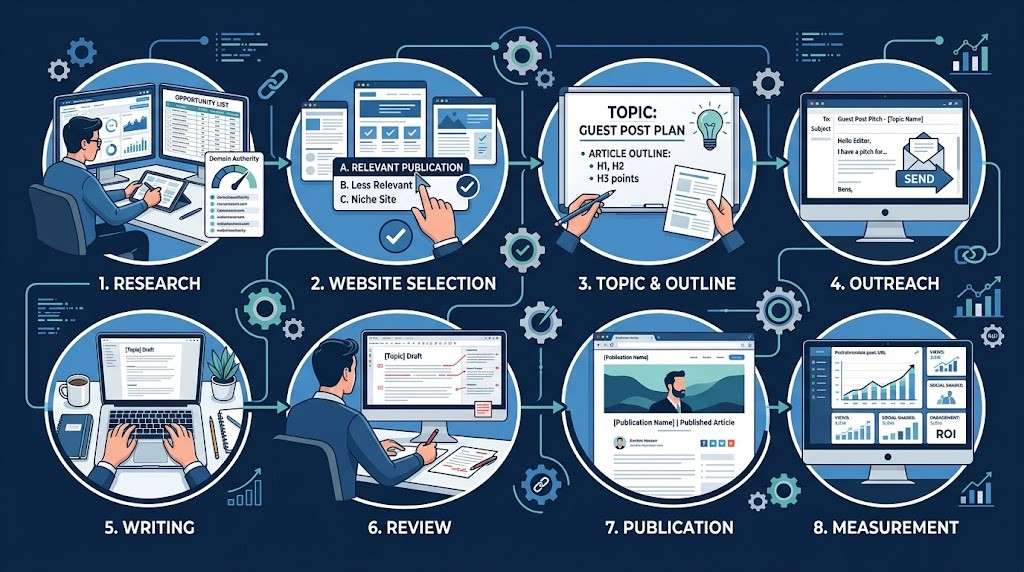
Guest posting works by connecting a contributor who has useful expertise with a relevant publication that has an audience interested in that expertise. The process usually involves defining a goal, finding suitable websites, evaluating publishers, researching content opportunities, pitching a topic, writing an original article, completing editorial review, publishing the contribution, and measuring what happened afterward.
The important part is that guest posting is not simply a matter of placing an article and adding a backlink. A successful contribution needs to make sense for the publication, solve a genuine reader problem, follow editorial requirements, and use links appropriately.
In this guide, you will learn how guest posting works step by step, from prospect research and outreach to writing, editorial review, publication, and performance measurement. You will also learn how to evaluate potential websites, create better pitches, avoid common mistakes, and build a process that prioritizes relevance and reader value.
What Is the Guest Posting Process?
At a basic level, guest posting follows this sequence:
Goal → Niche → Website Research → Website Evaluation → Content Research → Topic Selection → Outreach → Writing → Linking → Editorial Review → Publication → Measurement
Each stage affects the next.
For example, choosing the wrong publication makes it harder to find an appropriate topic. A weak topic makes outreach less compelling. A poor pitch can prevent a strong article idea from getting approved. And an otherwise excellent article can still fail if it ignores the publisher’s editorial requirements.
The process therefore works best as a connected workflow rather than a collection of isolated SEO tasks.
The objective should be to create an article that the publisher is happy to publish and that readers would find useful even if no search engine existed.
Step 1: Define Your Guest Posting Goal
Before searching for publications, decide why you are guest posting.
Different goals can lead to different types of opportunities.
Brand Awareness
You may want more people in your industry to recognize your company, website, product, or personal brand.
In this case, publications with a relevant and engaged audience may be more valuable than websites selected purely for SEO metrics.
Referral Traffic
If referral visits matter, prioritize publications whose readers have a genuine reason to click through to your website.
For example, a website selling project-management software could contribute to a small-business publication and link to a useful project-planning resource.
Audience Development
Guest contributions can introduce your expertise to people who have never encountered your website.
The best prospects are publications that already reach the audience you want to develop.
Thought Leadership
A guest article can demonstrate knowledge through original analysis, practical experience, frameworks, examples, or expert commentary.
This works particularly well when the contributor has something meaningful to say rather than simply rewriting information already available elsewhere.
Content Marketing
Guest posting can distribute useful information beyond your own website.
Instead of waiting for your existing audience to discover an article, you can contribute relevant information to publications that already have established readerships.
Relevant Editorial Exposure
Some campaigns are primarily about getting a business, expert, or resource mentioned in an appropriate editorial environment.
The important point is to establish the objective before beginning outreach. Otherwise, it is easy to measure success only by the number of published articles or links.
Step 2: Choose Your Niche and Audience
Once the goal is clear, identify the subject areas and audiences that make sense for your expertise.
A strong guest post begins with audience alignment.
Ask:
- What topics do I genuinely understand?
- What problems can I explain better than a generic article?
- Who would benefit from that knowledge?
- Which publications already reach those people?
- What type of content does that audience consume?
For example, an SEO consultant might target marketing publications, SaaS blogs, business websites, entrepreneurship publications, or specialist digital-marketing resources.
A home-improvement expert might look at renovation, interior design, property, DIY, architecture, and homeowner publications.
The niche does not have to be identical to your website’s category, but there should be a logical relationship between your expertise and the publication’s audience.
Relevance should come before volume.
A smaller publication with a highly relevant audience may provide a better opportunity than a much larger website whose readers have little interest in your subject.
Step 3: Find Relevant Websites
After defining your niche and audience, build a prospect list.
There are several ways to find potential publishers.
Use Google Searches
Search for combinations of your topic and contributor-related phrases.
Examples include:
SEO + "write for us"digital marketing + contributorssmall business + guest authorhome improvement + contributortechnology + submit an article
These searches can uncover publications that openly accept contributions.
However, do not assume that a website must have a “write for us” page to be a potential opportunity.
Search by Topic
Instead of searching only for guest-posting terminology, search for the subjects you want to discuss.
Look at websites that consistently publish useful content in your niche.
You can then investigate whether they accept outside contributions.
Research Existing Contributors
Look at authors who have already published on relevant websites.
Check:
- Their author pages
- Their recent articles
- Other publications where they contribute
- Topics they cover
- Whether they are industry specialists
This can reveal publications that accept expert contributions without advertising the opportunity publicly.
Study Industry Publications
Industry newsletters, magazines, specialist blogs, associations, and professional publications can all be potential prospects.
Think beyond conventional SEO blogs.
Use Competitor Backlink Research Carefully
Competitor backlink research can help identify publications that have mentioned or featured businesses in your industry.
However, do not automatically copy every link.
A competitor’s backlink is a research clue—not proof that the publication is appropriate for you.
After finding a potential website, evaluate it independently.
For a more detailed prospecting process, see our guide to finding suitable guest post opportunities.
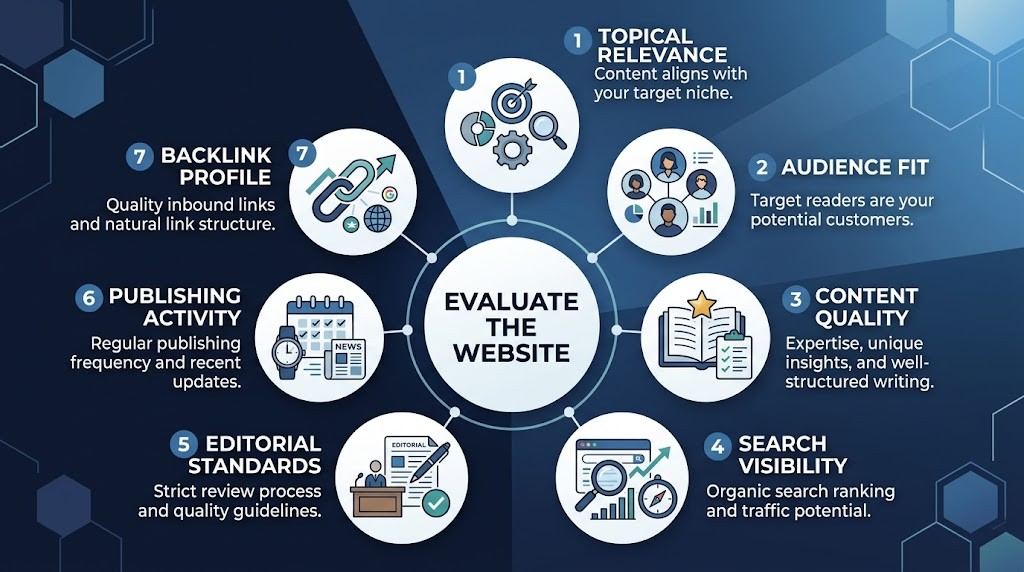
Step 4: Evaluate the Website
Finding a website is only the beginning.
Before pitching, determine whether the publication is actually worth your time.
Topical Relevance
Does the website consistently cover your subject or a closely related topic?
A publication should have a logical connection to your expertise.
Audience Fit
Who reads the site?
Consider whether its audience includes:
- Potential customers
- Industry professionals
- Business owners
- Researchers
- Decision-makers
- People who genuinely need your information
Content Quality
Read several recent articles.
Look for:
- Original information
- Useful examples
- Strong editing
- Clear structure
- Accurate claims
- Meaningful depth
If most articles are thin, repetitive, or obviously created only to publish links, treat that as a warning sign.
Search Visibility
Search for topics covered by the publication.
Does its content appear in relevant search results?
Do not assume that every page needs to rank highly. Instead, look for evidence that the site has a real editorial and search presence.
Editorial Standards
Look for contributor guidelines.
Pay attention to requirements involving:
- Word count
- Originality
- Formatting
- Citations
- Images
- Author bios
- Links
- Promotional language
Publishing Consistency
Check whether the website is active.
A publication that regularly produces useful content may provide a more meaningful environment than a neglected site with hundreds of old pages.
Backlink Profile
Backlinks can provide additional information about a site’s history and reputation.
But do not make backlink metrics the final decision.
What About DA and DR?
Domain Authority and Domain Rating can be useful third-party comparison metrics, but they are not Google ranking factors and should not be treated as a complete measure of publication quality.
A site with a high DR can still have:
- Poor audience relevance
- Weak editorial standards
- Low-quality content
- Excessive sponsored material
- Unnatural linking patterns
Likewise, a smaller publication with a lower metric can have an excellent audience and strong editorial standards.
Use metrics as supporting evidence, not as your entire evaluation.
Step 5: Research Existing Content
Once you identify a suitable website, study what it has already published.
This prevents you from pitching an idea the editor has covered repeatedly.
Look for:
Content Gaps
Maybe the publication has several beginner guides but no advanced tutorial.
That can create an opportunity for a more practical contribution.
Outdated Topics
An older article may cover a useful subject but contain outdated processes, examples, or tools.
You could pitch an updated approach—provided the publication actually wants that type of contribution.
Unanswered Questions
Read the comments, headings, related articles, and frequently discussed questions around the topic.
You may discover an audience need that existing content does not address well.
Missing Practical Guides
Some publications explain concepts but lack step-by-step implementation content.
A practical guide can fill that gap.
Original Perspectives
Look for areas where you have genuine experience, data, or expertise that can add something different.
Do not simply search for a keyword and rewrite the first five results.
Google’s guidance emphasizes creating helpful, reliable, people-first content rather than producing material primarily to attract search traffic.
Step 6: Choose the Right Guest Post Topic
A good topic needs to satisfy three audiences:
- The reader
- The publisher
- The contributor
Start with the reader.
What problem are they trying to solve?
Then consider the publisher.
Does the subject fit its existing editorial direction?
Finally, consider your expertise.
Can you contribute something genuinely useful?
Consider Search Intent
If the topic is informational, readers may want an explanation.
If it is practical, they may want instructions.
If it is comparative, they may want differences, advantages, and disadvantages.
If it is problem-solving, they may want a process or checklist.
Understanding intent helps you choose the right format.
Make the Topic Specific
Compare:
Weak:
“SEO Tips”
Stronger:
“How Small Businesses Can Audit Their Local SEO Without Enterprise Tools”
The second topic defines an audience, problem, and practical outcome.
Avoid Overly Promotional Topics
Editors are more likely to reject topics that read like advertisements.
The article should teach something first.
Your brand can be mentioned where genuinely relevant, but the contribution should not require the reader to become a customer.
Step 7: Prepare Personalized Outreach
Your pitch is often the first evidence an editor sees of your quality.
A strong outreach email is short, specific, and useful.
A practical structure is:
Introduction → Publication observation → Topic idea → Value → Credentials → CTA
Example Guest Post Pitch
Hi [Editor Name],
I enjoyed your recent coverage of small-business marketing, particularly the practical focus of your articles.
I’d like to contribute an original guide titled “How Small Businesses Can Build a Practical Content Promotion Workflow.”
The article would explain how to prioritize channels, create a repeatable promotion process, track useful outcomes, and avoid common mistakes. It would be written specifically for your small-business audience rather than repurposed from an existing article.
I regularly work on SEO and content strategy and can provide practical examples and supporting references where appropriate.
Would this topic fit your upcoming editorial calendar?
Best,
[Name]
Notice that the pitch does not begin with a list of requested backlinks.
The emphasis is on editorial value.
Personalization Matters
Instead of writing:
“I want to submit a guest post to your site.”
Mention something real about the publication.
For example:
“I noticed you have several articles about content planning, but very little covering the measurement side of content promotion.”
That demonstrates research and gives the editor a reason to consider your idea.
Step 8: Write the Guest Article
After a topic is approved, write the article specifically for that publication.
Do not take an old article from your website and make superficial changes.
Start With the Headline
The headline should accurately describe the article.
Avoid sensational claims that the content cannot support.
Write a Useful Introduction
The opening should establish:
- The reader’s problem
- Why it matters
- What the article will explain
Avoid spending several paragraphs talking about your company.
Use Logical Headings
Use H2 and H3 headings to divide the article into meaningful sections.
A reader should be able to scan the headings and understand the article’s structure.
Include Practical Examples
Examples make advice easier to understand.
Instead of saying:
“Research your audience.”
Explain what that research could involve and how the information changes the article topic.
Support Important Claims
Use reliable sources when discussing statistics, official recommendations, technical requirements, or other claims that require evidence.
Add Original Insights
The strongest guest articles usually contain something beyond basic summaries.
That could be:
- A practical workflow
- A framework
- A decision process
- An original example
- Lessons from experience
- A useful checklist
Make It Easy to Read
Use:
- Short paragraphs
- Descriptive headings
- Bullets
- Numbered steps
- Tables when useful
- Examples
- Clear transitions
A guest post should feel like a natural part of the host publication.
Step 9: Add Links Naturally
Links should support the reader rather than interrupt the article.
A contextual link works best when the destination provides additional information that the reader would reasonably want.
For example, this article discusses the broader role of guest posting as an SEO strategy.
The anchor is descriptive and relevant to the destination.
Use Natural Anchor Text
Avoid forcing the same commercial keyword into every article.
Natural anchors may include:
- a descriptive phrase
- the name of a resource
- a brand name
- a relevant topic
- a natural continuation of the sentence
The surrounding text should make the reason for the link clear.
Link to Useful Pages
Potential destinations include:
- Detailed guides
- Original research
- Tools
- Templates
- Supporting resources
- Relevant service pages
- Educational content
Do Not Add Links Just Because You Can
More links do not automatically make an article better.
If removing a link makes the article clearer and does not reduce the reader’s ability to understand the subject, the link may not be necessary.
Understand Sponsored and Qualified Links
If a publication is receiving payment or another form of compensation for a placement, link handling matters.
Google recommends rel="sponsored" for paid or advertising links, while nofollow remains an acceptable option in situations where you do not want Google to associate your site with or crawl the linked page through that link.
Google’s guidance on guest-post link spam identifies paid articles or guest posts containing links intended to pass ranking credit, particularly when optimized anchor text is involved, as an example of link spam.
The safest approach is to make the commercial and editorial relationship clear and qualify links according to their actual context.
Step 10: Editorial Review
After submission, the article normally enters the publisher’s review process.
The editor may assess:
- Originality
- Accuracy
- Topic relevance
- Structure
- Readability
- Promotional language
- Links
- Sources
- Images
- Formatting
Be Prepared for Revisions
An editor may ask you to:
- Rewrite an introduction
- Remove a promotional paragraph
- Replace a source
- Change a heading
- Add examples
- Remove unnecessary links
- Adjust formatting
- Provide an image
- Clarify a claim
This is normal.
Editorial review is not necessarily a rejection of your work. It is part of adapting the contribution to the publication’s standards.
Respond Professionally
If a publisher requests reasonable changes, respond clearly and promptly.
A good contributor relationship can matter beyond one article.
Step 11: Publication
Once the article passes editorial review, the publisher schedules or publishes it.
Depending on the website, you may see:
- An author byline
- Author bio
- Featured image
- Publication date
- Editorial links
- Social sharing options
- Related articles
Check the live article after publication.
Verify:
- The article displays correctly
- Your author attribution is accurate
- The intended links work
- The destination URLs are correct
- The content has not been changed in a misleading way
- Images display properly
Do not assume that publication means the process is finished.
A quick post-publication review helps catch errors early.
Step 12: Measure the Outcome
The final step is understanding whether the contribution achieved its actual purpose.
Do not judge success only by the number of links.
Referral Traffic
Use analytics tools to see whether visitors reached your website from the published article.
Brand Exposure
Consider whether the article introduced your brand to a relevant audience.
Engagement
Depending on the publication and tracking available, look at:
- Page visits
- Time engaged
- Clicks
- Resource downloads
- Sign-ups
- Enquiries
Published Links
Record which pages were referenced and how the publisher handled the links.
However, a published link should not automatically be treated as a ranking gain.
Google has stated that it can detect and neutralize many spammy link schemes, so the sustainable approach is to prioritize useful content and legitimate editorial value rather than assuming every acquired link produces SEO benefit.
Relevant Audience Discovery
One of the most useful questions is:
Did the article reach people who actually care about the subject?
If yes, the contribution may have succeeded even if referral traffic was modest.
Relationships
Did the publication become a useful professional relationship?
Did the editor respond positively?
Could you contribute another genuinely useful article in the future?
Conversions
If the article attracts visitors who become subscribers, leads, customers, or partners, those outcomes may be more meaningful than raw traffic numbers.
How Long Does Guest Posting Take?
There is no universal guest-posting timeline.
The process can take days or weeks depending on:
- Prospect research
- Outreach response time
- Topic approval
- Writing time
- Editorial workload
- Revision requests
- Publication scheduling
Some publishers review submissions quickly, while others have a longer editorial queue.
The term TAT, or turnaround time, can refer to different stages of this process depending on the publisher or service.
For a focused explanation of this terminology, see our guide to publication turnaround in guest posting.
Do not confuse the time needed to submit an article with the time required for final publication.
Guest Posting Example
Imagine a fictional SaaS company that provides project-management software for small businesses.
The company wants to introduce its expertise to business owners.
Stage 1: Goal
Its objective is to increase brand awareness and introduce useful project-management resources to a relevant business audience.
Stage 2: Research
The marketing team finds a small-business publication that regularly covers productivity, operations, and technology.
Stage 3: Evaluation
The team reviews recent articles and confirms that:
- The audience is relevant.
- The publication is active.
- Articles are professionally edited.
- Topics are closely related.
- Contributor content fits the publication.
Stage 4: Content Research
The team notices that the publication has several articles about team productivity but few practical guides about reducing unnecessary project meetings.
Stage 5: Topic
They propose:
“How Small Teams Can Organize Projects Without Creating More Meetings.”
Stage 6: Outreach
The pitch explains why the topic fits the publication and what readers would learn.
Stage 7: Writing
The company produces an original article containing:
- A practical workflow
- Examples
- A meeting-reduction framework
- Project-planning recommendations
- Supporting references
Stage 8: Linking
The article references a relevant project-planning resource on the company’s website where it genuinely helps the reader.
Stage 9: Review
The editor asks the company to shorten the introduction and remove a promotional paragraph.
The writer makes the requested revisions.
Stage 10: Publication
The article goes live with an author attribution and appropriate resource references.
Stage 11: Measurement
The company tracks referral visits, engagement, resource interactions, and enquiries.
This example demonstrates why guest posting is a process rather than a single link-placement event.
For a dedicated walkthrough, see how a guest post works in practice.
Common Guest Posting Mistakes
Even a well-planned campaign can become ineffective when the execution is poor.
Generic Outreach
Sending the same email to hundreds of websites often produces weak responses.
Better approach: personalize the pitch around the publication and its audience.
Irrelevant Websites
A high-authority website is not automatically a good prospect.
Better approach: prioritize topical and audience relevance.
Weak Topics
Generic topics provide little reason for an editor to accept your proposal.
Better approach: identify a specific reader problem or content gap.
Thin Content
Short, generic articles that provide no original value are unlikely to create meaningful editorial value.
Better approach: add practical examples, useful frameworks, evidence, and original insights.
Excessive Links
Too many outbound links can make an article look promotional or distract readers.
Better approach: include only links that genuinely improve the article.
Poor Anchor Text
Forcing commercial exact-match phrases into every article can make the content unnatural and create unnecessary link-risk concerns.
Better approach: use concise, descriptive, reader-friendly anchors.
Duplicate Articles
Submitting the same article repeatedly removes the exclusivity and editorial value of the contribution.
Better approach: create original content for each publication.
Ignoring Publisher Requirements
An excellent article can still be rejected if it ignores formatting, sourcing, image, or link requirements.
Better approach: read the guidelines before writing.
Treating Every Metric as a Ranking Signal
DA, DR, traffic estimates, and other third-party measurements can help with research, but none should replace editorial judgment.
Focusing Only on Backlinks
Google’s guidance has long distinguished legitimate contributor content from large-scale guest-post campaigns created primarily to manipulate links.
The more useful question is:
Would this article still be worth publishing if there were no SEO benefit from the link?
If the answer is yes, you are much closer to a reader-first approach.
Practical Guest Posting Checklist
Use this checklist before starting a campaign.
Before Prospecting
- Define the main campaign goal.
- Identify the target audience.
- Choose relevant subject areas.
- Determine what expertise you can contribute.
- Decide how success will be measured.
During Website Research
- Check topical relevance.
- Check audience fit.
- Read recent articles.
- Review content quality.
- Check publishing activity.
- Review editorial guidelines.
- Examine search visibility.
- Review backlink patterns.
- Use DA/DR only as supporting metrics.
Before Outreach
- Research the publication.
- Identify a genuine content gap.
- Develop a specific topic.
- Explain the reader benefit.
- Personalize the email.
- Keep the pitch concise.
- Include relevant credentials when useful.
During Writing
- Create an original article.
- Match the publication’s tone.
- Write a useful introduction.
- Use logical headings.
- Add practical examples.
- Support important claims.
- Include original insights.
- Format the article for readability.
- Avoid unnecessary promotion.
Before Submission
- Check grammar and spelling.
- Verify facts.
- Review every link.
- Use natural anchor text.
- Remove unnecessary links.
- Follow image requirements.
- Follow the publisher’s formatting rules.
- Confirm originality.
After Publication
- Check the live article.
- Verify links.
- Confirm author attribution.
- Monitor referral traffic.
- Track meaningful engagement.
- Record relevant business outcomes.
- Maintain the publisher relationship.
Frequently Asked Questions
How does guest posting work?
Guest posting works by having a contributor create an original article for another relevant publication. The process usually includes goal setting, prospect research, website evaluation, topic selection, personalized outreach, writing, editorial review, publication, and performance measurement.
How do I find websites for guest posting?
Start by searching for relevant publications in your niche using Google, industry searches, contributor research, competitor backlink research, and existing authors. Then evaluate each prospect for relevance, audience fit, content quality, editorial standards, and overall reputation.
How do I pitch a guest post?
A good pitch briefly introduces you, demonstrates that you understand the publication, proposes a specific topic, explains why it would benefit readers, provides relevant credentials when appropriate, and ends with a simple question about fit.
What should a guest post include?
A strong guest post should include an accurate and useful headline, clear introduction, logical headings, practical examples, original insights, supporting evidence where necessary, useful references, readable formatting, and only relevant links.
How long does guest posting take?
There is no standard timeline. Research, outreach, editorial review, revisions, and publication scheduling can all take different amounts of time. The publisher’s workflow and editorial queue usually have a major effect on the final turnaround.
Should guest posts contain backlinks?
A guest post can contain links when they genuinely help readers and fit the publication’s editorial standards. However, links should not be forced into articles solely to manipulate rankings. Paid placements and other commercial relationships may require appropriate link qualification under Google’s guidance.
How do I evaluate a guest posting website?
Evaluate the website using multiple factors, including topical relevance, audience fit, content quality, search visibility, editorial standards, publishing activity, backlink patterns, and reputation. DA or DR can provide additional context, but they should not be the sole deciding factors.
Conclusion
Understanding how guest posting works becomes much easier when the process is treated as an editorial workflow rather than a backlink transaction.
Start with a clear goal. Choose a relevant audience. Find publications that genuinely serve that audience. Evaluate them carefully instead of relying on a single SEO metric. Research their existing content, identify useful gaps, and pitch a topic that gives the editor a reason to say yes.
Then create an original article that is genuinely worth publishing.
Use links sparingly and naturally. Follow the publisher’s requirements. Respond professionally to editorial feedback. After publication, measure outcomes such as referral traffic, audience discovery, engagement, relationships, and conversions rather than assuming that every link produces a ranking improvement.
This approach also aligns with Google’s broader emphasis on helpful, reliable, people-first content and its policies against link spam and content created primarily to manipulate search results.
Ultimately, the most sustainable guest-posting process is simple:
Find the right publication → understand its audience → propose something useful → create excellent content → respect editorial standards → use links responsibly → measure the real-world result.
That is how guest posting works when quality and reader value come first.