


Guest posting is the practice of creating an original article for publication on another website rather than publishing it exclusively on your own site. In an SEO context, it can become part of a broader content marketing, outreach, digital PR, and link-building strategy, particularly when the article is genuinely useful to the host publication’s audience and includes relevant editorial links where appropriate.
Unlike publishing an article on your own website, guest posting places your expertise in front of an audience you do not directly control. A well-chosen publication can introduce your brand to new readers, generate referral traffic, develop relationships with publishers and editors, and create opportunities for people to discover useful resources on your website.
However, guest posting should not be reduced to a method for collecting backlinks. Quality, topical relevance, editorial standards, audience fit, and the usefulness of the content all matter. Google’s current spam policies specifically warn against low-value content and links created primarily to manipulate search rankings, including certain paid or optimized links in guest posts.
This guide explains what is guest posting in SEO, how the process works, what makes a publication worth pursuing, how guest-post links should be handled, common mistakes to avoid, and how beginners can evaluate opportunities responsibly.
What Is Guest Posting?
Guest posting is the process of writing and publishing an article on a website operated by someone else.
The article may be called a guest article, guest blog post, contributor article, or contributor content. The website publishing the article is the host website or publisher, while the person who creates the article is the guest author or contributor.
The basic relationship looks like this:
Guest author → creates useful content → host website publishes it → relevant readers discover it
For example, imagine that you operate a website about home improvement. You write a detailed article explaining how homeowners can plan a practical media wall. A relevant interior-design publication accepts the article because its audience is interested in home renovation.
The article is published on that publication, with an author attribution and, where appropriate, a contextual link to a useful resource on your own website.
The value is not limited to the link. Readers who are genuinely interested in media walls may discover your expertise, visit your website, remember your brand, or use one of your resources later.
That distinction is important: good guest posting creates value for three parties—the reader, the publisher, and the contributor.
What Is Guest Posting in SEO?
Guest posting in SEO is the use of guest-contributed content and publisher outreach as part of a broader strategy for increasing relevant visibility, earning exposure, attracting referral traffic, developing relationships, and potentially acquiring editorial links.
The SEO connection usually comes from the relationship between the published article, the host website, the linked resource, and the surrounding context.
For example, a cybersecurity company might contribute an article to a technology publication explaining how small businesses can improve password security. If the article naturally references a detailed security checklist on the company’s website, that link can help readers reach a relevant resource.
Several concepts are involved:
Contextual and Editorial Links
A contextual link appears within relevant content rather than being placed randomly in a sidebar, footer, author bio, or unrelated directory.
An editorial link is a link that makes sense from the publisher’s editorial perspective because it helps the reader understand or explore the subject.
The important question is not simply:
“Can I get a backlink?”
A better question is:
“Would this link make sense if search engines did not exist?”
If the answer is yes, the link is more likely to serve a genuine user purpose.
Referral Traffic
A relevant guest article can send visitors directly to your website.
For example, a specialist accounting firm contributing a practical tax-planning article to a small-business publication may attract readers who want more information. Those readers can follow relevant links to the firm’s resources.
Referral traffic is particularly valuable when the audience has a genuine reason to continue exploring your website.
Brand Exposure
Guest posting can introduce your business to people who have never encountered your brand.
Repeated exposure through genuinely useful contributions can make a company, consultant, agency, or publisher more recognizable within a particular industry.
Topical Relevance
Relevance should be one of the strongest filters when evaluating guest-post opportunities.
A link from a website that discusses the same subject area—or a closely related audience problem—can make much more sense than a link from a completely unrelated publication.
Authority and Expertise
A useful contributor article can demonstrate that you understand a particular subject.
This is especially effective when the article contains practical experience, original analysis, examples, explanations, or useful resources rather than generic information that could have been produced for any website.
Relationship Building
Guest posting is also an outreach activity.
Contributors may develop relationships with editors, publishers, writers, marketers, agencies, and businesses. Those relationships can lead to future editorial opportunities, interviews, collaborations, expert contributions, or content partnerships.
Guest Posting Is Not a Guaranteed Ranking Technique
Guest posting should never be presented as a guaranteed way to increase Google rankings.
Google’s documentation explains that links can help Google discover pages and understand relationships between resources, but its spam policies also prohibit links and content created primarily to manipulate rankings.
The sustainable approach is therefore to treat guest posting as a content and relationship strategy that can support SEO, not as a shortcut to rankings.
Why Does Guest Posting Matter?
Guest posting can serve several marketing objectives at the same time.
Reach a New Audience
Publishing on another relevant website gives you access to readers who may not have discovered your website independently.
The opportunity becomes stronger when the host publication already attracts the type of audience you want to reach.
For example, a B2B software company gains more from contributing to a publication read by business owners and technology professionals than from a website whose audience has no connection with its product.
Build Brand Visibility
Useful contributions can increase familiarity with a brand.
A reader may encounter your company through one article, recognize the name in another context later, and eventually visit your website when they have a relevant need.
This is a longer-term benefit than simply measuring the number of links acquired.
Generate Referral Traffic
A relevant link can give readers a direct route to additional information.
The strongest referral opportunities are usually connected to the article’s subject.
If an article explains how to audit a website, for instance, a contextual link to a detailed audit checklist is more useful than a generic link to a homepage.
Build Industry Relationships
Guest posting requires communication with editors, publishers, content managers, writers, marketers, and sometimes business owners.
Good relationships can become valuable over time.
A publisher who appreciates your work may invite you to contribute again. An editor may recommend you to another publication. A fellow contributor may become a content partner.
Demonstrate Expertise
A guest article gives you an opportunity to explain something clearly to an audience that does not already know your business.
Practical examples, original observations, useful frameworks, and well-supported explanations can communicate expertise more effectively than a promotional sales pitch.
Support a Broader SEO Strategy
Guest posting should work alongside other activities such as:
- Creating useful content on your own website
- Internal linking
- Digital PR
- Brand building
- Content partnerships
- Organic outreach
- Technical SEO
- Audience development
- Relevant link acquisition
- Expert contributions
Google’s SEO guidance emphasizes helping users and making content understandable and useful rather than relying on secret techniques that guarantee rankings.
Guest posting therefore works best as one component of a broader strategy, not as the entire SEO strategy.
How Does Guest Posting Work?
A professional guest-posting campaign normally involves more than sending the same email to hundreds of websites.
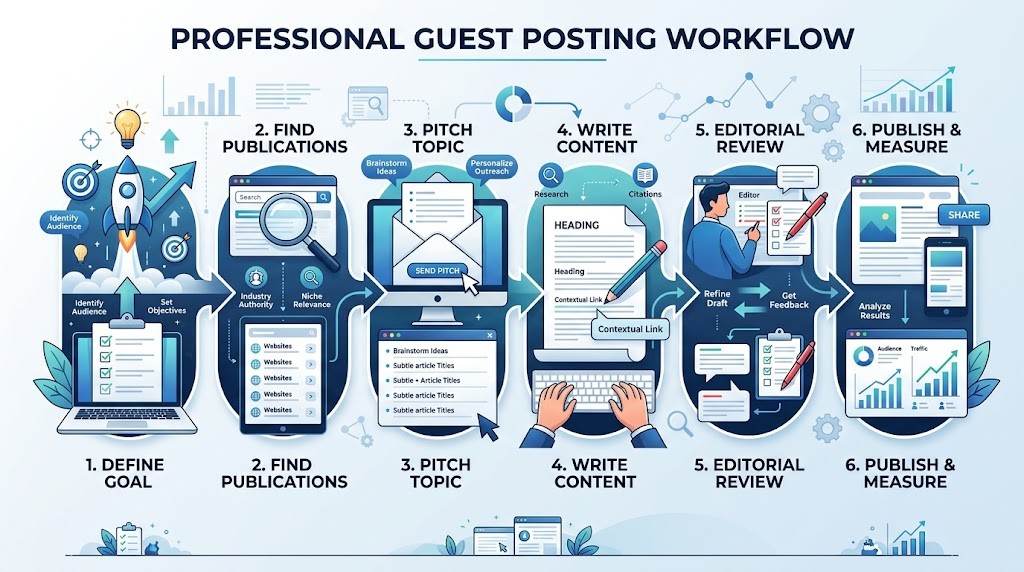
1. Define the Goal
Start by deciding what you want the campaign to accomplish.
Your goal could be:
- Brand exposure
- Referral traffic
- Industry recognition
- Content distribution
- Relationship building
- Digital PR
- Relevant editorial mentions
- Supporting a particular resource
Having a clear objective makes it easier to evaluate opportunities later.
2. Choose a Relevant Niche
Determine which industries, topics, and audiences are genuinely connected to your business.
The closer the relationship between your expertise and the publication’s audience, the easier it becomes to create something useful.
3. Find Suitable Publications
Search for publications that already discuss your subject area.
Do not restrict your research to sites that openly advertise “write for us.” Some high-quality publications accept contributors through direct editorial outreach without maintaining a public guest-posting page.
For a more detailed process, see the step-by-step guest posting process.
4. Evaluate the Website
Check the publication’s:
- Topic relevance
- Audience
- Content quality
- Publishing history
- Search visibility
- Editorial standards
- Link practices
- Reputation
- Overall user experience
Do not make Domain Rating or Domain Authority the only deciding factor.
5. Research Its Audience
Read several recent articles.
Ask:
- Who is the publication writing for?
- What topics perform well?
- How detailed are its articles?
- What tone does it use?
- Does it prefer tutorials, opinion pieces, case analysis, or guides?
- What questions appear repeatedly?
This research helps you pitch something that belongs on the publication.
6. Choose a Useful Topic
Choose a subject that solves a real audience problem.
Avoid submitting a generic article simply because it contains a keyword you want to target.
7. Contact the Editor
Write a personalized pitch.
Mention something specific about the publication and explain why your proposed topic would be useful to its readers.
8. Create Original Content
Once the topic is approved, create an article specifically for that publication.
Do not simply copy an existing article from your own website.
9. Add Relevant Links Naturally
Links should support the article.
A useful destination page might provide:
- Additional research
- A deeper explanation
- A practical checklist
- A tool
- A relevant service
- Supporting documentation
The link should make sense in context.
10. Submit for Review
Follow the publisher’s formatting and editorial requirements.
11. Make Revisions
Editors may request changes to:
- Headings
- Examples
- Links
- Claims
- Tone
- Formatting
- Promotional language
Treat editorial feedback as part of the publishing process.
12. Publish and Monitor Results
After publication, monitor meaningful outcomes such as:
- Referral traffic
- Brand mentions
- Engagement
- Referral conversions
- New relationships
- Search visibility of the linked resource
- Overall campaign quality
Do not judge the entire campaign solely by how many links were published.
What Makes a Good Guest Posting Website?
A good guest-posting opportunity is not simply a website with a high authority score.
Look at the complete picture.
Topical Relevance
Does the publication genuinely cover your industry or a closely related subject?
Audience Relevance
Are its readers potential customers, industry professionals, researchers, decision-makers, or people who could reasonably benefit from your resources?
Content Quality
Read several articles. Are they useful, original, well edited, and specific?
Editorial Standards
A strong publication normally has recognizable standards for contributors.
Look for clear expectations around originality, formatting, sourcing, promotional content, and links.
Publishing Activity
A site that has stopped publishing or has a large archive of abandoned pages may be less valuable than an active publication with a consistent editorial operation.
Organic Visibility
Look at whether the publication appears to attract real search visibility and whether its content addresses topics people actually search for.
Website Reputation
Consider the overall reputation of the publication.
Would you be comfortable telling a potential customer that your article appeared there?
Backlink Profile
A website’s inbound links can provide additional context, but backlink metrics should not be treated as a complete quality assessment.
User Experience
Check whether the site is easy to navigate, readable, mobile-friendly, and reasonably maintained.
Most importantly, do not use DA or DR as the deciding factor.
A publication with a lower third-party metric can sometimes offer a much better audience fit and editorial environment than a site with a higher score.
For a practical prospecting process, see how to find relevant guest posting sites.
Guest Posting and Backlinks
Backlinks are one reason guest posting is often discussed within SEO.
A backlink is simply a link from another website to a page on your website. In guest posting, the ideal link is relevant to the article and useful to someone reading it.
Context Matters
Suppose an article explains how to conduct technical SEO research.
A link to a detailed technical SEO checklist could be useful.
A random link to an unrelated product page would make much less sense.
Use Natural Anchor Text
Anchor text is the visible wording used for a link.
Useful anchor text should describe the destination without sounding forced.
For example:
- technical SEO checklist
- website audit guide
- content strategy framework
Avoid turning every guest post into an exercise in inserting an exact commercial keyword.
Google’s link guidance recommends descriptive, concise, relevant anchor text and specifically cautions against stuffing keywords into link text.
The Destination Page Should Be Useful
The page receiving the link should genuinely help the reader.
Good destinations might include:
- Detailed guides
- Original research
- Tools
- Templates
- Educational resources
- Relevant service pages
- Supporting articles
Avoid Excessive Exact-Match Anchors
Using the same commercial phrase repeatedly across unrelated publications can create an unnatural link profile.
A more responsible approach is to prioritize reader-friendly wording and let the surrounding content provide context.
Understand Google’s Link Policies
This is one of the most important areas for anyone using guest posting for SEO.
Google’s current spam policies identify link spam as links created primarily to manipulate search rankings. The policy includes examples involving paid links, excessive link exchanges, automated link creation, low-value content created for ranking manipulation, and paid articles or guest posts containing links intended to pass ranking credit or optimized anchor text.
That does not mean every guest article is inherently problematic.
The distinction is intent, quality, editorial context, and how links are qualified.
Google also explains that paid advertising and sponsorship links can exist when they are appropriately qualified, such as with rel="sponsored" or rel="nofollow".
The practical lesson is simple:
Do not build guest posts primarily as a mechanism for manipulating search rankings. Build useful articles that deserve to exist, and handle links according to their actual commercial and editorial context.
What Makes a Guest Post High Quality?
A high-quality guest post should be able to stand on its own even without the author’s backlink.
Look for these characteristics:
Original Research or Useful Insights
Add something that was not already obvious from the first page of search results.
This could be:
- Original analysis
- Practical observations
- A unique framework
- Expert commentary
- An original process
- Examples from genuine experience
Clear Structure
Use logical headings, short paragraphs, bullets, tables where useful, and descriptive subheadings.
Strong Introduction
The opening should immediately establish:
- The problem
- The subject
- Why it matters
- What the reader will learn
Practical Examples
Examples turn abstract advice into something readers can apply.
Relevant References
Cite reliable sources when factual claims require supporting evidence.
Useful Formatting
Make the article easy to scan.
Use:
- H2 and H3 headings
- Bullet points
- Numbered processes
- Short paragraphs
- Examples
- Checklists
Appropriate Links
Links should add context or help readers continue their research.
Audience Fit
An excellent article can still be a poor guest post if it does not belong on the host publication.
Editorial Quality
Check grammar, accuracy, clarity, formatting, originality, and promotional language before submission.
Quick Guest Post Quality Checklist
Before submitting, ask:
- Is the article original?
- Does it solve a genuine reader problem?
- Does it fit the publication?
- Is the information accurate?
- Are examples useful?
- Are links relevant?
- Is the anchor text natural?
- Does the article avoid unnecessary promotion?
- Does it follow editorial guidelines?
- Would the article still be useful without the backlink?
If several answers are “no,” improve the article before sending it.
What Is TAT in Guest Posting?
TAT usually means Turnaround Time.
In guest posting, it describes the amount of time involved in moving a contribution through part or all of the publishing process.
Depending on the publisher or service, TAT may refer to:
- Submission
- Initial review
- Editorial feedback
- Revisions
- Approval
- Publication
TAT can vary considerably because publishers have different editorial schedules, review processes, workloads, and publishing frequencies.
If you need to understand this concept in more detail, see the guide to guest post turnaround time.
The important point is that a promised submission date is not necessarily the same thing as a guaranteed publication date.
What Is a Guest Posting Example?
Consider a fictional software company that provides project-management tools for small businesses.
The company wants to reach business owners who are struggling with team productivity.
A relevant business publication accepts a guest article titled:
“How Small Teams Can Organize Projects Without Creating More Meetings.”
The article explains practical project-management methods, gives examples, and discusses common mistakes.
Within one section, the author references a more detailed project-planning resource hosted on the software company’s website.
The link is relevant because the resource expands on the topic being discussed.
The publication gains useful content for its readers.
Readers gain practical advice.
The software company gains exposure to a relevant audience and a potential referral path to its website.
That is a much stronger model than writing an article solely because a publisher will allow a backlink.
For another practical scenario, see this real-world guest posting example.
Guest Posting vs. Other SEO Strategies
Guest posting overlaps with several other outreach methods, but they are not identical.
| Strategy | Main Purpose | Typical Approach |
|---|---|---|
| Guest posting | Content contribution and audience exposure | Create an original article for another publication |
| Digital PR | Publicity and brand visibility | Earn media attention through newsworthy stories or expertise |
| Resource-page outreach | Resource discovery | Ask relevant sites to consider a genuinely useful resource |
| Broken-link outreach | Help publishers replace unavailable resources | Identify broken references and suggest an appropriate replacement |
| Expert contributions | Demonstrate expertise | Provide commentary, quotes, or specialist insight |
| Content partnerships | Shared audience development | Collaborate with another business or publisher on content |
| Niche edits | Contextual resource placement | Add a relevant reference to existing content where editorially appropriate |
None of these methods is automatically superior.
The right approach depends on your objective.
If you have strong expertise and can produce excellent articles, guest contributions may make sense.
If you have original research that journalists can reference, digital PR may be more appropriate.
If you have a genuinely useful resource that complements an existing article, resource outreach may be the better fit.
The key is matching the tactic to the asset and the audience rather than forcing every SEO campaign into a backlink-building model.
How to Choose the Right Guest Posting Opportunity
Use a structured evaluation process instead of judging a website from one metric.
1. Check Relevance
Does the website discuss your topic or serve a closely related audience?
2. Study the Audience
Would your ideal reader actually spend time there?
3. Review Content Quality
Read recent articles rather than judging the site from its homepage alone.
4. Check Publishing Frequency
Is the publication active?
5. Examine Search Visibility
Does the site appear to have genuine visibility for topics relevant to its niche?
6. Review Editorial Standards
Look for author guidelines, contributor requirements, editing practices, and content policies.
7. Inspect Link Practices
Be cautious if every article appears overloaded with commercial links.
8. Consider Reputation
Ask whether the publication would strengthen or weaken your brand association.
9. Evaluate Business Value
Could the publication realistically help you reach:
- Potential customers?
- Industry peers?
- Journalists?
- Partners?
- Researchers?
- Decision-makers?
10. Consider the Opportunity as a Whole
Do not reduce the evaluation to DA, DR, traffic estimates, or a single SEO metric.
A good opportunity is usually one where relevance + audience + editorial quality + reputation + business value make sense together.
Common Guest Posting Mistakes
Guest posting becomes less effective when the process is treated as a volume game.
Choosing Websites Only Because of DR or DA
Third-party authority metrics can be useful for comparison, but they do not tell you everything about audience quality, editorial standards, reputation, or topical relevance.
Irrelevant Placements
A website does not become a good prospect simply because it has a high authority score.
Poor-Quality Articles
Thin, generic, repetitive articles provide little value to readers or publishers.
Generic Outreach
Mass emails that do not demonstrate any knowledge of the publication are easy to ignore.
Excessive Commercial Anchors
Repeatedly forcing exact-match commercial keywords into articles can make the link unnatural.
Unnecessary Links
Every link should have a reason to exist.
Duplicate Content
Submitting the same article to multiple publications can undermine originality and editorial value.
Publishing Solely for Backlinks
When the only objective is acquiring a link, content quality and audience relevance often suffer.
Ignoring Editorial Guidelines
If a publisher asks for specific formatting, word counts, sourcing, or link policies, follow them.
Mass Automated Outreach
Automation can help organize research, but indiscriminate mass outreach usually produces poor personalization and weak relationships.
Google’s spam documentation also warns against automated link creation and low-value content created primarily to manipulate ranking and linking signals.
Guest Posting for Beginners
Beginners do not need to start with hundreds of prospects.
A better approach is to learn the fundamentals first:
- Choose one relevant niche.
- Study several publications.
- Learn how their content works.
- Build a small list of realistic prospects.
- Create genuinely useful topic ideas.
- Personalize your outreach.
- Start with quality rather than volume.
- Track what happens after publication.
If you are completely new to the process, the dedicated guide to guest posting for beginners can help you understand the fundamentals before developing a larger outreach campaign.
The goal at the beginning should be learning how publishers think, how audiences respond, and what makes an article genuinely publishable.
Frequently Asked Questions
What is guest posting in SEO?
Guest posting in SEO is the practice of creating useful content for another relevant website as part of a broader content, outreach, brand, referral, and SEO strategy. It may include relevant editorial links, but it should not be treated as a guaranteed ranking technique.
Is guest posting good for SEO?
Guest posting can support an SEO strategy when it involves useful content, relevant publications, appropriate links, and genuine audience value. Its benefits can include referral traffic, brand exposure, relationships, and relevant editorial mentions. It should not be used primarily to manipulate search rankings.
How does guest posting work?
The process generally involves defining a goal, finding relevant publications, evaluating their quality, researching the audience, pitching a useful topic, writing original content, adding appropriate links, submitting the article, making revisions, publishing, and measuring results.
What makes a good guest posting website?
A good publication usually has strong topical and audience relevance, useful content, reasonable editorial standards, active publishing, genuine visibility, a good reputation, sensible linking practices, and a positive user experience. DA or DR alone should not determine whether a website is suitable.
Are guest post backlinks always valuable?
No. A backlink’s usefulness depends on context, relevance, destination-page quality, publication quality, and how the link is acquired and presented. A random link from an irrelevant or low-quality page may have little practical value.
Does guest posting guarantee Google rankings?
No. Guest posting does not guarantee rankings. Google explicitly warns against creating links or low-value content primarily to manipulate ranking signals. Sustainable guest posting focuses on useful content, relevant audiences, and responsible linking.
What is the difference between guest posting and link building?
Guest posting is a content-contribution and outreach activity. Link building is the broader practice of acquiring links to a website. Guest posting can be one method within a larger link-acquisition or digital outreach strategy, but not every guest post needs to be built around obtaining a backlink.
Conclusion
Guest posting is most useful when it is treated as publishing for another audience, not simply placing a backlink on another domain.
The strongest opportunities combine a relevant publication, a clearly defined audience, genuinely useful content, appropriate editorial links, and a reason for readers to continue exploring the contributor’s resources.
For businesses and marketers, that makes guest posting more than a link-building tactic. It can support content marketing, brand visibility, referral traffic, industry relationships, digital PR, and broader SEO efforts.
The practical standard is straightforward: create something worth publishing, choose a publication where it belongs, make every link useful, respect editorial standards, and measure the value beyond the number of backlinks acquired.