
A guest article introduces your ideas to a new audience, but the article is not the only thing readers see. Your author bio also gives readers and editors quick context about who you are, what you do, and why your background is relevant to the subject.
A strong guest post author bio should establish credibility without turning the contribution into an advertisement. It can explain your professional role, highlight relevant experience, and give readers an appropriate way to learn more about your work.
If you are new to guest blogging, it is useful to learn how guest posting works before preparing your submission. Understanding the broader process helps you see where the bio fits alongside topic selection, pitching, writing, and editorial review.
There is no bio formula that guarantees publication, higher rankings, more traffic, or conversions. Every publication has its own standards. The purpose of an author bio is simpler: provide accurate, relevant, concise information that helps readers understand the person behind the article.
What Is a Guest Post Author Bio?
A guest post author bio is a short description of the person who contributed an article to another website or publication.
It commonly appears at the end of the article, although some publications place it beneath the headline, beside the author’s name, or on a contributor profile.
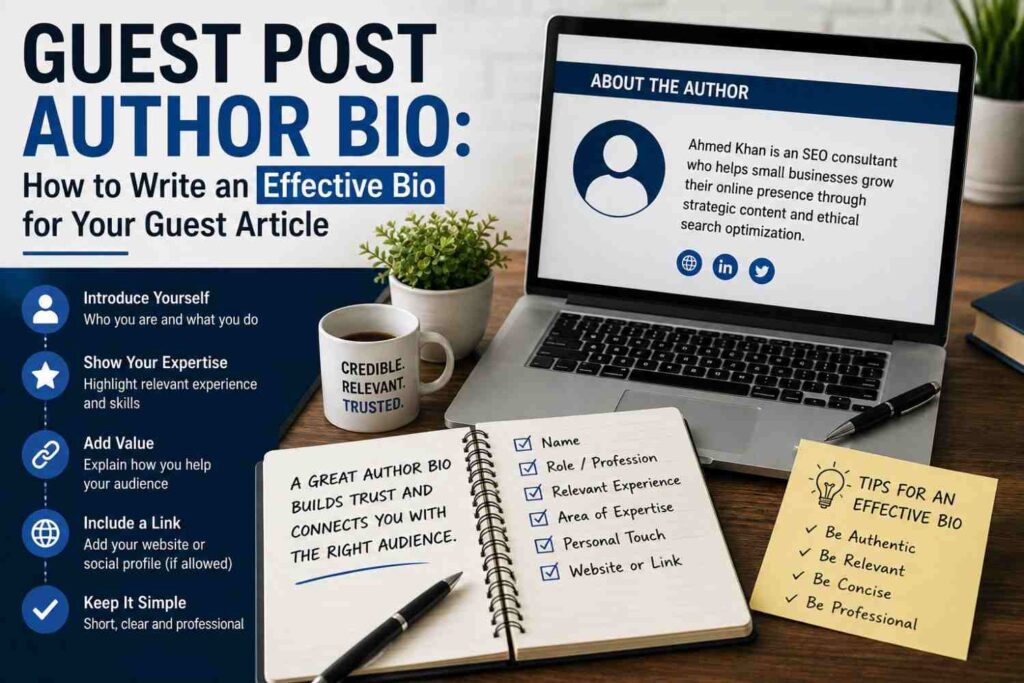
Depending on the publication’s requirements, an author bio may include:
- Your name
- Your professional role
- Relevant experience
- Your area of expertise
- Your company or organization
- A relevant professional or personal detail
- An approved website, portfolio, or professional profile
For example:
Ahmed Khan is a freelance content writer specializing in SEO and digital marketing. He focuses on creating practical, easy-to-understand resources that help small businesses improve their online presence.
This example gives readers useful context without making the bio sound like a sales pitch.
An author bio is also different from a company description. A company description explains what a business does, while an author bio focuses on the person who contributed the content.
Likewise, an author bio is not the same as an author profile page. A profile page may contain a detailed biography, publishing history, social profiles, and a collection of articles. A guest contributor bio is generally much shorter.
Why Is an Author Bio Important for Guest Posts?
A well-written bio can give readers information that is not immediately obvious from the article itself.
Establishing context
Readers can quickly see who created the content and understand the author’s professional background.
Demonstrating relevant expertise
A concise description of relevant experience can help explain why the author is qualified to discuss a particular subject.
For example, someone writing about technical SEO might mention experience with website structure, technical audits, or search-focused content instead of listing unrelated career achievements.
Helping readers understand the author’s background
An author bio answers a simple but useful question:
Who wrote this?
That context can be particularly valuable when an article covers a specialist or professional subject.
Building a professional identity
Accurate contributor bios can help establish a consistent professional identity across publications. The emphasis should be on truthful information rather than trying to make every bio sound impressive.
Providing appropriate attribution
An author bio gives readers a clearer understanding of who contributed the article and what background they bring to the subject.
Google’s guidance emphasizes creating helpful, reliable content for people and making it clear who created content where appropriate. Google’s search quality guidance
Giving readers a way to learn more
When a publication allows links, an author bio can provide a natural next step for readers who want to explore the author’s website, portfolio, or professional profile.
The key is relevance. The bio should support the article rather than compete with it.
What Should a Guest Post Author Bio Include?
A useful guest article author bio usually contains several basic elements.
1. Your Name
Use your real professional name or the name permitted by the publication.
Avoid unnecessary variations between publications unless there is a legitimate professional reason to do so.
2. Your Role or Profession
Tell readers what you do in straightforward language.
Instead of:
Ahmed is a digital growth ninja.
Use:
Ahmed is an SEO consultant who works with small businesses on content strategy and search optimization.
The second version immediately communicates the person’s professional role.
3. Relevant Experience
Mention experience directly related to the article.
For an article about email marketing, relevant experience could include email campaigns, content strategy, marketing automation, or audience research.
You do not need to list every job you have ever held.
4. Area of Expertise
Identify subjects you genuinely understand.
“Digital marketing expert” is broad. “SEO content strategy and technical website optimization” provides more specific context.
Only describe expertise that accurately reflects your background.
5. Company or Brand — When Relevant
Mentioning your company can make sense when it provides useful context about your professional role.
For example:
Sara is a content strategist at BrightPath Digital, where she develops search-focused content for B2B companies.
That provides context.
Compare it with:
Visit BrightPath Digital today for the world’s best and most affordable SEO services.
The second version is advertising rather than an author introduction.
6. A Relevant Personal or Professional Detail
One useful detail can make a bio feel more human.
For example:
Outside of client work, Daniel enjoys testing productivity systems and writing about practical ways to improve remote workflows.
Keep personal information brief and relevant.
7. Optional Website or Profile Link
If the publication permits links, choose a destination that genuinely helps readers.
Possible destinations include:
- A personal website
- A portfolio
- A professional profile
- A company page
- A relevant resource

Follow the publication’s rules and avoid keyword-rich or manipulative anchor text.
How Long Should a Guest Post Author Bio Be?
There is no universal ideal length.
Different publications may request a single sentence, a short paragraph, or a longer biography. Some contributor pages also provide more space than individual articles.
Generally:
- Short bio: Useful when the publication requests a brief introduction.
- Medium-length bio: Appropriate for many guest articles when no specific format is provided.
- Longer bio: Best reserved for publications that specifically request more detail.
When no requirement is provided, concise writing is usually preferable. Include the information that helps readers understand your background and remove everything else.
Do not write to an arbitrary word count simply because you believe a particular length will improve search performance. The usefulness of the information matters more than hitting a specific number of words.
Guest Post Author Bio Examples
The following examples are original and illustrative. They demonstrate different approaches rather than representing real people or credentials.
Example 1: SEO Professional
Maria is an SEO consultant who helps small businesses improve their content strategy, website structure, and organic search visibility. She focuses on practical optimization techniques that business owners can understand and apply.
This works because the author’s professional focus is directly relevant to SEO-related content.
Example 2: Freelance Writer
James is a freelance writer specializing in business, technology, and digital marketing. He focuses on turning complex subjects into clear, practical articles for professional audiences.
This version establishes both the writer’s role and subject areas without unnecessary detail.
Example 3: Business Owner
Nadia runs a small e-commerce business and writes about practical lessons from managing online operations, customer experience, and digital marketing.
The business is mentioned as professional context rather than as an advertisement.
Example 4: Subject-Matter Expert
Dr. Imran Malik is a researcher focused on workplace technology and organizational productivity. His writing explores practical ways businesses can adopt digital tools without creating unnecessary complexity.
The example communicates specialist knowledge without relying on exaggerated claims.
Example 5: Beginner Guest Blogger
Ali is an early-career digital marketer interested in content strategy, SEO, and online publishing. He enjoys researching practical marketing techniques and sharing what he learns with other beginners.
A beginner does not need to pretend to have years of experience. Honest positioning can be more credible than inflated credentials.
Poor vs. Improved Author Bio Examples
Poor Example
Ahmed is the world’s best SEO expert and the founder of the number-one digital marketing company. His unbeatable services have transformed thousands of businesses, and you should contact him today for guaranteed SEO success.
This bio has several problems:
- It is overly promotional.
- It uses unsupported superlatives.
- It focuses heavily on selling a service.
- It makes claims that may not be verifiable.
- It gives readers little useful information about the author’s actual expertise.
Improved Example
Ahmed is an SEO consultant who works with small businesses on content strategy and search optimization. He focuses on creating practical SEO resources that help business owners understand and improve their websites.
The improved version identifies the author’s role, audience, and professional focus without turning the bio into an advertisement.
How to Write a Guest Post Author Bio Step by Step
Step 1: Check the Publication’s Requirements
Before writing your bio, review the publication’s submission rules.
A website may specify:
- Maximum bio length
- First-person or third-person style
- Whether links are permitted
- Which social profiles are allowed
- Whether a headshot is required
- What professional information should be included
Always check the publisher’s requirements before finalizing the bio.
Step 2: Identify the Article’s Main Subject
Look at the article you are submitting and ask:
What part of my background makes me relevant to this subject?
Your answer should influence the bio.
For example, someone writing about content marketing might highlight content strategy experience rather than an unrelated professional background.
Step 3: Choose Your Most Relevant Credentials
Select two or three useful facts.
Prioritize:
- Relevant experience
- Current role
- Subject expertise
- Professional focus
Do not turn the bio into a complete résumé.
Step 4: Write the Main Bio
Create a simple first draft.
A useful structure is:
Name + role + relevant expertise + optional detail + permitted link
For example:
Laura is a freelance writer specializing in SaaS and B2B content. She focuses on creating practical guides that help professional audiences understand complex software and marketing topics.
Step 5: Remove Promotional Language
Read each sentence and ask whether it informs the reader or sells something.
Replace exaggerated phrases with specific, factual descriptions.
For example:
Promotional:
He provides unbeatable SEO services with guaranteed results.
Professional:
He works with small businesses on content strategy and search optimization.
Step 6: Add an Appropriate Link If Allowed
If the publisher permits one link, choose a destination that provides genuine value.
A relevant portfolio may be more useful than a generic commercial landing page. Follow the site’s editorial rules instead of assuming that more links are better.
Step 7: Proofread
Before submission, check:
- Grammar
- Spelling
- Name accuracy
- Job title
- Company information
- Website URL
- Professional claims
- First- or third-person consistency
A short bio still deserves careful editing.
First Person vs. Third Person Author Bios
Both styles can work.
First Person
I am a freelance SEO writer who helps small businesses create practical search-focused content.
First person feels direct and conversational. It may work well on personal websites or publications with a conversational editorial style.
Third Person
Ahmed is a freelance SEO writer who helps small businesses create practical search-focused content.
Third person often fits publications that use formal contributor biographies.
Neither style is universally better. The publication’s editorial style should determine which one you use.
If the website consistently presents contributors in third person, match that format. If it specifically requests first person, follow its instructions.
How to Write an Author Bio Without Sounding Promotional
Credibility and advertising are different.
Too Promotional
Ahmed is the world’s best SEO expert and runs the number-one SEO agency providing unbeatable services.
More Professional
Ahmed is an SEO consultant who works with small businesses on content strategy and search optimization.
The second version provides useful information without making exaggerated claims.
Avoid unsupported phrases such as:
- Best
- #1
- Leading
- World’s top
- Guaranteed
- Unbeatable
If a claim is genuinely verifiable and the publication permits it, it may be appropriate in a specific context. Otherwise, specific and restrained language is usually more credible.
The same principle applies to the article itself: useful information, accuracy, originality, and reader value should come before attempts to influence search systems.
Should You Include a Link in a Guest Post Author Bio?
Only if the publisher permits it.
Possible destinations include:
- Personal website
- Professional profile
- Company website
- Portfolio
- Relevant professional resource
The best destination depends on the article, publication, and reader’s likely next step.
For example, a freelance designer contributing an article about visual branding might reasonably link to a portfolio if the publication allows it.
Avoid treating the bio as a place to insert multiple commercial links or keyword-heavy anchor text.
A link should make sense from a reader’s perspective and comply with the publication’s editorial rules.
How Many Links Should an Author Bio Have?
There is no universal number.
A publication might:
- Allow one website link.
- Allow a website plus selected social profiles.
- Allow no external links.
- Automatically link the author’s name to a contributor profile.
- Require links to be approved by an editor.
More links do not automatically make a bio better.
Follow the site’s specific policy. If one useful link is allowed, select the destination most relevant to readers rather than trying to maximize the number of URLs.
Google’s search spam guidance is especially relevant when considering keyword stuffing, unnatural links, or other attempts to manipulate search systems. Google’s policies on search spam
Common Guest Post Author Bio Mistakes
1. Making the Bio Too Long
Problem: The bio becomes a résumé rather than a short introduction.
Fix: Keep information that helps explain the author’s relevance and remove unrelated details.
2. Using Excessive Promotional Language
Problem: The bio reads like an advertisement.
Fix: Replace sales language with factual descriptions of your role and expertise.
3. Adding Irrelevant Experience
Problem: The bio lists unrelated jobs, hobbies, or achievements.
Fix: Prioritize information connected to the article topic.
4. Exaggerating Credentials
Problem: The writer claims awards, expertise, clients, or results that cannot be substantiated.
Fix: Use accurate information that you can support if questioned.
5. Using Generic Descriptions
Problem: Phrases such as “passionate professional” provide little useful information.
Fix: Explain what you actually do and which subjects you work with.
6. Stuffing Keywords Into the Bio
Problem: The bio sounds unnatural because the same search phrase is repeated.
Fix: Describe your role naturally and write for readers.
7. Adding Too Many Links
Problem: The bio becomes a collection of URLs.
Fix: Use only links permitted by the publication that provide a genuine reader benefit.
8. Ignoring Publication Guidelines
Problem: The bio does not follow the site’s requirements.
Fix: Review contributor instructions before submission.
9. Writing in a Different Style From the Publication
Problem: A formal publication receives an overly casual bio, or a conversational site receives an excessively corporate one.
Fix: Match the publication’s established tone.
10. Using an Outdated Bio
Problem: The author has changed roles, companies, or professional focus but continues using old information.
Fix: Maintain a current master bio and review it regularly.
How to Make Your Author Bio More Credible
Credibility usually comes from accuracy and relevance rather than impressive-sounding language.
Use these principles:
- State your professional information accurately.
- Mention experience related to the article.
- Be specific where useful.
- Avoid unsupported claims.
- Keep information current.
- Connect your expertise to the article topic.
- Use a professional tone.
- Follow the publisher’s requirements.
If you use AI to help draft a bio, treat the output as a starting point rather than a final statement of your credentials. Check factual claims yourself, remove anything inaccurate, and make sure the final version reflects your actual background and the publication’s rules.
AI assistance does not remove the need for human judgment. The finished bio should be accurate, relevant, original, and useful to readers.
Author Bio vs. Company Bio
| Feature | Author Bio | Company Bio |
| Main purpose | Introduce the writer | Introduce the business |
| Focus | Person and expertise | Company and services |
| Tone | Personal/professional | Corporate/professional |
| Typical use | Guest articles, contributor pages | About pages, company profiles |
| Main audience benefit | Understand who wrote the content | Understand what the company does |
A guest article normally benefits from an author-focused bio because readers need context about the contributor.
A company description can provide useful business information, but it should not replace the author’s identity and relevant expertise.
Author Bio for Different Types of Guest Contributors
Freelance Writers
Focus on your writing specialization and the subjects you regularly cover.
Example approach:
Maya is a freelance writer specializing in business technology and digital marketing content.
SEO Professionals
Highlight your specific SEO focus, such as content strategy, technical SEO, or website optimization.
Example approach:
Hassan is an SEO consultant focused on technical optimization and search-focused content strategy.
Marketing Specialists
Mention your relevant marketing discipline, such as content marketing, email marketing, paid advertising, or customer research.
Example approach:
Emma is a marketing specialist focused on content strategy and audience research for growing businesses.
Business Owners
Briefly explain the business and your role in it. Avoid turning the bio into a sales pitch.
Example approach:
Daniel runs an e-commerce business and writes about practical lessons from online operations and customer experience.
Agency Employees
Identify your role within the agency and your professional specialty.
Example approach:
Olivia is a content strategist at a digital marketing agency, where she develops resources for B2B audiences.
Consultants
Explain the type of problems you help clients address, particularly when they relate to the article.
Example approach:
Ryan is a business consultant who helps small companies improve their planning, operations, and digital workflows.
Researchers
Mention your research area and relevant subjects you study.
Example approach:
Ayesha is a researcher focused on workplace technology and digital productivity.
Industry Specialists
Focus on practical professional knowledge that directly supports the article.
Example approach:
Mark is an operations specialist who writes about practical approaches to supply chain planning and process improvement.
Beginners
Be honest about your current level of experience.
Example approach:
Sara is an early-career marketer interested in content strategy, SEO, and online publishing.
You do not need to pretend to have extensive experience. Your current role, interests, education, or developing expertise can provide useful context when relevant.
How to Update Your Guest Post Author Bio
Your bio should change when your professional circumstances change.
Consider updating it after:
- Starting a new role
- Changing companies
- Developing a new area of expertise
- Changing your professional focus
- Updating your website
- Changing your portfolio
- Building relevant experience
- Encountering different publication requirements
A useful approach is to maintain one master bio containing your current information. You can then adapt it for individual publications.
You do not have to use exactly the same version everywhere. A technology publication, marketing website, and specialist industry publication may each require a slightly different emphasis.
How an Author Bio Fits Into the Guest Posting Process
An author bio is only one part of a professional submission.
A simplified workflow looks like this:
Choose a relevant publication → Research the audience → Develop a useful topic → Prepare the pitch → Write the article → Follow submission requirements → Add an appropriate author bio → Submit professionally
Your pitch should explain why the proposed article is useful to that publication’s audience. If you need to improve that part of the process, you can prepare a stronger pitch before submitting.
After submission, follow the publication’s communication preferences. If the site permits follow-up messages, you can follow up with the editor professionally rather than sending repeated promotional messages.
The author bio should support the entire process, not become the main focus of it.
What If Your Guest Post Is Rejected?
A rejected guest article is not necessarily evidence that the author bio was the problem.
Editors may reject submissions because of:
- Topic mismatch
- Weak pitch
- Poor content quality
- Guideline violations
- Excessive promotion
- Lack of editorial fit
- A topic that has already been covered
- Limited editorial space
- Changing publication priorities
If a publication rejects an article, review the complete submission rather than immediately rewriting only the bio.
A strong author bio cannot compensate for an article that does not meet the publication’s expectations.
Guest Post Author Bio Checklist
| Check | Question |
| Name | Is the author’s name accurate? |
| Relevance | Does the bio relate to the article topic? |
| Expertise | Does it clearly explain relevant experience? |
| Accuracy | Are all claims truthful and current? |
| Length | Does it meet the publication’s requirements? |
| Promotion | Is promotional language limited? |
| Links | Are links allowed and genuinely useful? |
| Style | Does the bio match the publication? |
| Grammar | Has it been properly proofread? |
Frequently Asked Questions
What is a guest post author bio?
It is a short description of the person who contributed an article to another publication. It usually explains the author’s role, relevant expertise, and sometimes provides an approved website or professional profile link.
What should I include in a guest post bio?
Include your name, professional role, relevant experience, area of expertise, and optionally one useful personal or professional detail. Add links only when the publication permits them.
How long should a guest post author bio be?
There is no universal length. Follow the publisher’s requirements. When no length is specified, a concise paragraph containing the most relevant information is usually sufficient.
Should a guest post bio be written in first or third person?
Either style can work. The publication’s editorial style should determine the choice. Use third person if contributor bios are normally written that way, and first person if the publication requests or prefers it.
Should I include my website in my author bio?
Only if the publication allows it and the website provides a useful destination for readers. A relevant portfolio or professional website can be appropriate.
How many links should an author bio contain?
There is no universal number. Some publications allow one website link, while others permit social profiles or no external links at all. Follow the specific rules.
Can I use the same author bio for every guest post?
You can maintain a master bio, but adapting it to the publication and article topic is often more useful. Highlight the expertise most relevant to each contribution.
Should I mention my company in a guest post bio?
Yes, when it provides useful context about your professional role. Keep the mention factual and avoid turning the bio into an advertisement.
How do I write an author bio if I am a beginner?
Be honest. Explain what you currently do, what subjects you are learning or working in, and what perspective you bring to the article. Do not invent credentials to appear more experienced.
What should I avoid in a guest post author bio?
Avoid exaggerated claims, irrelevant experience, excessive promotional language, keyword stuffing, unnecessary links, fabricated credentials, and information that conflicts with the publication’s requirements.
Can an author bio affect guest post acceptance?
It can form part of an editor’s overall assessment of a submission, but there is no universal bio format that guarantees acceptance. Editorial fit, article quality, relevance, and compliance with the publication’s requirements can all matter.
Conclusion
A strong guest post author bio does not need to be complicated.
It should:
- Clearly identify the writer.
- Establish relevant expertise.
- Give readers useful context.
- Stay concise.
- Avoid exaggerated claims.
- Limit promotional language.
- Follow publication requirements.
- Use links responsibly.
- Match the publication’s editorial style.
Think of the bio as a bridge between the article and its author. It should help readers understand who contributed the information and why that person’s background is relevant.
The strongest approach is not to make the bio sound as impressive as possible. It is to make it accurate, relevant, credible, concise, and useful.
When the author bio supports the article instead of competing with it, it becomes a natural part of a professional guest contribution rather than an advertisement attached to one.