
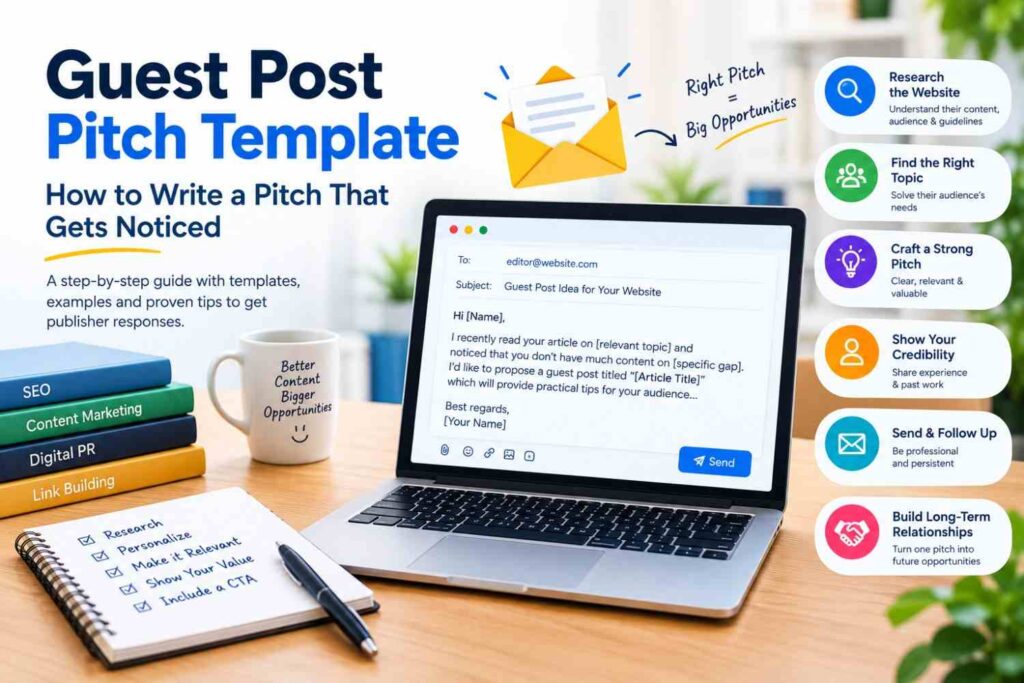
A strong guest post pitch gives a publisher a clear reason to consider your article idea. Instead of sending a generic message asking, “Do you accept guest posts?”, an effective pitch demonstrates that you understand the website, its audience, and the type of content its readers need.
If you are looking for a guest post pitch template, this guide gives you more than a copy-and-paste email. You will learn how to research a publication, identify suitable topics, create a useful article angle, personalize your pitch, present your credentials, follow up professionally, and build lasting relationships with publishers.
The goal is simple: make your proposed article useful enough that an editor can quickly understand why it belongs on their website.
What Is a Guest Post Pitch?
A guest post pitch is a short proposal sent to a website owner, editor, blogger, publisher, or content manager suggesting an article you would like to contribute.
A good pitch normally answers five basic questions:
- Who are you?
- What do you want to write about?
- Why does the topic fit this website?
- What will readers gain from it?
- What should the publisher do next?
The pitch is not the article itself. It is an opportunity to show that your proposed article deserves consideration.
For example, compare these two approaches:
“Hi, I want to write a guest post about SEO. Do you accept guest posts?”
With:
“I noticed your marketing section covers content strategy and SEO fundamentals but has limited content on evaluating existing content before creating new pages. I would like to propose a practical guide showing small businesses how to identify pages that should be updated, consolidated, or expanded.”
The second pitch gives the editor something concrete to evaluate.
This reader-first approach also fits Google’s broader guidance around creating useful content for people rather than producing content primarily for search-engine manipulation. Google’s SEO documentation provides additional guidance on creating useful, well-structured content.
Guest Post Pitch vs. Guest Post Outreach Email
A guest post pitch and a guest post outreach email are closely connected, but they serve slightly different purposes.
The outreach email is the communication you send to the publisher.
The pitch is the article proposal contained within that communication.
For example:
Outreach introduction:
“Hi Sarah, I recently read your article about content marketing and noticed that you cover content planning in detail.”
Guest post pitch:
“I would like to propose an article titled ‘How to Audit Existing Content Before Publishing More’…”
Your outreach email gets the publisher’s attention. Your pitch gives them a reason to continue the conversation.
For more practical outreach guidance, see these email pitch examples and adapt the structure to each publisher rather than sending the exact same message everywhere.
What Should a Guest Post Pitch Include?
A professional guest post pitch does not need to be complicated.
| Pitch element | Purpose |
| Personalized introduction | Shows that you researched the publication |
| Relevant topic | Gives the editor a specific idea to evaluate |
| Proposed headline | Makes the concept immediately understandable |
| Content angle | Explains how the article will approach the subject |
| Website fit | Shows why the topic belongs on that publication |
| Reader benefit | Explains what readers will learn or accomplish |
| Writer credibility | Establishes relevant expertise |
| Writing samples | Demonstrates the quality of your work |
| Call to action | Gives the editor an easy next step |
The strongest pitches are generally specific, relevant, concise, and easy to scan.
How to Write a Guest Post Pitch Step by Ste

1. Research the Website
Before writing the pitch, research the publication.
Look at:
- Main categories
- Recently published articles
- Existing guides
- Article formats
- Target audience
- Writing style
- Author pages
- Editorial guidelines
- Guest contribution requirements
Do not rely only on the homepage.
Read several relevant articles so you can understand what the publication actually considers useful.
If the site already has a detailed contributor page, follow those instructions before contacting an editor directly.
2. Understand the Audience
The right topic for one website can be completely wrong for another.
Imagine a website whose audience consists mainly of small business owners.
A pitch such as:
“Enterprise-Level International SEO Architecture for Global Corporations”
may not be the best fit.
A more suitable idea could be:
“A Practical SEO Checklist for Small Businesses Launching a New Website”
Before pitching, ask:
Would this publication’s existing readers genuinely find this useful?
That question should matter more than whether the topic happens to contain a valuable keyword.
3. Review Existing Content
Search the website before proposing your idea.
You want to avoid pitching an article that is almost identical to something already published.
Review:
- Recent articles
- Related posts
- Category archives
- Popular guides
- Existing headlines
- Internal links
- Articles covering adjacent topics
Look for both overlap and opportunities.
For example, a website might already have:
“What Is Link Building?”
But it may not have:
“How to Evaluate a Link-Building Opportunity Before Outreach”
The second topic can complement the existing content without simply repeating it.
4. Identify a Content Opportunity
A content gap does not always mean a subject has never appeared on the website.
It could mean:
- An existing topic is too broad
- A practical tutorial is missing
- A beginner guide needs an advanced follow-up
- Readers need examples
- An important subtopic has not been explained
- Several related concepts could be brought together in one useful guide
This is where good pitching becomes more than simply asking for a publishing opportunity.
You are identifying something the publication could reasonably add to its content library.
5. Choose a Relevant Topic
A useful topic generally sits where three factors overlap:
Website relevance + audience need + your ability to provide useful information
Before adding a topic to your pitch, ask:
- Does the website cover this subject?
- Is the audience likely to care?
- Is there already a similar article?
- Can I offer a useful angle?
- Can I provide examples or practical steps?
- Does the topic fit the site’s editorial style?
If you are new to guest blogging, review these guest blogging basics before building a larger outreach campaign.
6. Create a Specific Headline
A proposed headline helps an editor understand your idea quickly.
Weak:
SEO Tips
Better:
7 SEO Checks to Complete Before Publishing a New Business Website
Stronger headlines are usually:
- Specific
- Clear
- Relevant
- Useful
- Appropriate for the target publication
Avoid sensational claims such as:
The Secret SEO Strategy That Will Instantly Double Your Traffic
You cannot guarantee such an outcome, and exaggerated claims can make an otherwise useful proposal look promotional.
7. Explain the Article Angle
The headline tells the editor what you want to write.
The angle explains how you plan to write it.
For example:
Headline:
Local SEO for New Businesses
Weak angle:
“The article will explain local SEO.”
Stronger angle:
“The article will focus on the practical local SEO tasks a new business should prioritize when launching, including business information consistency, local landing pages, review processes, and basic performance tracking.”
The second version gives the editor a much clearer picture of the finished article.
8. Explain Why It Fits the Website
This is one of the most important parts of your pitch.
Instead of saying:
“I think your readers will love this.”
Explain why.
For example:
“Your website already covers general SEO fundamentals, but this article would give small business owners a practical process for handling local SEO during their first few weeks after launch.”
That statement connects:
existing content → audience → proposed topic
This is much more persuasive than a generic compliment.
9. Personalize the Introduction
Good personalization goes beyond using the editor’s first name.
Mention something specific that demonstrates you actually researched the site.
For example:
“I recently read your guide to content audits, particularly the section about identifying outdated pages.”
Then connect that observation to your proposal:
“That prompted an idea for a practical follow-up focused specifically on deciding whether an underperforming page should be updated, consolidated, or removed.”
This type of personalization takes more effort, but it also makes the message more relevant.
10. Establish Your Credibility
You do not need an impressive list of brand names to demonstrate that you can write a useful article.
Relevant credibility might include:
- Your professional experience
- Your area of expertise
- Published articles
- A portfolio
- Experience working with a particular subject
- Relevant educational or professional background
Keep this section short.
Your pitch should answer:
“Why can this person write this article?”
It should not become a full biography.
11. End With a Simple CTA
Make the next step easy.
For example:
“Would this topic be a fit for your upcoming content calendar?”
Or:
“If the idea is relevant, I can send a detailed outline for review.”
Avoid asking the editor to answer five different questions in the first email.
One clear CTA is enough.
Guest Post Pitch Template
Use the following as a starting point, then customize the important details for every publication.
Subject: Guest Article Idea for [Website Name]
Hi [First Name],
I recently read your [specific article/category] about [specific subject] and noticed that your website covers [relevant topic].
I would like to propose an original guest article:
Proposed title: [Specific Article Title]
Angle: [Explain in 1–2 sentences what the article will cover, how it will approach the topic, and why it would be useful to the site’s audience.]
The article would help readers [specific benefit or outcome]. I would make it practical, original, and aligned with your editorial requirements.
A few relevant writing samples:
- [Sample 1]
- [Sample 2]
- [Sample 3]
Would this topic be a good fit for your site?
Best,
[Your Name]
How to customize this template
Do not simply replace [First Name] and [Website Name].
Customize:
- The opening observation
- The proposed topic
- The article angle
- The reader benefit
- Your most relevant samples
Those are the parts that make a template feel like an actual editorial proposal.
Short Guest Post Pitch Template
When contacting a busy publisher, a concise pitch can be appropriate.
Subject: Article Idea for [Website]
Hi [Name],
I enjoyed your recent article about [specific topic].
I’d like to propose an original article titled:
“[Proposed Headline]”
The article would explain [brief angle] and help readers [specific benefit].
Here are two relevant writing samples:
- [Sample]
- [Sample]
Would this be a fit for your upcoming content?
Best,
[Name]
The short version works best when the topic is already very closely aligned with the publication.
Guest Post Pitch Email Example
Here is a realistic example for a marketing publication.
Subject: Article idea: SEO reporting for small businesses
Hi Emma,
I recently read your guide on measuring marketing performance, particularly the section about choosing meaningful KPIs.
I have an article idea that could complement that topic:
Proposed title: SEO Reporting for Small Businesses: 10 Metrics Worth Tracking
The article would explain which SEO metrics small businesses should monitor, what each metric can tell them, and which numbers can be misleading when viewed without context. The approach would be practical rather than tied to one specific SEO platform.
I can include examples and a simple reporting framework readers could adapt to their own websites.
Relevant writing samples:
- [Sample article]
- [Sample article]
Would this be a useful addition to your editorial calendar?
Best,
[Your Name]
Notice that the email does not begin by asking for a backlink.
It begins with an editorial idea.
Guest Post Pitch for a Marketing Website
Marketing websites often cover broad subjects, so your pitch should explain exactly what makes your idea useful.
Example
Subject: Content idea for [Marketing Website]
Hi [Name],
I was reading your recent content on content strategy and noticed that you cover planning and distribution but have less material focused on evaluating existing content before producing more.
I’d like to propose:
“How to Audit Existing Content Before Publishing More”
The article would show marketers how to identify pages that may need updating, consolidation, expansion, improved internal linking, or no changes at all.
Rather than another general content marketing checklist, the article would give readers a practical decision-making framework they can use when reviewing an existing content library.
Relevant samples:
- [Sample]
- [Sample]
Would this be a useful topic for your audience?
Best,
[Name]
The key is the specific content opportunity.
Guest Post Pitch for a Technology Website
Technology publications often serve more specialized audiences, so your proposal should demonstrate technical relevance.
Example
Subject: Technology article idea: Website performance monitoring
Hi [Name],
I was reading your recent coverage of website performance and noticed that several articles focus on optimization, while there is less coverage of what teams should monitor after significant changes are deployed.
I’d like to propose:
“Website Performance Monitoring: What to Check After Every Major Release”
The article would cover practical checks for page speed, broken resources, JavaScript issues, mobile usability, and other user-facing problems that can appear after a deployment.
I would keep the guide platform-neutral and make the checks understandable to both developers and technically minded marketers.
Relevant samples:
- [Sample]
- [Sample]
Would you be open to reviewing the idea?
Best,
[Name]
Guest Post Topic Pitch Examples
Different publications need different content angles.
| Website type | Topic idea | Why it could fit |
| Marketing | How to Audit Existing Content Before Creating More | Helps marketers improve content efficiency |
| SEO | SEO Checks Before a Website Redesign | Addresses a practical SEO problem |
| Technology | Website Performance Checks After a Major Release | Useful for technical audiences |
| SaaS | How to Create a Product Onboarding Checklist | Provides a practical product workflow |
| Small Business | Local SEO Checklist for New Businesses | Solves an early-stage business need |
| E-commerce | Product Page Checks Before Launch | Supports an important e-commerce workflow |
| Entrepreneurship | Turning Customer Questions Into Content Ideas | Connects customer research with content strategy |
Do not choose a topic simply because it has a valuable keyword.
Choose it because the publication’s audience has a reason to read it.
Guest Post Pitch Subject Lines
Your subject line should make the purpose of the email obvious.
Useful options include:
- Guest article idea for [Website]
- Article idea for [Website]
- Content idea: [Specific Topic]
- Guest contribution: [Topic]
- Proposed article for [Website]
- [Topic] article idea
- Content suggestion for [Website]
- Possible guest article: [Topic]
Avoid misleading or overly promotional subject lines such as:
- “You won’t believe this!”
- “Amazing opportunity!!!”
- “URGENT”
- “Guaranteed traffic”
- “Quick question”
A clear subject line sets the right expectation.
Common Guest Post Pitch Mistakes
Sending Generic Pitches
Templates can save time, but an unchanged mass email often looks exactly like that: a mass email.
Better approach: Keep a basic structure but customize the publication reference, topic, angle, and relevant samples.
Ignoring Editorial Guidelines
If a publication says:
- Submit through a specific form
- Pitch two or three topics
- Include an outline
- Avoid certain subjects
- Follow a particular formatting style
follow those instructions.
Editorial guidelines are there to make the process easier for both sides.
Pitching Irrelevant Topics
A high-quality article can still be rejected if it does not belong on the publication.
Always prioritize audience relevance.
Reusing the Same Pitch Everywhere
Use a template as a framework—not as an excuse to remove personalization.
The structure can stay similar while the actual proposal changes.
Writing an Extremely Long Email
Your pitch is not the article.
The editor should quickly understand:
who you are + what you propose + why it fits + what happens next
If the first email contains several pages of explanation, the important information may get buried.
Focusing Only on Backlinks
When your main argument is:
“I want to publish because I need a backlink,”
the editorial value becomes secondary.
Instead, lead with:
- Reader value
- Topic relevance
- Originality
- Article quality
- Editorial fit
If the publisher allows links, follow its linking policy.
Using Exaggerated Claims
Avoid statements such as:
“This article will definitely generate thousands of visitors.”
You cannot guarantee traffic, rankings, social shares, or conversions.
Explain what the article will actually provide.
Sending Too Many Topics
A huge list of topics can create unnecessary work for the publisher.
One strong idea is often easier to evaluate. If the publisher requests multiple options, provide the requested number.
Poor Grammar and Formatting
Your pitch is also a sample of your communication.
Proofread:
- Grammar
- Spelling
- Names
- Website names
- Article titles
- Portfolio links
- Formatting
A simple mistake can make the message look careless.
Following Up Too Aggressively
A professional follow-up is reasonable.
Repeated emails every day are not.
Give the publisher enough time to review your proposal.
How to Improve Guest Post Pitch Response Rates
There is no guaranteed response rate, but you can improve the quality of your outreach process.
Prioritize relevance
Contact publications where your topic genuinely belongs.
Research before pitching
Understand the website before writing the email.
Propose a specific idea
“Can I write about digital marketing?” is difficult to evaluate.
“7 Digital Marketing Metrics Small Businesses Should Track Monthly” gives the editor something concrete.
Explain the reader benefit
Tell the publisher what readers will learn, solve, compare, or accomplish.
Personalize intelligently
Reference something real about the publication.
Keep the message concise
Respect the editor’s time.
Use relevant writing samples
Choose samples that demonstrate your ability to write about the proposed subject.
Check every link
Broken or irrelevant portfolio links can reduce confidence.
Use a professional sender identity
Your email address and signature should make it easy for the publisher to understand who is contacting them.
Track your outreach
Keep a simple record containing:
- Website
- Contact person
- Date contacted
- Topic pitched
- Follow-up date
- Response
- Outcome
This prevents duplicate outreach and makes follow-up much easier.
When Should You Follow Up?
There is no universal waiting period for every publisher.
If the website provides a submission timeline, follow it.
If no timeline is provided, waiting several business days before sending one concise follow-up is a reasonable approach.
Follow-Up Example
Subject: Re: Article idea for [Website]
Hi [Name],
Just following up on the article idea I sent regarding “[Topic]”.
I understand you may be busy, so I wanted to check whether the topic could be a fit for your upcoming content calendar.
I’m happy to provide an outline if useful.
Best,
[Name]
If there is still no response, avoid turning the conversation into a series of repeated reminders.
Guest Post Pitch Best Practices
Before sending your pitch, check the following:
- Research the publication.
- Understand its audience.
- Read the editorial guidelines.
- Review existing content.
- Look for a genuine content opportunity.
- Choose a specific topic.
- Create a clear headline.
- Explain the article angle.
- Explain the reader benefit.
- Personalize the introduction.
- Include relevant samples.
- Keep the email concise.
- Use a clear subject line.
- End with one simple CTA.
- Proofread the message.
- Check every link.
- Follow up politely.
- Respect the publisher’s decision.
- Build relationships instead of treating every publication as a one-time link opportunity.
If you are building a larger prospecting list, you can also review websites that accept guest contributions and evaluate each opportunity based on relevance, editorial standards, and audience fit.
How to Build Genuine Relationships With Publishers
Guest blogging becomes more valuable when you treat publishers as long-term content partners rather than one-time link sources.
When a publisher accepts your contribution:
- Deliver the article on time.
- Follow the agreed requirements.
- Respond professionally to editorial feedback.
- Avoid unnecessary promotional language.
- Submit original work.
- Thank the editor after publication.
- Share the published article where appropriate.
- Keep future ideas relevant.
- Respect the site’s linking policy.
- Avoid repeatedly asking for additional links.
A good first collaboration can make future conversations much easier.
The objective is not simply to get one article published.
It is to become someone the publisher can trust to provide useful content.
Should You Mention Backlinks in a Guest Post Pitch?
Usually, backlinks should not be the main focus of your initial pitch.
Your strongest argument should be:
This is a useful article for your audience.
Not:
This article will give me a backlink.
If a publisher has specific rules about links, attribution, author bios, or promotional references, follow those rules.
Links can provide useful context when they genuinely help readers. Google’s SEO guidance also recommends using descriptive link text and linking where it is useful to users.
The practical rule is simple:
Pitch the content first. Follow the publication’s linking rules second.
Email Deliverability Tips for Guest Post Outreach
Even legitimate editorial outreach needs sensible email practices.
Use a professional sender identity, avoid misleading subject lines, keep your messages relevant, and maintain good email-sending practices.
Mailchimp’s email deliverability tips cover areas such as sender reputation, authentication, list hygiene, and content practices that can affect delivery.
For guest post outreach, relevance is especially important. Sending highly targeted messages to appropriate publications is a better approach than indiscriminate bulk emailing.
Frequently Asked Questions
What is a guest post pitch?
A guest post pitch is a proposal sent to a publisher or editor suggesting an article you would like to contribute. It normally explains the topic, angle, audience benefit, credibility, and next step.
How do I pitch a guest post?
Research the website, understand its audience, review existing content, identify a suitable topic, create a specific headline, explain the angle, personalize your message, provide relevant samples, and finish with a simple CTA.
What should a guest post pitch include?
A good pitch usually includes a personalized introduction, proposed topic, headline, article angle, website fit, reader benefit, relevant credentials or samples, and a clear next step.
How long should a guest post pitch be?
Keep the initial pitch concise. A few short paragraphs are usually enough to explain the proposal. The editor should understand your idea without reading the entire article.
How many topics should I suggest?
One strong topic is often sufficient. If the publication specifically asks for multiple ideas, provide the number requested.
Should I include article samples?
Yes, when appropriate. Two or three relevant samples can help demonstrate your writing quality. Choose examples related to the proposed topic or publication whenever possible.
How long should I wait before following up?
If no response timeline is provided, wait several business days before sending a short follow-up. Always prioritize the publisher’s stated submission process.
Why are guest post pitches ignored?
Common reasons include poor topic relevance, generic personalization, weak subject lines, overly long emails, irrelevant writing samples, failure to follow editorial guidelines, and excessive focus on backlinks.
A good pitch can also go unanswered simply because publishers receive many submissions.
Should I mention backlinks in a guest post pitch?
Do not make backlinks the central selling point. Lead with the article’s usefulness, relevance, and editorial fit. Follow the publisher’s specific rules regarding links.
Can I use the same guest post pitch template for every website?
You can use the same basic structure, but important sections should be customized for every publication. The introduction, topic, angle, audience fit, and writing samples should be relevant to the recipient.
What makes a guest post pitch stand out?
Specificity.
A strong pitch demonstrates that you understand the publication and have a concrete idea that would be useful to its readers. A specific article proposal is much easier to evaluate than a generic request to “write a high-quality guest post.”
Final Takeaway
A successful guest post pitch is not about finding a magic sentence that guarantees an editor’s approval.
It is about making a relevant editorial proposal.
Research the publication. Understand its audience. Review its existing content. Identify a genuine opportunity. Propose a specific topic. Explain the angle and reader benefit. Personalize your message. Provide relevant samples. Keep the email concise. Then follow up respectfully.
Use this guest post pitch template as a framework, but adapt it to every publication you contact.
The strongest outreach feels less like a sales message and more like a useful content idea arriving at the right publication at the right time.