
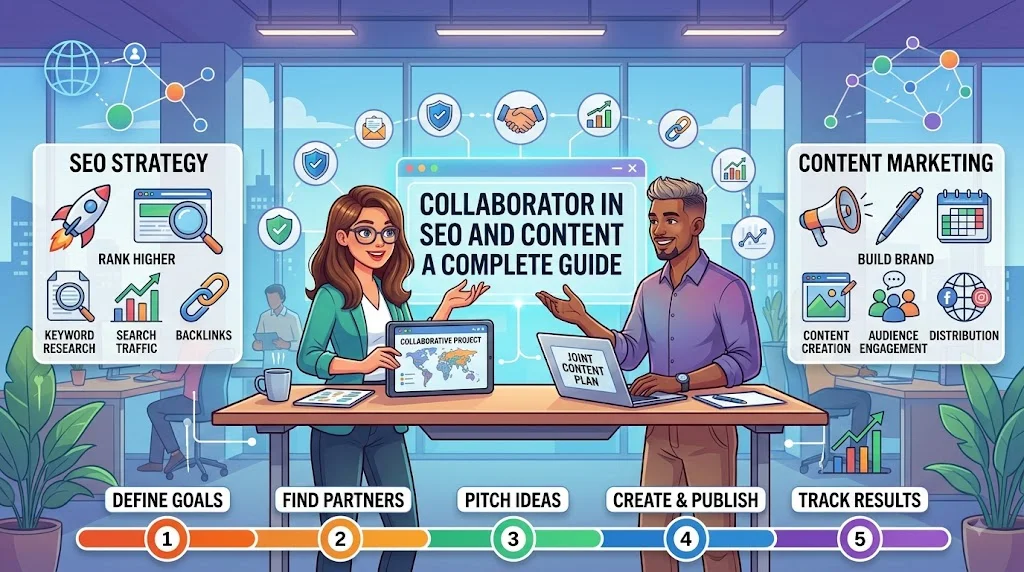
A collaborator is someone who works with another person, business, publisher, or organization to achieve a shared objective. In SEO and content marketing, collaboration can involve creating content, sharing expertise, reaching new audiences, building relationships, and developing valuable publishing opportunities.
For website owners and digital marketers, the right collaborator can become much more than a content contributor. A relevant collaborator may be a blogger, SEO specialist, publisher, brand, subject-matter expert, content creator, or marketing professional.
When collaboration is based on relevance and genuine value, it can support content marketing, digital PR, brand awareness, referral traffic, and a sustainable SEO strategy.
This guide explains what a collaborator means in SEO, the different types of content collaborators, how to find them, how to approach them, and how collaboration can become part of a strong guest posting strategy.
What Is a Collaborator?
A collaborator is a person or organization that works together with another party to accomplish a shared goal.
In digital marketing, a collaborator may contribute:
- Original content
- Industry expertise
- Research or data
- Expert opinions
- Website publishing opportunities
- Audience access
- Content promotion
- Marketing knowledge
For example, an SEO professional may collaborate with a marketing website by writing an educational article. The publisher receives useful content for its audience, while the contributor gains exposure and an opportunity to demonstrate expertise.
The relationship is based on mutual value, not simply on exchanging links.
What Does Collaborator Mean in SEO?
In SEO, a collaborator is generally someone who participates in creating, publishing, promoting, or distributing content that supports a website’s broader marketing goals.
An SEO collaborator could be:
- A content writer
- A website publisher
- A blogger
- An SEO consultant
- A digital marketing agency
- A business owner
- A subject-matter expert
- A PR professional
- A brand representative
Collaboration can happen through guest posts, expert interviews, research studies, content partnerships, podcasts, webinars, expert roundups, and other forms of content.
The important factor is relevance.
A collaboration between two websites with related audiences can be much more useful than a partnership created only to obtain a backlink.
Google’s guidance emphasizes creating helpful, reliable, people-first content rather than content created primarily to manipulate search rankings. Google Search Central: Creating Helpful, Reliable, People-First Content
Why Are Collaborators Important for Content Marketing?
Content marketing requires more than publishing articles.
A website may have excellent content but limited reach. Another publisher may have an established audience but need fresh expertise. Collaboration can connect these resources.
Reach New Audiences
A contributor can introduce their expertise to an audience they could not easily reach through their own website.
Create Better Content
Different collaborators bring different experiences and perspectives.
An SEO expert, for example, may provide technical knowledge that a general marketing writer does not have.
Build Professional Relationships
A successful collaboration can lead to future opportunities such as interviews, guest articles, expert contributions, podcasts, webinars, and joint research.
Increase Brand Awareness
Being featured on relevant websites can help people become familiar with your business and expertise.
Generate Referral Traffic
If readers find your contribution useful, they may visit your website to learn more.
These benefits make collaboration a broader strategy than simply acquiring backlinks.
Collaborator vs. Guest Poster
A guest poster and collaborator can overlap, but they are not exactly the same.
A guest poster generally writes and contributes an article to another website.
A collaborator has a broader role.
A collaborator may:
- Write a guest article
- Provide expert quotes
- Participate in an interview
- Contribute original research
- Join a podcast
- Co-create an industry guide
- Participate in a webinar
- Share professional insights
- Help promote useful content
Therefore, guest posting is one form of content collaboration.
Understanding this distinction can help marketers build more diverse relationships instead of relying on one type of link-building activity.
How Collaborators Support Topical Authority
Topical authority comes from demonstrating meaningful coverage of a subject rather than publishing one isolated article.
For example, a website focusing on guest posting could build supporting content around:
- Guest posting for beginners
- Guest post outreach
- Guest posting opportunities
- Guest post guidelines
- Content collaboration
- Publisher outreach
- Link building
- Editorial links
- Anchor text
- Referral traffic
- Content marketing
- Digital PR
- SEO outreach
These topics are closely connected.
For example, someone learning the fundamentals can continue to a detailed guest posting for beginners guide.
A reader who already understands guest posting but wants to learn how to contact publishers can continue to the guest post outreach guide.
This type of contextual internal linking helps users discover related information while creating a clearer topical relationship between pages.
Types of SEO and Content Collaborators
Different collaborators can support different marketing objectives.
Website Publishers
Publishers provide access to an established audience and may accept expert contributions that fit their editorial standards.
SEO Professionals
SEO specialists can contribute knowledge about search optimization, technical SEO, keyword research, content strategy, and link evaluation.
Content Writers
Experienced writers can help transform research and expertise into useful, readable content.
Subject-Matter Experts
Experts can provide first-hand knowledge, examples, opinions, and unique insights.
Brands
Brands can collaborate with publishers or complementary businesses on educational resources, research, and industry content.
Digital PR Professionals
PR specialists can help turn original research, expert commentary, or newsworthy information into media opportunities.
The best collaborator depends on the goal of the campaign.
How to Find the Right Collaborator
Finding a collaborator should begin with relevance rather than quantity.
1. Define Your Objective
First decide what you want to achieve.
Are you trying to:
- Publish educational content?
- Reach a new audience?
- Build brand awareness?
- Create original research?
- Find expert contributors?
- Develop a content partnership?
Your objective will determine the type of collaborator you need.
2. Look for Topical Relevance
The potential collaborator should have knowledge, content, or an audience related to your subject.
For example, an SEO website could look for collaborators in:
- Digital marketing
- SaaS
- Web development
- Business
- Entrepreneurship
- Content marketing
- Technology
3. Check Content Quality
Review their existing work.
Look for original information, accurate explanations, useful examples, clear writing, and consistent editorial standards.
4. Evaluate the Audience
A smaller audience that is highly relevant can be more valuable than a large audience with little connection to your subject.
5. Check Their Professional Reputation
Look at the website, published content, authors, social presence, and overall reputation.
Don’t judge a potential collaborator only by third-party SEO metrics such as Domain Rating or Domain Authority.
How to Approach a Potential Collaborator
Successful collaboration starts with relevant outreach.
Before sending a message, research the person or website.
Mention something specific about their work and explain why your idea would benefit their audience.
For example:
“I noticed that your website regularly publishes practical digital marketing content. I’d like to contribute an original guide explaining how businesses can build effective content collaborations and identify relevant publishing opportunities.”
This is more effective than sending a generic message that only asks for a backlink.
Your outreach should explain:
- Who you are
- Why you’re contacting them
- What you want to collaborate on
- What value you can provide
- Why the idea fits their audience
Keep the message concise and professional.
How to Build a Successful Guest Posting Collaboration
Guest posting works best when the contributor and publisher both care about the reader.
Start by identifying websites that publish content relevant to your expertise.
Then research their existing articles and find a genuine content gap.
Create a topic that:
- Fits the publication
- Answers a real question
- Provides practical information
- Adds something new
- Matches the site’s editorial standards
After the topic is accepted, write original content specifically for that audience.
Don’t simply copy an article from your own website and change a few words.
A strong guest article should feel like it belongs on the publisher’s website.
How Should Links Be Used in Collaboration?
Links should support the content rather than dominate it.
For example, if an article explains how to contact publishers, a relevant outreach resource can provide additional information.
Avoid forcing exact-match commercial keywords into every link.
Natural anchor text can include:
- guest post outreach guide
- learn more about guest posting
- relevant resource
- detailed guide
- content collaboration
The destination should be genuinely useful to the reader.
Google’s documentation explains that links should be created and qualified appropriately according to their relationship and purpose. Google Search Central: Qualify Outbound Links
Common Collaborator Mistakes
Choosing Collaborators Only for Backlinks
A backlink should not be the sole reason for a partnership.
Consider audience, expertise, relevance, and content quality.
Ignoring Topical Relevance
A link or article from an unrelated website may provide little value to readers.
Using Over-Optimized Anchor Text
Repeatedly using the same keyword as anchor text can make links appear unnatural.
Publishing Thin Content
Collaboration should result in something useful, not another generic article.
Sending Mass Outreach
Copying the same message to hundreds of websites often produces poor results.
Personalized outreach demonstrates that you’ve actually researched the publication.
Focusing Only on SEO Metrics
SEO metrics can help with prospecting, but they don’t replace manual evaluation.
Collaboration and Link Building
Collaboration and link building can overlap, but they should not be treated as exactly the same thing.
Traditional link building focuses heavily on acquiring links.
Content collaboration focuses on creating value through relationships, expertise, publishing, and audience development.
A natural link may become part of a successful collaboration, but the content should remain useful without it.
Google has specifically discussed the risks of large-scale guest-post campaigns that primarily exist to build links rather than provide value to users. Google Search Central: A Reminder About Links in Large-Scale Article Campaigns
This is why modern SEO collaboration should prioritize quality and relevance.
Collaboration and Digital PR
Collaborators can also play an important role in digital PR.
Instead of producing another standard blog post, you could work with experts to create:
- Original research
- Industry surveys
- Expert roundups
- Data reports
- Interviews
- Case studies
- Industry predictions
- Research-based guides
These assets can provide information that publishers and readers actually want to reference.
For example, a company could survey 100 marketing professionals about their SEO priorities and publish the findings as an original report.
Experts who contributed to the research may also share it with their audiences.
That creates a much stronger reason for people to discuss and reference the content.
How to Build Long-Term Collaborator Relationships
The most valuable collaborators are often long-term partners.
After a successful project:
- Thank the contributor or publisher
- Share the published content
- Keep communication professional
- Suggest relevant future ideas
- Offer useful expertise
- Support their content when appropriate
- Stay connected
A single successful guest post can eventually become an ongoing content relationship.
That relationship may lead to more articles, interviews, research projects, podcasts, webinars, and other opportunities.
A Simple Collaborator Strategy for Beginners
If you’re starting from scratch, use this process:

Step 1: Choose Your Topic
Decide what subject you want to build authority around.
Step 2: Define Your Ideal Collaborator
Determine whether you need a publisher, writer, expert, brand, or SEO professional.
Step 3: Build a Prospect List
Find relevant websites and professionals within your niche.
Step 4: Research Each Prospect
Check relevance, content quality, audience, expertise, and reputation.
Step 5: Create a Collaboration Idea
Develop an idea specifically suited to each prospect.
Step 6: Send Personalized Outreach
Explain the mutual value of the opportunity.
Step 7: Create Original Content
Make the final content useful, accurate, and relevant.
Step 8: Add Contextual Links
Include links only when they genuinely help readers.
Step 9: Promote the Content
Share the published work through appropriate channels.
Step 10: Maintain the Relationship
Look for opportunities to collaborate again.
Final Thoughts
A collaborator in SEO and content marketing is much more than someone who helps obtain a backlink.
The right collaborator can bring expertise, content ideas, audience access, industry relationships, brand exposure, referral traffic, and new publishing opportunities.
For guest posting, the strongest relationships are built around relevance, quality, trust, and mutual value.
Instead of searching for websites simply because they accept guest posts, look for publishers, experts, brands, and content creators whose audiences genuinely overlap with yours.
Create content that deserves to be published. Approach potential partners professionally. Use links naturally. And focus on building relationships that can produce value beyond a single article.
That approach makes collaboration a useful part of a broader SEO and content marketing strategy—and gives your website a stronger foundation for building topical authority over time.