


Building backlinks is an important part of developing a website’s authority and online visibility, but not every backlink has the same value. A link from an unrelated or low-quality website may provide little meaningful value, while a relevant reference within genuinely useful content can support both users and a broader SEO strategy.
Guest posting for backlinks involves creating valuable content for another website and earning a relevant link to a useful page on your own website when that reference genuinely fits the topic. The goal should not be to collect as many links as possible. Instead, the focus should be on relevant publishers, useful content, natural link placement, and a good experience for the reader.
This guide explains how guest post backlinks work, why relevance matters, how to find suitable publishing websites, how to choose anchor text and destination pages, which mistakes to avoid, and how to measure the broader value of your efforts.
What Is Guest Posting for Backlinks?
Guest posting is the practice of contributing an original article to another website, usually within a relevant industry or subject area. When appropriate, the article may reference a useful resource, guide, service page, research article, or other relevant content on the contributor’s website.
The backlink is therefore part of a larger content relationship rather than the sole purpose of the article.
For example, a digital marketing publication might publish an article explaining how businesses can improve their organic visibility. If a contributor has a detailed resource that expands on a topic mentioned in the article, linking to that resource can provide additional value to readers.
Businesses looking for help with this process can also explore professional guest posting solutions from a provider that understands publisher selection, content quality, and link placement.
How Guest Posts Can Earn Backlinks
A typical guest posting process can involve:
- Finding a relevant publication.
- Researching its audience and existing content.
- Developing a useful topic that fits the publication.
- Creating original, publication-specific content.
- Including a relevant reference where it genuinely helps readers.
- Completing the publisher’s editorial process.
- Monitoring the published article and resulting traffic.
The important distinction is that the content should remain useful even if the backlink is removed. When the article provides genuine value independently, the link becomes a supporting element rather than the reason for creating the content.
Guest Posting vs. Simply Getting a Link
There is a significant difference between publishing useful guest content that naturally references a relevant resource and pursuing links without considering the surrounding content.
A link-first approach can result in:
- Irrelevant websites
- Generic articles
- Forced anchor text
- Excessive promotional language
- Poor-quality publishers
- Weak reader value
A content-first approach starts with the publication and its audience. The backlink is considered only when it makes sense in the context of the article.
Why Are Guest Post Backlinks Valuable?
The value of a guest post backlink cannot be determined by one SEO metric alone. Relevance, context, publisher quality, audience fit, destination-page usefulness, and overall content quality all deserve consideration.
Relevance Creates Context
A backlink is more meaningful when the linking website, article, and destination page have a logical relationship.
For example, a link from an article about technical SEO to a detailed technical SEO resource has an obvious connection. A link from an unrelated entertainment article to an SEO service page would be much more difficult to justify from a reader’s perspective.
A useful question to ask is:
Why would this reader want to visit the linked page?
If the answer is clear, the reference is more likely to feel natural.
Editorial Context Can Improve Link Value
A contextual link is integrated into useful content rather than placed randomly on a page.
Compare these two approaches:
Learn more here.
versus:
A technical SEO audit can help identify website issues that may be affecting how search engines crawl and understand important pages.
The second approach provides context and gives readers a clear reason to explore additional information.
The link should support the explanation rather than interrupt the reader’s experience.
Referral Traffic Adds Additional Value
Backlinks should not be viewed exclusively through the lens of search rankings.
A relevant guest article can introduce a business to people who have never visited its website. Those readers may become:
- New website visitors
- Subscribers
- Potential customers
- Industry contacts
- Referral sources
- Returning readers
This makes audience relevance an important part of publisher evaluation.
Businesses interested in using guest content to support SEO should therefore consider both search visibility and broader marketing value.
Brand Exposure Through Relevant Publications
A guest contribution can put a business, professional, or brand in front of a relevant audience.
Even when readers do not immediately click a link, seeing a company associated with useful information can increase familiarity over time.
For this reason, a relevant publisher with a well-matched audience may be more useful than a website selected solely because it has a high third-party SEO metric.
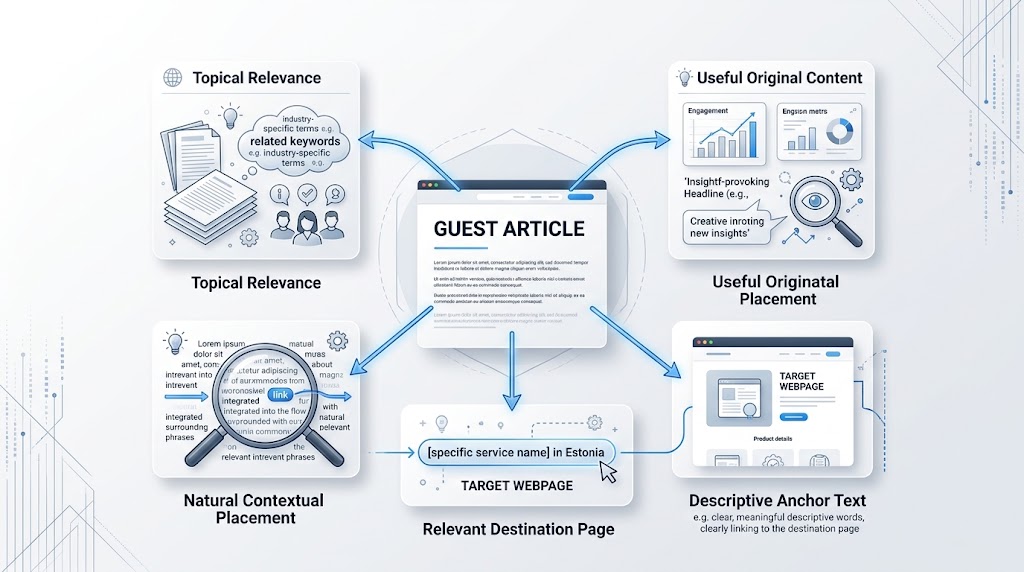
What Makes a High-Quality Guest Post Backlink?
Not every guest post backlink deserves equal attention. Evaluate the entire context surrounding the link before considering a placement.
Topically Relevant Publisher
The publishing website should cover your industry or a closely related subject.
A perfect topical match is not always necessary. Adjacent industries can also be appropriate when the audiences and subjects naturally overlap.
For example:
- SEO and content marketing
- Ecommerce and digital marketing
- Web development and online business
- SaaS and business technology
The stronger the topical relationship, the easier it is to create useful content and justify a relevant reference.
Useful and Original Content
The guest article should contribute something worthwhile to the publisher’s audience.
Useful content may include:
- Practical processes
- Original explanations
- Expert observations
- Examples
- Comparisons
- Actionable frameworks
- Industry experience
Avoid producing a generic article simply because a website accepts guest contributions.
Natural Link Placement
The backlink should appear where it makes sense within the article.
A good placement might support a statement, explain a concept, provide additional information, or direct readers to a resource that expands on the subject.
The link should feel like a useful reference, not an interruption.
Relevant Destination Page
The destination page should genuinely support the topic being discussed.
Potential destinations include:
- Detailed guides
- Research articles
- Tutorials
- Service pages
- Case studies
- Original resources
- Educational content
A relevant destination is much easier to reference naturally than a generic homepage.
Natural Anchor Text
Anchor text should describe the destination in a way that makes sense within the sentence.
Useful approaches include:
- Branded anchors
- Descriptive phrases
- Partial-match phrases
- Natural contextual wording
Exact-match commercial anchors should not be mechanically repeated throughout a campaign. The wording should primarily serve the reader.
How to Find Websites for Guest Post Backlinks
Finding potential publishers is relatively easy. Finding relevant and worthwhile publishers requires more analysis.
Search Within Your Niche
Start by identifying websites that already publish content related to your industry.
Look for publications that:
- Cover your subject
- Reach a relevant audience
- Publish consistently
- Maintain useful editorial content
- Accept appropriate expert contributions
Analyze Existing Content
Before contacting a publisher, read several recent articles.
Consider:
- Are the articles detailed?
- Do they provide practical information?
- Are the topics related to your industry?
- Are authors identifiable?
- Does the website have a consistent editorial direction?
- Are outbound links used naturally?
This helps determine whether your proposed contribution would genuinely fit.
Evaluate Website Relevance
Do not make domain authority or domain rating the only qualification criteria.
A website with strong third-party metrics may still be a poor choice if its audience has little connection to your business.
A smaller but highly relevant publication may offer stronger audience alignment than a larger website with little topical connection.
Check Publishing Standards
Look for signs that the website cares about editorial quality.
Positive indicators can include:
- Clear editorial requirements
- Consistent article standards
- Well-structured content
- Relevant authors
- Useful resources
- A coherent topical focus
Be cautious when a website publishes large volumes of unrelated promotional or guest content without a clear editorial direction.
Build a Qualified Publisher List
Rather than collecting hundreds of websites, create a smaller list of qualified prospects.
A practical evaluation order is:
Relevance → Content Quality → Audience → Editorial Fit → Link Opportunity
This keeps the backlink secondary to the overall publishing opportunity.
For additional discovery ideas, you can also explore ways to discover relevant publishing sites as part of your prospecting process.
How to Build Backlinks Through Guest Posting
A structured workflow can make guest publishing more efficient and consistent.
Step 1: Choose the Right Target Pages
Before creating content, identify which pages on your website genuinely deserve references.
Do not select a page simply because it contains an important keyword.
Consider whether the page:
- Provides substantial information
- Answers a relevant question
- Supports the proposed guest article
- Gives readers something useful to explore
Step 2: Research Publisher Topics
Study the publication before proposing an article.
Review:
- Recent topics
- Popular content themes
- Audience questions
- Existing content gaps
- Preferred article formats
This helps you develop a contribution that feels designed for the publication rather than copied from an existing content calendar.
Step 3: Develop a Useful Topic
Start with the reader’s problem, not the backlink.
A strong topic should answer a meaningful question, solve a specific problem, or provide useful knowledge to the publisher’s audience.
Step 4: Create Original Content
Write specifically for the target publication.
Avoid copying an existing article from your website or lightly rewriting an old post. Provide a distinct perspective and enough depth to make the contribution independently useful.
Step 5: Add Relevant References
Once the content is valuable on its own, identify places where an additional resource could improve the reader’s understanding.
Only add a backlink when it genuinely belongs there.
Step 6: Use Natural Anchor Text
Read the complete sentence after adding the link.
If the anchor sounds forced, rewrite the sentence or select a more natural phrase.
The objective is to make the reference feel like a normal part of the article.
Step 7: Track the Published Link
Maintain a simple record containing:
- Publisher
- Published URL
- Article title
- Linking page
- Destination page
- Anchor text
- Publication date
- Referral traffic
- Campaign notes
A structured tracking process makes it easier to evaluate future opportunities.
For businesses developing a broader guest post link acquisition approach, guest publishing can also be integrated with other relevant content and outreach activities rather than treated as an isolated tactic.
Guest Post Backlink Anchor Text: What Should You Use?
Anchor text deserves attention because repetitive patterns can make a campaign unnecessarily rigid.
Branded Anchor Text
A branded anchor uses the company or website name.
It is straightforward and can work naturally when the article is referring directly to a brand, business, or resource.
Descriptive Anchor Text
Descriptive anchors tell readers what they can expect after clicking.
For example:
technical SEO checklist
This approach works when the phrase accurately describes the linked destination.
Partial-Match Anchor Text
A partial-match anchor incorporates part of a target topic without forcing an exact commercial keyword.
This gives writers more flexibility when creating natural sentences.
Exact-Match Anchors
Exact-match anchors may occur naturally, but repeatedly forcing the same commercial phrase is unnecessary.
The anchor should accurately describe the destination and fit the sentence.
Keep Anchor Text Natural
A practical principle is:
Reader experience first, SEO considerations second.
If a reader can understand why the link exists and what they are likely to find after clicking, the anchor is serving its primary purpose.
How to Evaluate a Website Before Getting a Guest Post Backlink
Before accepting a placement, review the publisher as a complete website rather than focusing on one metric.
Topical Relevance
Does the website serve an audience that could reasonably care about your subject?
Content Quality
Read several pages instead of judging the website from its homepage alone.
Real Audience Signals
Look for evidence that the publication creates content for actual readers rather than publishing pages primarily for link acquisition.
Editorial Standards
A consistent editorial process is generally preferable to an environment where almost any topic can be published.
Outbound Link Quality
Review how the website links to other resources.
If articles contain large numbers of unrelated commercial links, consider that a warning sign.
Overall Content Pattern
Examine the website’s broader publishing behavior.
A focused publication with consistent topical coverage is generally more attractive than a website filled with unrelated subjects and repetitive promotional articles.
SEO Metrics as Supporting Data
Metrics such as domain authority and domain rating can help with prospecting, but they should remain supporting indicators.
They should not replace judgment about relevance, content quality, audience, and editorial fit.
Common Guest Post Backlink Mistakes
Several mistakes can weaken a guest posting campaign.
Choosing Websites Only Because of High DR
A high third-party metric does not automatically make a website relevant or valuable.
Ignoring Topical Relevance
A backlink from an unrelated subject can be difficult to justify and may provide limited audience value.
Overusing Exact-Match Anchors
Repeating the same commercial anchor across many publications can create an unnecessarily artificial pattern.
Publishing Thin Content
A guest post should not be a shortened sales page disguised as an article. Give readers useful information they can act on.
Adding Too Many Links
Every link should have a clear purpose. More links do not automatically create a better article.
Linking to Irrelevant Pages
The destination should logically extend the discussion.
Making the Article Overly Promotional
Readers visit editorial content for information, not a sales pitch. Mention your business only where it genuinely fits.
Buying Placements Without Evaluating the Publisher
A paid publishing opportunity should still be evaluated for relevance, content quality, editorial standards, and audience fit.
When reviewing potentially manipulative link-building practices, consult Google’s recommendations for natural links to keep your approach focused on useful, relevant references rather than attempts to manipulate search visibility.
Building Links Too Quickly
There is no universal publishing speed that guarantees success. A campaign should be guided by available opportunities, content quality, publisher relevance, and the wider marketing strategy.
Measuring Only Backlink Quantity
A larger number of links does not automatically mean a better campaign.
Relevant referring domains, referral traffic, audience fit, and business outcomes can provide a much more useful picture.
Guest Posting for Backlinks vs. Other Link Building Methods
Guest posting is one method within a broader link acquisition strategy.
| Method | Main Strength |
| Guest posting | Useful content combined with relevant publisher exposure |
| Digital PR | Newsworthy stories and brand visibility |
| Resource outreach | Earning references from useful resource pages |
| Original research | Creating information others may cite |
| Expert contributions | Demonstrating expertise while gaining exposure |
| Brand mention outreach | Converting relevant existing mentions into links |
The right approach depends on the business, industry, available resources, content assets, and audience.
Guest posting can work alongside other approaches rather than replacing them.
How Many Backlinks Can You Get From Guest Posting?
There is no universal number of backlinks a website should obtain through guest posting.
The appropriate volume depends on factors such as:
- Campaign objectives
- Industry
- Available content resources
- Publisher opportunities
- Website maturity
- Overall marketing strategy
A smaller campaign focused on strong topical relevance may be more useful than a high-volume campaign targeting loosely related websites.
The objective should be to build a credible collection of relevant publishing relationships rather than chasing an arbitrary backlink target.
How to Measure Guest Post Backlink Performance
A guest posting campaign should be evaluated using several signals rather than a single SEO metric.
Relevant Referring Domains
Track whether your placements are coming from websites that are genuinely relevant to your industry or audience.
Referral Traffic
Monitor whether readers are visiting your website through published guest articles.
Link Relevance
Review whether the article, anchor text, and destination page remain contextually connected.
Target Page Performance
Observe how the linked page performs as part of your wider content and marketing strategy.
Leads and Conversions
If referral visitors become subscribers, inquiries, customers, or other valuable actions, the placement may be contributing business value beyond SEO.
Publisher Quality
Continue evaluating the quality and relevance of the websites where your content appears.
Do not judge a campaign by backlink volume alone.
Frequently Asked Questions
Is guest posting good for building backlinks?
Guest posting can be a useful way to earn relevant links when the content provides genuine value, the publisher is appropriate, and the reference fits naturally within the article. The quality and relevance of the placement matter more than simply increasing backlink volume.
Are guest post backlinks still effective?
Guest posts can contribute to a broader content marketing and link acquisition strategy when they are based on useful content and relevant publishing opportunities. Results vary by industry, website, content quality, publisher, and overall SEO strategy, so backlinks should not be treated as a guaranteed ranking solution.
What makes a guest post backlink valuable?
A useful guest post backlink typically comes from a relevant publisher, appears in meaningful editorial context, points to a useful destination page, and uses natural anchor text. Audience relevance and referral potential can add additional value.
Should guest posts use exact-match anchors?
Exact-match anchors may occur naturally, but there is generally no reason to force the same commercial keyword repeatedly. Anchor text should accurately describe the destination and fit naturally into the surrounding sentence.
How do I find quality guest posting websites?
Start with websites that are relevant to your industry or audience. Review their existing content, editorial standards, topical consistency, outbound links, and overall publishing pattern. SEO metrics can support your evaluation but should not be the only qualification criteria.
Final Thoughts
Effective guest posting for backlinks is not about placing as many links as possible. It is about creating useful content for relevant audiences and earning references that make sense within that content.
A strong approach starts with publisher relevance, useful topics, original writing, appropriate destination pages, and natural anchor text. It also considers referral traffic, brand exposure, and the broader value of each publishing relationship.
If your goal is to build a sustainable backlink profile, focus less on how many links you can obtain and more on why each link deserves to exist. That shift creates a better experience for readers and a more disciplined approach to long-term link acquisition.